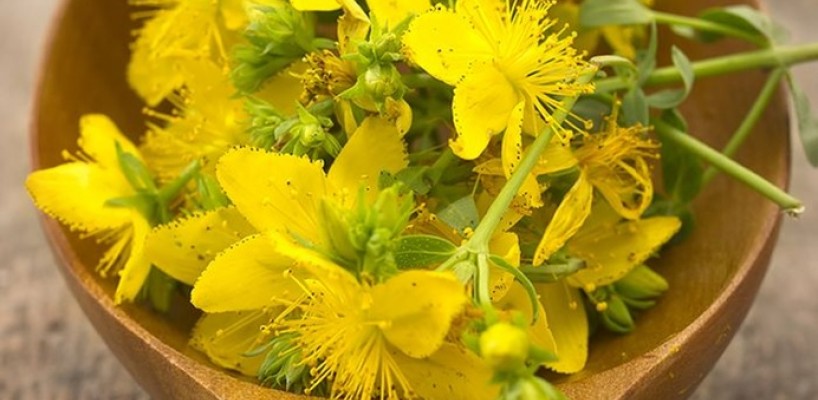
St. John’s Wort, the miraculous plant found in dry meadows, arid hills, and pastures, with its golden-yellow flowers, is an ancient and important medicinal plant used since antiquity.
St. John’s Wort (Hypericum perforatum) is a herbaceous plant from the Hypericaceae family, whose flowering stems (Herba Hyperici) contain essential oil, tannins, flavonoid glycosides, and a red pigment: hypericin.
St. John’s Wort has inspired the imagination of the ancient Romans, with elders claiming that the plant was sprinkled with blood, which is why its juice is red, as noted by Valer Butur in the Romanian Ethnobotanical Encyclopedia, Scientific and Encyclopedic Publishing, Bucharest 1979.
From the flowers macerated in oil for a few days, either in the sun or in heat, St. John’s Wort oil is obtained and used for wounds, sores, lumbago, and burns. When applied to the skin, it helps heal allergies, irritations, and eczema.
The dried plant was ground and mixed with sour cream, which was used to treat sweet sores. In some areas, ash obtained by burning the plant with roasted and ground white beans, mixed with sour cream, was also used to treat sweet sores.
Tea made from flowering stems was taken for coughs, colds, stomach pains, liver diseases, kidney issues, or genital pain in women.
The decoction was given against dysentery. The plant was also used macerated in brandy for this condition. Additionally, the decoction was used to treat leucorrhea. It was also taken for pathological psychic disorders and against melancholia (a strong fear that causes excessive paleness).
The infusion was taken as a stimulant for blood purification. It was also used in the baths of children suffering from scarlet fever and in treatments against rheumatism.
The plant is recognized for its effects in harmonizing psycho-emotional states and provides protection to the body against stress, being considered by some specialists as the most powerful natural antidepressant.
In veterinary medicine, it was used to treat animals that urinated blood.
The plant was also used for dyeing in yellow and orange.
Precautions
Specialists recommend that those taking anticoagulants, medications for heart diseases, or asthma, or those undergoing chemotherapy should not simultaneously follow a St. John’s Wort regimen. It reduces the effectiveness of certain medications.
Additionally, it is possible that repeated and prolonged consumption of St. John’s Wort tea over several years may induce pain along the peripheral nerves, and these pains, which do not represent an actual illness, disappear once consumption is stopped, but they can lead to significant confusion: neuralgias, sciatica, rheumatism.
When used for an extended period, St. John’s Wort can cause photosensitivity, and individuals who consume this tea daily for several years may experience skin rashes. During St. John’s Wort treatments, sun exposure should be avoided.




