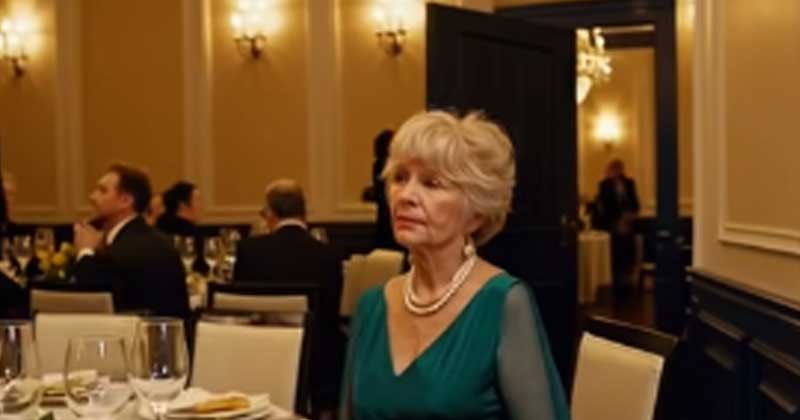
My name is Elena Marinescu, and the first sign that my role in my son’s life was slowly and silently fading came in the form of an elegant invitation, on cream-colored cardstock, with embossed golden letters. It arrived on a Tuesday in March, slipped between a water bill and a supermarket flyer.
“Mr. and Mrs. Andrei Marinescu cordially invite you…”
I read it twice until I understood. My son was getting married. And that’s how I found out. No phone call. No meeting. Just a formal, printed card, as if I were a distant relative they couldn’t completely escape.
I stood frozen in my kitchen, the invitation placed next to overdue bills. Andrei was now 28 years old and lived in a modern apartment building in downtown Bucharest, with valet parking and floor-to-ceiling windows. He worked in IT. His fiancée, Bianca, was impeccable and cold. I had met her twice. She looked around my apartment as if poverty were contagious.
The wedding was scheduled for June 15, at the “Magnolia Hill” Private Club. Formal attire, optional, it said in small letters. I had nothing suitable. And yet, I held the card carefully, my heart oscillating between pride and rejection. I was invited, technically speaking. But I had never felt more like a stranger in my own child’s life.
That evening, I called Andrei.
“Hi, Mom,” he answered, his voice distant, distracted.
“I received the invitation,” I said, trying to sound cheerful.
“Uh-huh. Okay.” No warmth. Just a confirmation.
“I’d love to help with something… maybe the flowers, or the cake…”
“Mom, please.” His tone sharpened. “Everything is already arranged. Bianca’s parents are taking care of everything.”
“I wasn’t referring to money, Andrei. I just wanted to be part of it… to dance with you, to choose the boutonnieres together…”
“We’ve already chosen,” he sighed. “Just… come, okay? Dress nicely, but not too outdated. Bianca’s family is… more traditional.”
“I understand,” I said, my voice calm, even though the lump in my throat was rising. “I don’t want to embarrass anyone.”
“It’s not about embarrassment,” he murmured. “I have to hang up.”
And he hung up.
I looked at the phone. Then at the invitation. Formal attire, optional. Optional—just like me.
After that call, I made a decision. If I was going to be a stranger at my own son’s wedding, then at least I would show up with my head held high. For three months, I saved every leu. I skipped meals, walked to work, cut my cable TV. By May, I had saved enough to buy a simple yet elegant emerald green dress from a store I had never dared to enter. I also got matching shoes. I had my hair styled at a salon for the first time in over a decade.
When the stylist turned me toward the mirror, I didn’t recognize myself. For a moment, I imagined Andrei’s reaction. Maybe he would tell me I looked beautiful. Maybe he would proudly introduce me to Bianca’s family. Whatever it was, I knew I was going in there with dignity. Not for Andrei. For myself. Because sometimes, dignity is the only gift you can give yourself when others have forgotten your worth.
The club was exactly as I imagined: perfectly manicured lawns, expensive cars out front, crystal chandeliers in the lobby. I spotted Andrei by the stairs, looking impeccable in a tuxedo. Bianca, next to him, radiant. They looked like they stepped out of a magazine.
I approached, my heart racing. His gaze found me, and his smile transformed, not into warmth, but into a kind of unease.
“Mom,” he said, in a neutral tone. “You came.”
“You look so handsome,” I said, reaching out to adjust his bow tie. He pulled back slightly.
“Thank you. You look… nice.” The pause between “look” and “nice” stung.
Bianca’s father extended his hand: “You must be Andrei’s mother. I’m Toma Enache.”
“Elena Marinescu,” I replied. “Congratulations on a wonderful son-in-law.”
“Indeed,” he replied politely, then turned back to Andrei.
And so, I was erased, invisible, at my own son’s wedding.
At the reception, each table had name cards. I was at table 8—the last one, next to the kitchen door. The others at the table were complete strangers to me. Clearly, I was off the list.
At the head table: Andrei and Bianca, surrounded by her family. Table 1—close friends. Table 2—Andrei’s college classmates. It was a map of importance.
An elderly lady approached. “Are you Andrei’s mother?” she asked, smiling gently. “I’m Margareta, Bianca’s aunt. May I sit with you? I don’t know anyone.”
“Of course,” I said, relieved.
As time passed, I watched Andrei greet all the guests—except me. I told myself he was caught up in the excitement, that he would come. But with each minute, I felt the emptiness growing in my stomach.
Dinner began. The waiters served the head table, then the nearby tables. At our table, we waited. Margareta was served, the others too. Me—nothing.
A young waiter came, flustered: “I’m sorry, ma’am. There was a mix-up. It’s coming right away.”
Twenty minutes passed. Then thirty. The others were already finishing. Finally, another waiter brought me a plate. Cold salmon. Soft asparagus.
Margareta whispered: “This is unacceptable.”
But I smiled. “It’s okay. I’m just glad to be here.” A lie I told often.
Halfway through my plate, Andrei’s voice rang out. He was giving a speech. Before he officially began, he leaned toward Bianca and said, loud enough:
“Did you see they brought my mom food? She’s used to eating leftovers. It doesn’t bother her.”
Bianca laughed. Others laughed. I set my fork down. My hands were steady. But inside, something broke.
Margareta was shocked. “Did he just… say that?”
“I’m fine,” I said. But the words tasted like ash.
After dinner, the parent dances began. Bianca’s father danced with her. Her mother danced with Andrei. I waited. He didn’t seek me out. He didn’t invite me. He didn’t look at me.
Then I understood. I hadn’t been invited to participate. I had been invited to witness. In silence.
Margareta approached: “Are you okay, dear?”
I looked at the lights dancing on the floor, at the man who had been my little boy. And for the first time, I felt clear. “I’m perfect,” I said. And I truly was.
I stood up. I smoothed my dress. And I left. No one noticed me.
At home, the silence was different. I changed, sat at the table, and opened my laptop. I began to write.
Andrei,
I’m writing while the memories of your wedding are still fresh in my mind. Perhaps my memories will be different from yours. Your remark last night about how I’m used to the leftovers of life wasn’t just cruel. It was honest. And it gave me something unexpected: perspective.
You’re right. For years, I accepted what was left—time, attention, respect. I taught you, without meaning to, that it was normal to put me second. I called the crumbs “love.” But I won’t do that anymore.
Starting today, I’m cutting off all financial support. Including the 2500 lei a month you thought came from a fund. There is no fund. It was from me. Overtime. Skipped meals. A postponed life, so you could build yours.
I’m also canceling the credit card in your name. And I’m putting the house up for sale—the one you already considered yours. It’s valued at about 340,000 euros. I will use the money to travel, to rest, to live.
This isn’t a punishment. It’s not revenge. It’s the moment I start to matter for myself too. I wish you happiness. And I hope that one day you understand the difference between being loved and being respected.
You will always be my son. But I will no longer be your safety net.
Mom.
I read the email three times before I hit “Send” at 3:47 AM.
By noon, Andrei had replied:
“Mom, what the hell is this? Are you having a crisis? It was just a joke. You’re too sensitive. Selling the house is crazy. You’re talking about my inheritance. Dad would be turning in his grave.”
I didn’t respond. By Friday, I had changed my phone number.
On Saturday, another email came, sharper:
“Mom, I’ve been calling you for two days. Answer. We need to talk about that house before you do something stupid. I spoke with a lawyer. You can’t just exclude me from the inheritance.”
I forwarded it to the real estate agent with a simple message:
“Please expedite the listing process.”
By Tuesday, the house was already on the market. By Thursday, I had two offers. I accepted the highest one: 15,000 euros over the asking price, cash payment, closing in 30 days.
On Sunday, the last message from Andrei came:
“You won. Whatever lesson you were trying to teach, congratulations. You destroyed our relationship and made me a laughingstock in front of Bianca’s family. I hope it was worth it. Don’t contact me again.”
I printed it and put it in a folder titled “Evidence.” Not for court. For memory.
The signing of the documents was scheduled for July 20. I paid the deposit for a furnished apartment in Sibiu and a month at a guesthouse in Bucovina. For the first time in 30 years, I was making plans that didn’t involve Andrei.
Sibiu welcomed me warmly, not just in temperature but in spirit as well. I rented a small apartment on a quiet street, where neighbors still say “good day.” I found a part-time job in a local bookstore. I spent my days among stories and my evenings walking by the Bridge of Lies. For three months, I heard nothing from Andrei.
Then, one Thursday afternoon, my boss handed me a note. “A gentleman called. He says he’s your son. He sounded desperate.”
Two days later, Andrei appeared in person. He looked smaller, thinner, with deep dark circles under his eyes. His expensive shoes were worn out.
“Please,” he whispered. “Can we talk?”
I told him I was getting off work at 6 PM. The café nearby closed at 7 PM. He had an hour.
That evening, we sat face to face while he fumbled through a repeated apology.
“I miss you,” he said. “I miss having a mom who believed in me.”
“I believed in you,” I replied. “But belief without limits isn’t love. It’s dependency.”
He asked how we could fix things. How to start over. I told him we couldn’t. Not because I hated him. But because I had already left. He just hadn’t noticed until the benefits stopped.
As we walked out of the café and stepped into the gentle night of Sibiu, I didn’t look back.
I had spent 30 years accepting what was left. Now I was building a life where I set the table. And this time, I choose where I sit.
This work is inspired by real events and people, but has been fictionalized for creative purposes. Names, characters, and details have been changed to protect privacy and enhance the narrative. Any resemblance to real persons, living or dead, or to real events is purely coincidental and not intended by the author.
The author and publisher do not assume responsibility for the accuracy of events or for how characters are portrayed and are not liable for any misinterpretations. This story is offered “as is,” and any opinions expressed belong to the characters and do not reflect the views of the author or publisher.


