— Misha, look! I froze at the gate, unable to believe what I was seeing.
My husband stumbled through the doorway, bent under the weight of a bucket full of fish. The early chill of a July morning seeped into my bones, but what I saw on the bench made me forget all about the cold.
— What’s there? Mihai asked, setting the bucket down and approaching.
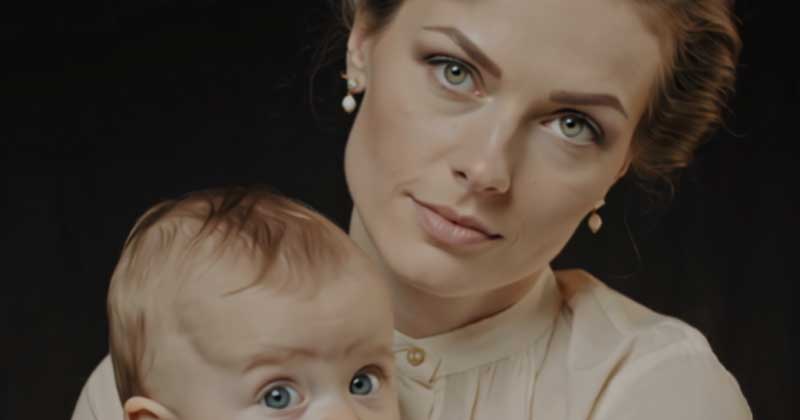
On an old bench, by the fence, sat a woven basket. Inside, covered with a worn blanket, was a child. A little boy of about two years old.
His big brown eyes looked straight into mine, without fear, without curiosity — just looking.
— God, Mihai said, where did he come from?
I gently ran my fingers through his dark hair. The boy didn’t flinch, didn’t cry — he just blinked.
In his tiny fist was a crumpled note. I carefully unfolded his fingers and read: “Please help him. I cannot. Forgive me.”
— We need to call the police, Mihai said, frowning and scratching his head. And we should notify the local council.
But I had already taken him in my arms, pressing him to my chest. He smelled of dusty roads and unwashed hair. His overalls were worn but clean.
— Ana, Misha said worriedly, we can’t just take him.
— Yes, we can, I held his gaze. Misha, we’ve been waiting for five years. Five. The doctors told us we wouldn’t have children. And now…
— But the law, the paperwork… the parents might come back, he said.
I shook my head.
— They won’t come back. I feel it.
The boy smiled widely at me, as if he understood our entire conversation. And for me, that was enough. With the help of acquaintances, I obtained guardianship and the necessary paperwork. 1993 was a tough year.
A week later, I noticed something strange. The boy, whom I had named Ilie, did not react to sounds. At first, I thought he was just a daydreamer, lost in his thoughts.
But when the neighbor’s tractor passed right under our windows and Ilie didn’t move a muscle, my heart sank.
— Misha, he doesn’t hear, I whispered one evening after I had put him to sleep in the old cradle I had inherited from a nephew.
My husband stared at the fire in the stove for a long time, then sighed:
— We’re going to see Dr. Nicolae Petrovici in Zărnești.
The doctor examined Ilie and shrugged.
— Congenital deafness. Complete. Don’t get your hopes up — this is not a case where surgery would help.
I cried all the way home. Mihai said nothing, but he gripped the steering wheel so tightly that his knuckles turned white. That evening, after Ilie had fallen asleep, Mihai took a bottle from the cupboard.
— Misha, maybe we shouldn’t…
— Yes, we should, he said, pouring a glass and downing it. We’re not giving him up.
— Giving up who?
— Him. We’re not giving him up, he said firmly. We’ll manage.
— But how? How will we teach him? How…
Mihai stopped me with a gesture.
— If necessary, you will learn. You’re a teacher. You’ll find a way.
That night, I didn’t close my eyes. I stared at the ceiling and thought: “How do you teach a child who cannot hear? How do you provide everything he needs?”
In the morning, I understood: he has eyes, hands, and a heart. That means he has everything he needs.
The next day, I took out a notebook and began to make a plan. I searched for books. We put our minds together to learn without sound. Our lives changed forever from that moment.
That autumn, Ilie turned ten. He sat by the window drawing a sunflower. In his notebook, there were not just flowers — they seemed to dance in their own style.
— Misha, look, I said, touching his shoulder as I entered the room. Yellow again. He’s happy today.
Over the years, Ilie and I learned to understand each other. First, we learned the manual alphabet, then sign language.
Mihai was slower, but he had long memorized the important words — “son,” “love,” “proud.”
There was no school for deaf children in our village, so I taught him. He quickly learned to read: the alphabet, syllables, words. To count — even faster. But most of all… he drew. All the time. On anything he could find.
At first, with his finger on the foggy windows.
Then, with charcoal on a board that Mihai made for him. Later — with paints on paper and canvas. We ordered paints from the city by mail, saving on everything else just so the boy could have good materials.
— Your mute child is doodling again? neighbor Săndel laughed, looking over the fence. What good is that?
Mihai, with his hands in the garden soil, looked up:
— And you, Săndel, what good are you, besides your mouth?
It wasn’t easy with people. They didn’t understand us. They mocked Ilie, gave him nicknames, especially the children.
One day he came home with a torn shirt and a scratch on his cheek. Without saying anything, he showed me the culprit: Nelu, the mayor’s son.
I cried as I cleaned his wound. Ilie wiped my tears with the tips of his fingers and smiled at me, as if to say: “It’s okay, don’t worry.”
That evening, Mihai left. He returned late, without saying anything, but with a bruise under his eye. After that, no one ever bothered Ilie again.
In his teenage years, his drawings changed. He had developed his own style — as if from another world.
He drew a world without sounds, but with a depth that took your breath away. The walls of our house were filled with his paintings.
One day, a commission from the county came to see how I was teaching him at home. An older woman, with a stern look, entered, saw the paintings, and froze.
— Who painted them? she whispered.
— My son, I replied proudly.
— They need to be seen by specialists, she said, taking off her glasses. Your son… has a true talent.
But we were afraid. Ilie saw the world outside the village as a giant unknown. How would he manage without us, without the usual gestures and signs?
— We have to go, I said, gathering his things. There’s an art fair in the county. You need to exhibit your works.
Ilie was already seventeen, tall and thin, with long fingers and a keen gaze that observed everything. He nodded hesitantly; it didn’t make much sense to argue with me.
At the fair, his works were displayed in a corner. Five small paintings — farms, birds, hands holding the sun. People passed by, looked, but didn’t stop.
Then she appeared — an older lady, upright, with penetrating eyes. She stood for a long time in front of the paintings.
Then she suddenly turned to me:
— Are these your works?
— My son’s, I replied, pointing to Ilie, who stood nearby with his arms crossed.
— Is he deaf? she asked, noticing the signs.
— Yes, from birth.
She nodded:
— My name is Vera Stanciu. I’m from an art gallery in Bucharest.
— This one… she said, looking at a small painting of a sunset over a field. It has something that many artists seek their whole lives. I want to buy it.
Ilie froze, looking at me as I awkwardly translated. His fingers trembled, and disbelief was evident in his eyes.
— You really don’t want to sell? the woman insisted, firm and professional; she knew its worth.
— I’ve… I’ve never sold anything, I stammered, embarrassed. It’s just his soul on canvas.
She took out a leather wallet and, without negotiating, counted out what Mihai earned in six months of carpentry.
In mid-autumn, a letter arrived from Bucharest: “Your son’s works emanate a rare sincerity. A level of understanding that cannot be expressed in words. This is exactly what true collectors seek.”
Bucharest greeted us with gray streets and cold looks. The gallery was a small room in an old building on the outskirts of the city. But every day, people with bright eyes came.
They analyzed the paintings, talked about composition and color. Ilie stood aside, observing their lips and gestures.
Even though he couldn’t hear, their expressions clearly told him that something extraordinary was happening.
Scholarships, internships, articles in magazines followed. They called him “The Silent Artist.” His works — silent screams of the soul — moved everyone’s hearts.
Three years passed. Mihai couldn’t hold back his tears when he saw his son leaving for a solo exhibition in Cluj-Napoca. I tried to be strong, but my heart was breaking. Our boy had grown up. He was out there, in the world, without us. But he returned.
On a beautiful day, he appeared at the door with a bouquet of wildflowers. He hugged us and led us through the village, past curious gazes, to a secluded field.
There was a house. New, white, with a balcony and large windows. The village had been gossiping for a long time about who was building it, but no one knew to whom it belonged.
— What is this? I whispered, unable to believe what I was seeing.
Ilie smiled and pulled out a key. Inside were spacious rooms, a studio, shelves of books, new furniture.
— Son, Mihai said in amazement, looking around, this house… is yours?
Ilie shook his head and signed: “Ours. Yours and mine.”
Then he took us to the yard, where a huge painting decorated the wall: a basket at the gate, a woman with a radiant face holding a child, and above, in sign language: “Thank you, mom.”
I froze, unable to move. Tears streamed down my cheeks, but I didn’t wipe them away.
Mihai, always reserved, ran to him and hugged him so tightly that Ilie could barely breathe.
Ilie hugged him back and extended his hand to me. And we stood there, the three of us, in the middle of the field, next to our new home.
Now, Ilie’s paintings are exhibited in some of the most prestigious galleries in the world. He has established a school for deaf children in the big city and raises funds for educational programs.
The village is proud of him — our Ilie, who listens with his heart.
And we live in that wonderful white house. Every morning I step out onto the porch with a cup of tea and look at the painting on the wall.
And sometimes I think: what if I hadn’t stepped out that July morning? What if I hadn’t seen him? What if I had been afraid?
Now, Ilie lives in a large apartment in the city, but he comes home every weekend. He hugs me, and all doubts disappear.
He will never hear my voice. But he understands every word I say.
He cannot hear music, so he composes his own music through colors and lines.
And when I see his happy smile, I understand:
Sometimes, the most important moments in life happen in perfect silence.


