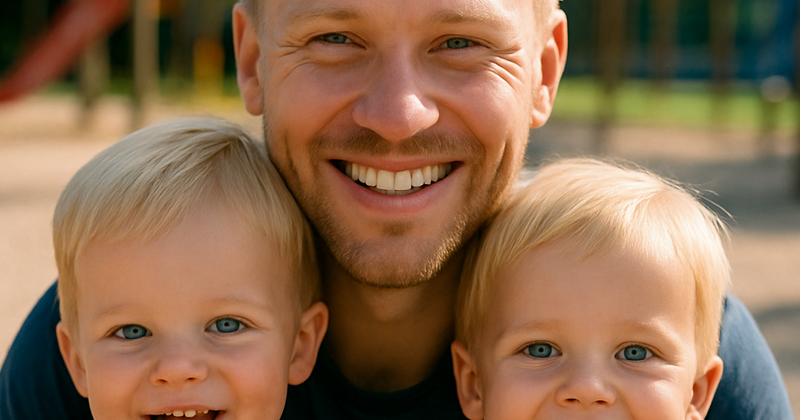
Two years ago, my wife left me and our children at the hardest moment of my life. After fighting and rebuilding our family, I saw her in a café, alone and crying. What she told me afterward left me completely speechless.
When Ana walked out of our apartment with nothing but a suitcase and a coldness, saying, “I can’t go on like this,” I stood there, holding our four-year-old twins, Mihai and Lilia, in my arms.
My dignity was shattered, but not as much as my heart. She didn’t even throw me a last glance. It was as if a switch had been flipped. One moment we were a family, the next, I was alone with two small children and a mountain of bills.
Everything happened because I lost my job, and we were living in one of the most expensive cities in the country. I was a software engineer at a tech company that promised great benefits, but something suspicious happened, and the firm went bankrupt before we realized it. I went from a six-figure salary to relying on unemployment benefits overnight.
The day I broke the news to Ana, I saw the disappointment in her eyes. She was a marketing director, always impeccable and organized. Even after we got married, I had never seen her with messy hair or wrinkled clothes.
She looked like a princess even while giving birth to our children, and that was something I loved about her. But I never imagined she would leave me in a moment of crisis.
The first year was a nightmare. Between the overwhelming loneliness, constant money worries, and the exhaustion of balancing work with caring for the kids, I felt like I was drowning.
I drove for ride-sharing apps at night and delivered food during the day while trying to take care of Mihai and Lilia. They were both emotionally crushed and kept asking about their mother.
I tried to explain as best as I could, with words suitable for four-year-olds, that their mom was away for a while, but they seemed not to understand.
Fortunately, my parents lived nearby. They helped me with the twins at night and whenever I needed it, although they couldn’t support me financially. They were already retired and facing their own difficulties.
Mihai and Lilia were my lifeline. Their small arms around me at the end of a long day, their voices saying “We love you, Daddy” kept me strong. I couldn’t let them down. They at least deserved a father willing to give them everything.
The second year was different. I landed a freelance programming project, and the client was so impressed with my skills that he offered me a full-time remote position at his cybersecurity firm.
Although the salary was no longer six figures, it was stable. We moved into a more welcoming apartment, and I started taking care of myself again. I went back to the gym, cooked real meals, and created a routine for the kids. I was no longer surviving; I was truly living.
Then, exactly two years after Ana left, I saw her again.
I was in a café near our new home, working while Mihai and Lilia were at school. The air was filled with the aroma of freshly roasted coffee beans, and the murmur of conversations made it a good place to concentrate.
I didn’t expect to look up and see her there.
She was sitting alone at a corner table, head down, tears streaming down her face. She no longer resembled the woman I remembered: the confident and elegant marketing director, dressed in designer clothes with impeccable hair.
No, this woman looked exhausted. Her coat was faded, her hair dull, and the dark circles under her eyes told the story of sleepless nights.
For a moment, I felt my heart tighten. She was the woman who had left us at the hardest moment.
She had left to build a better life, without an unemployed husband and two children to raise, right? That’s what I had assumed when I heard her last cold and direct words.
To her, I was a burden, and she wanted more.
And yet, what had happened? Why was she crying in some random café? I knew I shouldn’t care. I should have ignored her, finished my coffee, and left. But after all, she was the mother of my children.
She probably felt me staring, because she looked up. Her gaze met mine, and her expression changed from surprise to shame.
I left the cup and laptop on the table and walked over to her, unable to control my impulse.
“Ana,” I said, clearing my throat. “What happened?”
She avoided looking at me, nervously playing with her hands. Finally, she whispered, “Dănuț, I didn’t expect to see you here.”
“It’s clear,” I replied, sitting down across from her. “You left us. You walked away without looking back. And now, two years later, I find you crying in a café. What happened?”
She burst into tears. She told me she had lost everything: her job, family support, friends. She admitted she had made a mistake and had regretted it every day since.
Although my feelings were mixed, I decided to listen to her. I didn’t know if I could forgive her, but I understood that our lives, in a way, were still intertwined.
This work is inspired by real events and people, but has been fictionalized for creative purposes. Names, characters, and details have been changed to protect privacy and enhance the narrative. Any resemblance to real persons, living or dead, or actual events is purely coincidental and not intended by the author.
The author and publisher do not assume responsibility for the accuracy of events or the portrayal of characters and are not liable for any misinterpretations. This story is provided “as is,” and any opinions expressed belong to the characters and do not reflect the views of the author or publisher.


