I sat in silence for a long time, only hearing the ticking of the clock in the kitchen and my daughter’s heavy breathing from the next room. On the table, my phone vibrated occasionally — messages from relatives, short and hypocritical: “Maybe you overreacted a bit,” “Mom didn’t mean any harm,” “Don’t ruin the family over a toy.” I looked at the screen, took a deep breath, and deleted them all. A family that stays silent when a child is hurt is no longer a family.
The next morning, I made a strong coffee, opened my laptop, and began to write. Every detail. Every word spoken. Every glance that turned away. I attached the photos of the marks on Emma’s cheek, added the date, time, and place. Then I wrote a simple text, without embellishments:
“No one has the right to hit a child. Not even a grandmother. This happened yesterday in my family. Silence makes you an accomplice.”
I read it ten times before I pressed “Publish.” Then I closed my laptop and went to Emma’s room. She was still sleeping, the unicorn missing from her arms, and the bed seemed emptier than ever. I sat beside her, stroked her forehead, and knew that no matter how much it hurt, I could no longer let silence cover the evil.
A few hours later, my phone started ringing. Friends, neighbors, even coworkers. Comments, hundreds, then thousands. People sharing how they too grew up with parents who “never make mistakes,” with grandparents who believed respect was enforced with a slap. People understood. And that day, for the first time, I didn’t feel alone.
My mother? She stayed silent. Two days, three, then I received a terse message: “You’ve embarrassed the family.” I smiled bitterly. The family had embarrassed itself long before I opened my mouth.
I started receiving messages from other mothers. Some told me they cried while reading. Others asked how I found the courage. The truth is, it wasn’t courage, but love. The love for a child who deserves to grow up knowing her mother protects her, even against the whole world.
In the following days, Mădălina tried to write to me. She said my mother was crying, that she wasn’t eating, that everyone was talking about her. I wanted to feel pity, but I couldn’t. Maybe her tears were for the lost image, not for the little girl who was hit.
Then, something unexpected happened. The police called me. A lady who worked in child protection had read the post and forwarded it. They opened an investigation. Not to “put mom in jail,” as some rushed to say, but to protect a child. My child.
When they came to talk to me, I showed them everything. Photos, messages, everything. They were polite, but I felt they were moved too. One of the officers said: “You are a brave mother. Few would do what you did.” I looked at her and simply replied: “It’s not bravery. It’s normality.”
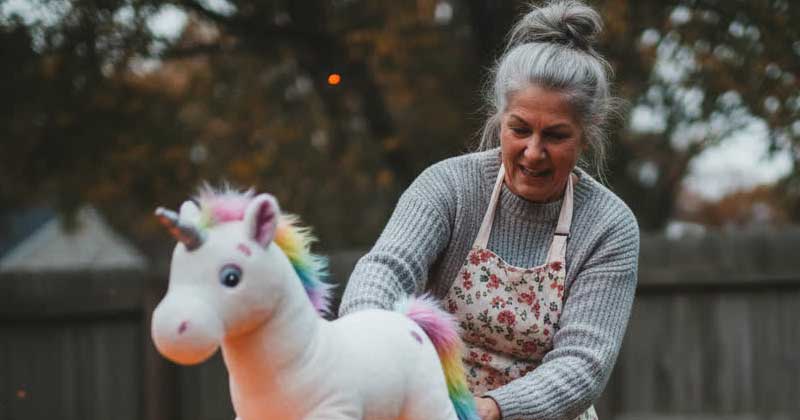
In a few weeks, the family’s silence shattered. Two aunts called to apologize. One cried. My father, for the first time, came to my house. He brought a small box — a handmade plush toy, with a colorful mane made of wool threads. “It will never be the same,” he said, “but I wanted to fix at least a little.”
Emma looked at the toy, smiled shyly, and said: “This is my light unicorn.” And in that moment, I felt that from the ashes of a burned childhood, something new was being born — a strength, a lesson, a promise.
Today, in the place where the fire pit was in my mother’s yard, I planted a small oak tree, brought from the village nursery. Emma waters its leaves every Sunday. She calls it “the tree that doesn’t let evil grow.”
And maybe, one day, when she is grown, she will understand that sometimes, to break a cycle of pain, you have to let it burn to the end — and from its flames, make your own light.
This work is inspired by real events and people, but has been fictionalized for creative purposes. Names, characters, and details have been changed to protect privacy and enhance the narrative. Any resemblance to real persons, living or dead, or to real events is purely coincidental and not intended by the author.
The author and publisher do not assume responsibility for the accuracy of the events or for how the characters are portrayed and are not liable for any misinterpretations. This story is provided “as is,” and any opinions expressed belong to the characters and do not reflect the views of the author or publisher.


