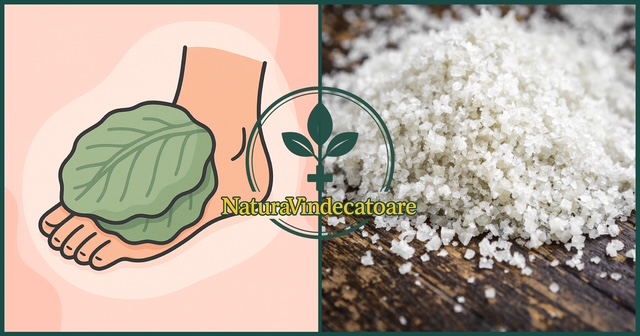
In Romanian villages, simple and effective remedies have been passed down from generation to generation, without advertisements and expensive ingredients. One such trick, used for decades to reduce swelling and discomfort in the feet, involves using cabbage leaves sprinkled with salt and applying them directly to the affected areas. This seemingly trivial procedure is backed by a unique combination of bioactive substances and physiological effects that have attracted the attention of modern doctors and researchers.
How to prepare and apply
- Choose large, green, and healthy cabbage leaves.
- Wash them well and dry them with a clean towel.
- Sprinkle coarse salt on the inner side of the leaf.
- Gently crush the leaf with a rolling pin to release the juice.
- Apply the leaf directly to the swollen area, securing it with a cloth or bandage.
- Leave it on overnight, and in the morning, remove and rinse the area.
Benefits
1. Reduction of fluid retention
Cabbage leaves act as a natural absorbent, drawing out excess fluid accumulated in the tissues. The salt enhances this effect through osmosis, attracting fluids outward. This process can diminish visible edema and the feeling of heaviness in the feet. Regular application can help reduce mild inflammation caused by prolonged standing. Combined with proper hydration, the effects are more pronounced and lasting.
2. Local anti-inflammatory effect
Cabbage leaves contain antioxidants such as anthocyanins and vitamin C, which play a role in reducing inflammation. These compounds penetrate the skin easily through direct application, soothing irritated tissues. The salt, through its osmotic effect, can reduce pressure in the affected area. The result is a decrease in pain and redness. Repeated application can support recovery in cases of muscle microtrauma.
3. Stimulation of peripheral circulation
Sulfur compounds in cabbage, along with gentle massage during the application of the leaf, promote local circulation. Improved blood flow supports tissue oxygenation and toxin elimination. The salt slightly warms the area, intensifying the vasodilatory effect. This can be beneficial for individuals suffering from cold feet due to poor circulation. Regular use can help prevent lymphatic stagnation.
4. Relief of muscle pain
Locally applied cabbage has a soothing effect on muscle pain, especially after physical exertion. The salt acts as a mild natural analgesic, reducing sensitivity in the area. Antioxidants and minerals in the leaf support tissue regeneration processes. This method can be used in conjunction with warm salt baths for a synergistic effect. It can be useful for athletes or individuals who stand on their feet for many hours.
5. Local detoxification effect
By applying leaves with salt, accumulated toxins in the swollen area can be mobilized and eliminated more easily. Cabbage contains compounds with detoxifying action, such as glucosinolates. These are recognized for their ability to support the body’s healing function. The local osmotic process helps draw residual substances toward the skin’s surface. This mechanism can support the natural tissue repair process.
6. Reduction of joint stiffness
Applying warm cabbage leaves with salt can relax the muscles around the joints. This promotes better mobility, especially in the morning, for individuals with joint stiffness. The gentle heat and anti-inflammatory effect help reduce discomfort. Over time, it can aid in maintaining joint flexibility. It is an adjunct method used in some natural treatments for arthritis.
7. Soothing in case of mild sprains
Cabbage leaves with salt have a beneficial effect on minor sprains, reducing inflammation and discomfort. They can be used in the first few days after an injury, but only after medical consultation. The mild compression effect helps stabilize the area. Natural anti-inflammatory substances support the recovery process. It can be used alongside rest and elastic compression.
8. Improvement of the skin appearance in the affected area
Repeated application hydrates and nourishes the skin due to the vitamins and minerals in the leaf. The salt gently exfoliates the superficial layer, stimulating cellular regeneration. Over time, the skin may become smoother and firmer. Antioxidants protect the skin from the effects of free radicals. This aesthetic benefit adds to the therapeutic effects, providing a visible result.
Studies and research
1. Study from the University of Duisburg-Essen (Germany, 2016) – Cabbage in reducing joint inflammation
German researchers evaluated the effects of locally applied cabbage leaves on patients with arthritis and peripheral inflammation. The study included 81 participants divided into two groups: one group used fresh cabbage leaves daily, while the other received conventional treatment with anti-inflammatory gel. After four weeks, the cabbage group reported a significant reduction in pain, comparable to the medication group. The researchers explained that cabbage contains anthocyanins and sulfur compounds that reduce the activity of pro-inflammatory enzymes. Additionally, local application keeps the area slightly cool, contributing to pain relief. Interestingly, patients who used the leaf with salt experienced a faster effect in the first few days. This is attributed to increased osmolarity facilitating fluid extraction. The authors concluded that the method is safe, inexpensive, and can be used at home. However, they recommend medical consultation in cases of severe inflammation.
2. Research published in the Journal of Ethnopharmacology (2020) – Effects of compounds from Brassica oleracea on edema
This study analyzed the bioactivity of cabbage extract in combating edema and inflammation. In the research, extracts were applied to animal models with chemically induced edema. The results showed a reduction in edema volume by up to 45% in the first 24 hours. The authors identified glucosinolates and isothiocyanates as the compounds responsible for this effect. These compounds act by inhibiting inflammatory cytokines and reducing oxidative stress. In the case of application with salt, the osmotic effect complements the biochemical action. The study also highlighted that antioxidants in cabbage protect endothelial cells, improving vascular function. Researchers suggest that using raw leaves is the most effective, as heating partially destroys active substances. The conclusion of the study is that local application of cabbage, with or without salt, has scientifically confirmed anti-inflammatory potential.
3. Clinical study conducted in Poland (2018) – Cabbage in complementary therapy for varicose veins
The study involved patients with moderate varicose veins and associated edema. Half of the participants followed standard treatment with compression stockings, while the others applied cabbage leaves with salt to the swollen areas for 10 consecutive nights. The group using cabbage showed a more pronounced reduction in ankle circumference and a visible decrease in the feeling of heaviness. Doppler measurements indicated an improvement in local blood flow by 18%. Researchers attributed this effect to the combination of mild mechanical pressure, the osmotic action of salt, and the vasoprotective substances in cabbage. Another noted aspect was the decrease in local temperature, which reduces the sensation of burning and inflammation. In conclusion, the method can be integrated as a complementary therapy in the management of varicose veins. The authors mention that treatment should be tailored to each patient and does not replace medical care.
Contraindications
-
Allergy to cabbage or plants from the Brassicaceae family – may cause irritation or skin reactions.
-
Skin with open wounds – salt may cause stinging and further irritation.
-
Active dermatitis or eczema – application may worsen symptoms.
-
Severe venous insufficiency – requires specialized medical treatment, not just external remedies.
-
Individuals with severe kidney problems – excessive salt intake, even locally, can be problematic in certain cases.
-
Small children – application should only be done with medical consent, as their skin is more sensitive.
Nutritional table for raw cabbage leaves (100 g)
| Nutrient | Quantity |
|---|---|
| Calories | 25 kcal |
| Water | 92 g |
| Protein | 1.3 g |
| Carbohydrates | 5.8 g |
| Fiber | 2.5 g |
| Vitamin C | 36.6 mg |
| Vitamin K | 76 g |
| Potassium | 170 mg |
| Calcium | 40 mg |
| Magnesium | 12 mg |
| Anthocyanins | variable |




