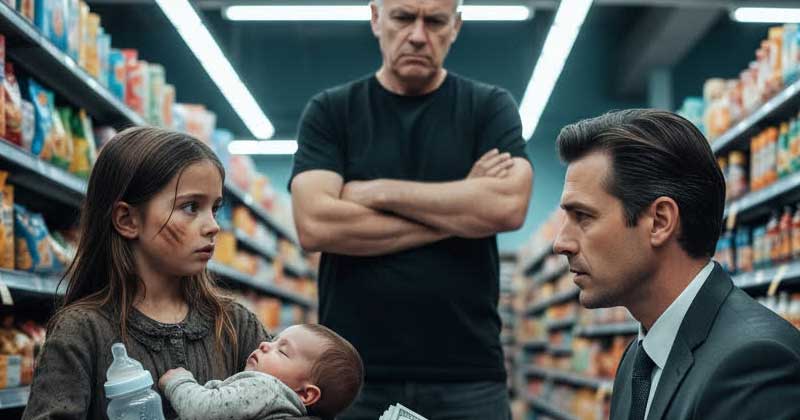
“Because I was once left alone too,” Grigore told her, slowly raising his gaze to the shelves full of food. “I know what it’s like to not be believed.”
The little girl remained still. She held her little brother close to her chest, and her eyes sparkled with held-back tears.
Grigore extended his hand. She looked at him for a long time, as if trying to guess whether she could trust him. Finally, she placed her small palm over his.
That’s how they left the store, under the astonished gazes of the people. It was drizzling outside. Grigore opened the door of his luxurious black car and gestured for them to get in.
“Where are we going?” asked Cătălina with a trembling voice.
“Home,” he said simply.
Grigore’s house was a large but cold villa. There hadn’t been the sound of a child’s laughter there for many years. His wife had died young, and he had buried his sorrow in work and money. But now, when he saw Cătălina rocking her sleeping brother, something changed in him.
In the days that followed, he called doctors, bought them clothes, and took them to school and kindergarten. The little girl didn’t ask for anything, but every morning she left a clumsily written note on the table: “Thank you, Mr. Grigore. I will never forget.”
Years passed. Cătălina grew into a young woman with a big heart. She learned, worked, and Mihăiță became a cheerful and clever little boy. Grigore considered them the family he had never had.
When Cătălina graduated from college, Grigore called her into his office.
“I promised you a better life. I think I gave it to you.”
She smiled. “You gave me a chance, sir. That is worth more than anything.”
But the next day, the whole town learned that Grigore had suffered a heart attack. The hospital was full of staff, but Cătălina didn’t leave his side for a moment. She held a carton of milk in her hand.
“Do you remember?” she said through tears. “You said you would give me a life. But I always owed you that milk.”
The man smiled weakly. “Cătălina, you don’t have to…”
“Yes, I do,” she interrupted him. “You believed in me when no one else would. It’s time for me to pay my promise.”
After his death, the world learned that Grigore had left his entire fortune to a foundation created by Cătălina and Mihăiță. It was called “The Milk of Hope” and helped abandoned children and families who had nothing to put on the table.
In an interview, someone asked her:
“Why didn’t you stop at continuing the business?”
Cătălina smiled with teary eyes. “Because a promise made with the heart cannot be paid with money. It is paid with deeds.”
Today, in every store of the chain founded by Grigore, there is a white box with a simple label: “The Milk of Hope – Donate a liter, give a chance.”
And somewhere, in a corner of the world, another hungry little girl will receive a bottle of milk and, perhaps, a new life.
Cătălina often goes there, without saying who she is. She stands aside and watches, smiling. For her, every child who rises from poverty is proof that true promises never expire.
Because sometimes, a simple carton of milk can change the fate of an entire world.
This work is inspired by real events and people, but has been fictionalized for creative purposes. Names, characters, and details have been changed to protect privacy and enhance the narrative. Any resemblance to real persons, living or dead, or to real events is purely coincidental and not intended by the author.
The author and publisher do not assume responsibility for the accuracy of events or for the portrayal of characters and are not liable for any misinterpretations. This story is provided “as is,” and any opinions expressed belong to the characters and do not reflect the views of the author or publisher.


