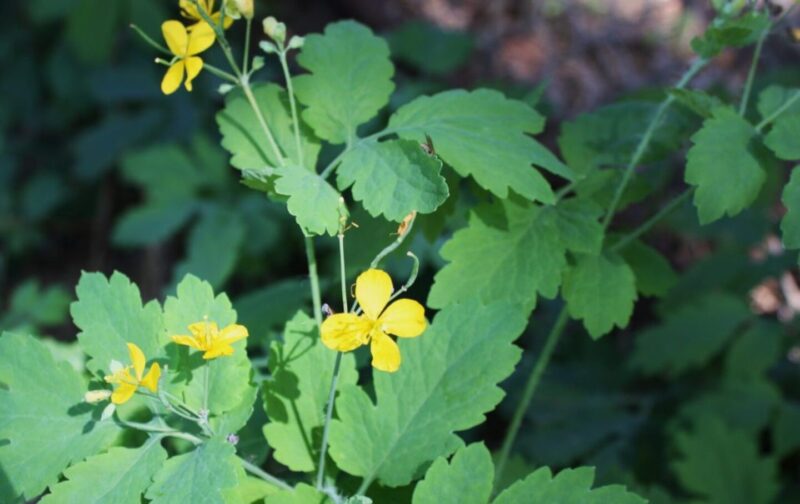
In Romanian folk tradition, greater celandine (Chelidonium majus) was used directly on warts, either in the form of freshly crushed leaves or by applying the yellow-orange sap. The plant is also known as wart herb and has been considered a natural remedy with burning and drying effects on warts. Today, modern medicine analyzes this practice, trying to determine whether it has scientific bases or is merely a tradition passed down from generation to generation.
Benefits
-
Keratolytic and cytotoxic action on warts
The sap of greater celandine contains alkaloids such as chelidonine, sanguinarine, berberine, and coptisine, compounds with cytotoxic effects on cells infected with the HPV virus. These can cause the drying and elimination of the affected skin layer, a process similar to that caused by salicylic acid. The proteolytic enzymes in the latex contribute to the degradation of keratinized tissue, accelerating the detachment of warts. Repeated local application may reduce their size and appearance. Many people have reported visible effects over time, although scientific evidence remains limited. -
Antimicrobial and antiviral properties
Laboratory studies have shown that extracts from greater celandine have antimicrobial and antiviral effects, including against some viral strains associated with warts. These compounds can inhibit the multiplication of the HPV virus and support skin regeneration. The antifungal activity also explains its traditional use for other skin issues. Additionally, external application may stimulate local immunity. However, efficacy in real-world usage conditions has not yet been demonstrated by large clinical studies. -
Natural alternative to conventional treatments
For sensitive individuals or small children, greater celandine may be perceived as a less painful alternative to cryotherapy or concentrated chemical treatments. There are documented cases where daily application of the sap for several weeks led to the reduction or complete disappearance of warts. The method is accessible, as the plant can be harvested from nature. However, effects appear slowly and require perseverance. Results depend on the type of wart and the individual’s response.
Scientific Studies
1. Musidlak Study (2022) – Direct effect on the HPV virus
Researchers analyzed fresh sap from greater celandine and separated the protein and alkaloid-rich components. In the laboratory, they placed these extracts in contact with HPV viral particles (the virus that causes warts). The results showed that the sap reduced the virus’s ability to produce E6 and E7 proteins, responsible for transforming healthy cells into infected ones, by over 70%. It was also observed that the sap stimulates a local immune response, increasing the production of a molecule called TNF-alpha, which helps the body fight the infection. The researchers concluded that greater celandine can act directly on the virus; however, these results were obtained only in the laboratory, not on patients, so the real effect on the skin requires further testing.
2. Nawrot Study (2020) – Case of a child treated with sap
This is one of the few documented clinical cases. A four-year-old boy had multiple warts on his fingers and hand. His parents applied the yellow sap directly on the warts twice a day, being careful not to touch the healthy skin around. After two weeks, the smaller warts completely disappeared, and the larger ones significantly reduced. After eight weeks, the skin was completely healed. The doctors monitoring the case acknowledged that the plant seemed to have an effect, but warned that there is not enough evidence to recommend this method to all patients, especially due to the risk of irritation or toxicity if used improperly.
3. Zieliska Scientific Review (2018) – Overview
This paper did not focus on a single experiment but analyzed all existing data on greater celandine: chemical composition, antiviral effects, traditional use, and risks. The authors showed that the plant contains substances with potential antiviral and anti-inflammatory properties, which could explain why it is used for warts. However, most studies are either on cells in the laboratory or individual observations, without large patient groups. The review also highlighted the risk of hepatic toxicity if the plant is ingested and the possibility of skin irritations. The conclusion was that greater celandine has potential, but large, controlled clinical studies are needed to confirm its efficacy and safety.
Contraindications
-
Hepatic toxicity – May cause increased liver enzymes and cases of toxic hepatitis, some severe.
-
Skin irritations – May cause redness, itching, burning, or contact dermatitis if it touches healthy skin.
-
Gastrointestinal disturbances – Accidental ingestion may cause nausea, vomiting, diarrhea, excessive salivation, dizziness, and weakness.
-
Phototoxicity – May sensitize the skin to sunlight, leading to inflammatory reactions.
-
Medical contraindications – Individuals with liver conditions or those taking hepatotoxic medications should avoid the plant.
-
Long treatment duration – Repeated application may be necessary for several months, increasing the risk of local irritations.
Sources
- PMC The use of Chelidonium majus sap in the treatment of viral warts: a case report
- Frontiers in Pharmacology Chelidonium majus: A Review of Its Phytochemistry and Pharmacological Properties
- MedLife Greater Celandine – Benefits, Properties, Contraindications




