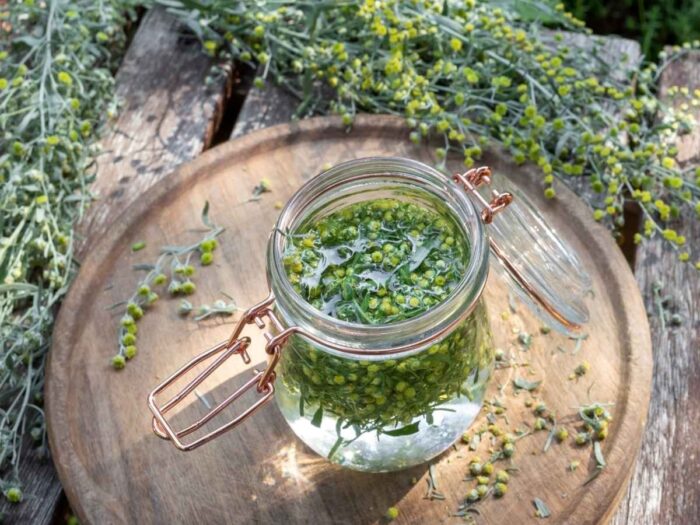
An ancient remedy, preserved in Romanian villages and passed down from generation to generation, is gaining attention from those seeking natural and effective solutions: sun-infused wormwood water. Wormwood (Artemisia absinthium), known for its unmistakably bitter taste, hides remarkable therapeutic power in its leaves, especially for the liver and for combating intestinal parasites. When infused in water under the sun, it releases its active substances in a gentle yet effective manner, without boiling.
Traditional Preparation: Simple but Powerful
For this recipe, you only need:
- 500 ml of still or spring water
- 1 tablespoon of dried wormwood leaves (or one tablespoon of fresh leaves)
- a glass jar with a lid
Preparation Method:
- Place the wormwood leaves in the jar and pour the water over them.
- Cover loosely with the lid (without sealing it tightly).
- Place the jar in a sunny spot for 6-8 hours, preferably in the morning.
- After maceration, strain the liquid and store it in the refrigerator for no more than 24 hours.
Consumption Method:
- Drink 1 small glass (30-50 ml), 2-3 times a day, 15-30 minutes before meals.
- The treatment should not exceed 7 consecutive days.
Benefits of Sun-Infused Wormwood Water
1. Supports Liver Detoxification and Regeneration
Sun-infused wormwood water stimulates bile production, contributing to the proper functioning of the liver. The bitter substances in wormwood (absinthin, artabsin) activate hepatic secretions and promote the elimination of toxins. Studies show that these bitter compounds have a choleretic and cholagogic effect, essential in conditions such as hepatic steatosis or biliary dyskinesia.
2. Destroys Intestinal Worms and Combats Parasitic Infections
Wormwood is one of the oldest natural vermifuges. The compound thujone, present in wormwood leaves, paralyzes and eliminates intestinal worms, especially pinworms and roundworms. Administering it in a sun-infused form allows for a slow extraction of the active principles, sufficient for the antiparasitic effect, but without harming the intestinal flora.
3. Improves Digestion and Reduces Bloating
The bitter substances stimulate taste receptors and trigger the digestive reflex. Through this mechanism, wormwood water helps in the secretion of gastric and pancreatic juices, improving digestion. It is useful in slow digestion, postprandial discomfort, and irritable bowel syndrome.
4. Contributes to Appetite Regulation
Taking wormwood 15-30 minutes before meals can regulate appetite, either by decreasing it (in cases of excessive appetite) or by stimulating it (in cases of loss of appetite). Studies show that wormwood acts through a neurochemical mechanism on the hypothalamus, the area responsible for the sensation of hunger.
5. May Help in Combating Intestinal Candidiasis
Wormwood has antifungal effects, especially against Candida albicans, due to its phenolic compounds and essential oils. Although it is not a first-line treatment, regular consumption in short courses can reduce the proliferation of intestinal fungi, especially when combined with an appropriate diet.
6. Supports Gallbladder Function
Through its choleretic effect, wormwood stimulates the elimination of bile from the gallbladder, preventing stagnation and the formation of gallstones. Sun-infused wormwood water can be useful in maintenance treatments for individuals with a history of gallbladder stones.
7. Has Anti-Inflammatory Effects on the Intestines
Some research indicates that wormwood has beneficial effects on intestinal inflammation, including in Crohn’s disease or ulcerative colitis. This is due to sesquiterpene compounds that modulate the immune response and reduce the activation of inflammatory cytokines.
Studies and Research
A study published in Phytomedicine (2020) analyzed the effects of wormwood extract on the liver in animal models with induced hepatotoxicity. The results showed that wormwood reduced liver enzyme levels (AST, ALT) and protected the histological structure of the liver, suggesting a clear hepatoprotective effect.
Another study published in Parasitology Research (2018) demonstrated the vermifuge effect of aqueous extracts of Artemisia absinthium against pinworms and roundworms. After 5 days of administration, the parasites were completely eliminated in 80% of the subjects included in the experiment.
An article published in Journal of Ethnopharmacology (2021) highlighted the efficacy of wormwood preparations in reducing intestinal dysbiosis, especially in cases of overpopulation with Candida albicans, confirming the moderate antifungal properties of the plant.
Contraindications
- Pregnancy and breastfeeding – wormwood may stimulate uterine contractions and is contraindicated.
- Gastric or duodenal ulcers – may irritate the mucosa and worsen symptoms.
- Epilepsy or other neurological diseases – thujones can have neurotoxic effects in high doses.
- Children under 12 years – not recommended without medical advice.
- Allergy to plants in the Asteraceae family – may cause allergic reactions.
It is important that wormwood is used only in short courses and not administered long-term, as it can become toxic.
Sun-infused wormwood water is a brilliant example of folk wisdom, but also a remedy validated by science. With its dual action of detoxification and antiparasitic properties, this bitter brew can be an excellent ally in supporting liver health and digestion. However, like any powerful natural remedy, it should be used with caution and respect for dosages and duration.
Sources:
- Phytomedicine – Hepatoprotective effect of Artemisia absinthium extract in rats
- Parasitology Research – Anthelmintic activity of Artemisia absinthium aqueous extracts
- Journal of Ethnopharmacology – Antifungal and antiparasitic potential of wormwood: a review




