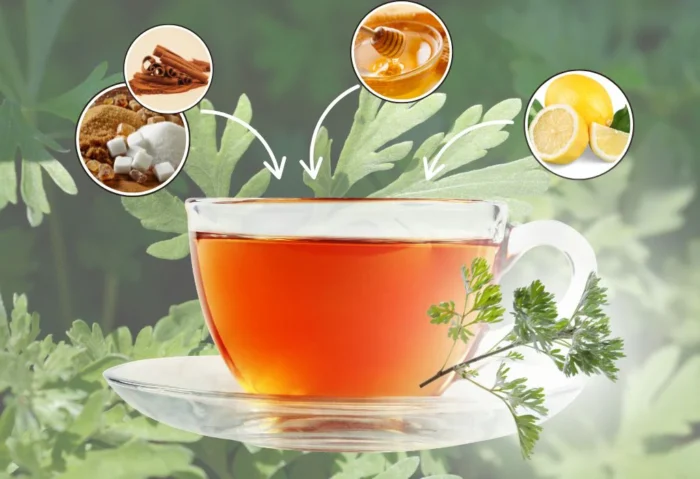
Few brews have a taste as intense as this combination of wormwood and lemon peel, yet this bitter infusion hides remarkable therapeutic properties. The resulting tea is a concentrated infusion of bitter principles, flavonoids, essential oils, and detoxifying compounds that stimulate liver functions, support sluggish bile, and promote the elimination of toxins from the body. Wormwood has been used since ancient times for hepatobiliary disorders, while lemon peel adds a boost of antioxidants, vitamin C, and limonene—a crucial compound for liver metabolism. Although the taste may not be to everyone’s liking, the effects are quick and visible in supporting digestion and liver functions. It is important to note that this tea should be used in short courses and only under supervision, as wormwood is a potent plant with intense effects.
Benefits of Wormwood and Lemon Peel Tea
1. Stimulates bile secretion and contributes to gallbladder emptying
The bitter principles in wormwood directly stimulate taste receptors and, implicitly, the vagus nerve, which triggers a chain reaction in the digestive organs. The liver is activated to produce more bile, while the gallbladder is stimulated to release it into the intestine. This effect is essential in cases of sluggish bile, slow digestion, or a feeling of heaviness after meals. Lemon peel, due to its limonene and flavonoid content, complements this effect by stimulating peristaltic movements and aiding in bile evacuation. Thus, the entire digestive function is optimized.
2. Deeply detoxifies the liver
Wormwood contains absinthin, anabsinthin, and artabsin—bitter compounds with choleretic (stimulating bile secretion) and cholagogic (facilitating bile emptying) effects. These help the liver eliminate toxins more efficiently and regenerate liver cells. Lemon peel provides a high concentration of citrus flavonoids that protect the liver from oxidative stress and fat accumulation in liver cells. The combination of these two plants supports the phases of liver detoxification, aiding both in the elimination of toxic substances and in their neutralization. When used correctly, this tea can contribute to a thorough cleansing of the liver in courses of 7 to 10 days.
3. Combats bloating and indigestion
Wormwood is a classic remedy for slow digestion, with feelings of heaviness and intestinal gas. It acts by stimulating gastric juices and digestive enzymes, leading to better food breakdown. Lemon peel has carminative properties (reducing gas) and helps relax intestinal muscles, preventing spasms. Consuming this tea before meals prepares the digestive system for the digestion process. Its effectiveness is especially enhanced in individuals with slow digestion and diets high in fats.
4. Supports immunity by detoxifying lymph
Lymph plays a crucial role in the body’s defense, and its drainage is closely linked to the proper functioning of the liver. An overloaded liver no longer filters toxins effectively, leading to the overburdening of the lymphatic system. Lemon peel has lymphatic drainage effects, while wormwood stimulates the elimination of toxins through digestion. This combination supports the entire immune system, especially during periods of fatigue, frequent infections, or convalescence. A course with this tea can help restore internal balance.
5. Has antiparasitic and antimicrobial effects
Wormwood is known for its antiparasitic effect, traditionally used in treatments against giardia, roundworms, and other intestinal parasites. Essential oils and bitter compounds destroy parasites and inhibit their multiplication. Lemon peel, with its limonene content, enhances this effect and has antibacterial action, especially in the digestive tract. Therefore, the tea has a curative and preventive effect against intestinal parasites. For maximum effect, it is recommended to consume it on an empty stomach for 7 days.
Relevant Studies
A study published in Journal of Ethnopharmacology (2018) analyzed the effects of wormwood extract (Artemisia absinthium) on the liver in animal models with hepatic steatosis. The results showed that wormwood reduces hepatic fat accumulation and normalizes liver enzyme levels (ALT, AST). The study concluded that wormwood activates liver detoxification pathways and reduces liver inflammation.
Research published in Phytotherapy Research (2020) demonstrated the hepatoprotective effect of limonene extracted from lemon peel. The study was conducted on patients with mild liver dysfunction, and daily administration of limonene led to a reduction in inflammatory markers (TNF-α, CRP) and improved transaminase values. The authors concluded that limonene helps regenerate the liver by protecting liver cells against oxidative stress.
Another study conducted by the Department of Biochemistry, Cairo University (2016) showed that wormwood has choleretic and cholagogic effects comparable to silymarin. The study analyzed bile secretion in animals treated with wormwood extract and observed a significant increase in both the volume and quality of bile. Additionally, wormwood reduced inflammation of the bile ducts and supported the enzymatic function of the liver.
Lemon peel was analyzed in a study published in Frontiers in Pharmacology (2021), which highlighted the ability of citrus flavonoids to inhibit fat accumulation in the liver by regulating the expression of genes involved in lipogenesis. The study concluded that flavonoids from citrus peel may be useful in preventing non-alcoholic fatty liver disease.
Contraindications
- Not to be administered during pregnancy—wormwood may stimulate uterine contractions and has potential toxicity in high doses.
- Prohibited in cases of active gastric or duodenal ulcers, as it stimulates gastric acidity.
- Not recommended for long-term treatments—wormwood may affect the nervous system if consumed for more than 14 consecutive days.
- Avoid administration to children under 12 years old.
- Individuals with severe liver conditions (cirrhosis, active hepatitis) should consult a doctor before consuming this tea.
Recipe: Wormwood and Lemon Peel Tea
Ingredients:
- 1 tablespoon of dried wormwood
- Peel from 1/2 organic lemon (untreated, well washed)
- 250 ml hot water
Preparation method:
- Add wormwood and lemon peel to a cup.
- Pour boiling water over them.
- Cover and let steep for 10 minutes.
- Strain and consume in small sips.
Drink 1 cup per day, in the morning, on an empty stomach, for 7 days. Do not sweeten. A break of 2 weeks can be taken before repeating the course.
Sources:
- Journal of Ethnopharmacology – Protective effect of Artemisia absinthium on hepatic steatosis
- Phytotherapy Research – Hepatoprotective potential of limonene against liver dysfunction
- Frontiers in Pharmacology – Citrus flavonoids in liver health: From molecular mechanisms to clinical applications
- Department of Biochemistry, Cairo University – Comparative study on choleretic effects of Artemisia and silymarin




