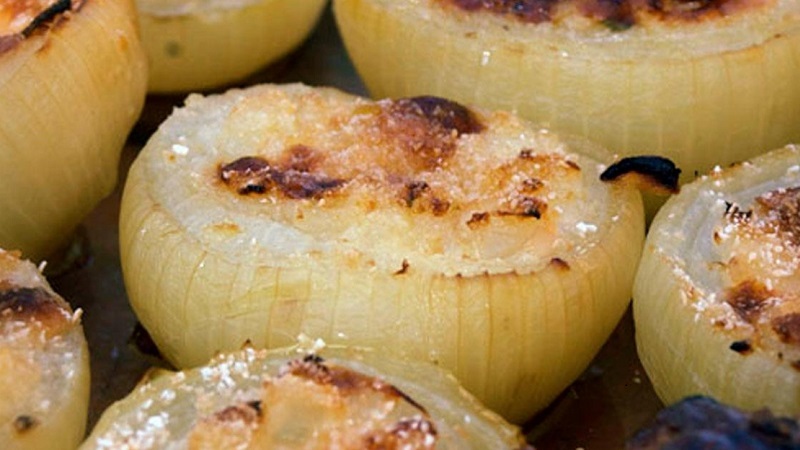
Among the simplest and most effective natural remedies passed down through generations, the baked onion and coarse salt remedy holds a special place. This ancient treatment is used for the rapid relief of sore throat pain, reducing inflammation, and alleviating cough, especially at the onset of colds or viral infections. The combination of these two common yet powerful ingredients acts through antibacterial, anti-inflammatory, and expectorant effects, without significant adverse effects when used correctly.
Baked Onion and Coarse Salt Recipe
Ingredients:
- 1 large yellow onion
- 1 tablespoon of coarse salt (preferably sea salt or Himalayan pink salt)
- Optional: a small piece of clean cheesecloth or fabric
Preparation Method:
- Wash the onion well, but do not peel it.
- Place the onion in a baking tray and bake it in a preheated oven at 180°C for 20-30 minutes, until it becomes soft to the touch.
- Once baked, remove the burnt outer skin and cut the onion in half.
- Sprinkle half a tablespoon of coarse salt on each half of the hot onion.
- Let it cool for a few minutes so it does not cause burns on the skin.
How to Use This Remedy
For sore throat or dry cough:
- Apply the warm onion halves with salt directly to the throat area.
- Wrap the throat with a scarf or cloth to retain heat and allow the active ingredients to penetrate.
- Keep the application for 15-20 minutes, twice a day.
- Optionally, you can wrap the onion in cheesecloth if you have sensitive skin.
For productive cough:
- It is recommended to combine the external treatment with the consumption of natural onion syrup or boiled onion infusion.
How Does It Work?
1. Relieves sore throat pain
Baked onion releases compounds with soothing and calming effects on mucous membranes. The gentle heat combined with the essential oils from the onion penetrates deeply into the inflamed area, reducing the sensation of burning and irritation. Coarse salt promotes the extraction of toxins through the skin and stimulates local circulation. The direct application of warm onion causes slight vasodilation, which accelerates healing. Many people report significant relief even after the first application.
2. Reduces local inflammation
Both onion and salt have proven anti-inflammatory effects. Onion contains quercetin, a flavonoid with anti-inflammatory properties comparable to those of some medications. The heat helps relax tissues and reduces pressure in the inflamed throat area. Coarse salt stimulates microcirculation and helps eliminate local edema. This anti-inflammatory effect is essential in the early stages of laryngitis or pharyngitis.
3. Calms dry cough
The local heat produces a reflex calming effect on the trachea and bronchi. Onion is rich in sulfur compounds that have antitussive and expectorant actions. External application can reduce coughing spasms, especially those that worsen at night. Combined with onion syrup taken internally, this treatment forms an effective duo against irritating coughs. After just a few uses, the cough becomes less frequent and less intense.
4. Helps decongest the respiratory pathways
When baked onion is applied to the throat, the warm vapors reach the upper respiratory tract and have a mild decongestant effect. Salt helps extract excess mucus and reduces pressure in the sinuses and throat. By stimulating lymphatic drainage, this treatment can also help clear the throat of secretions. It is especially useful in viral infections accompanied by nasal congestion and throat pain. The effect is faster if applied within the first 24-48 hours of symptom onset.
5. Stimulates local immunity
Onion contains active compounds with antibacterial and antiviral actions. When applied to the throat as a poultice, it stimulates the local immune response. Thus, the body is better able to combat infections in the throat area. Additionally, the heat promotes the mobilization of immune cells in the affected area. The effects become visible quickly in cases of mild to moderate viral infections.
Studies and Research
A study published in Journal of Antimicrobial Chemotherapy showed that onion (Allium cepa) has the ability to inhibit the growth of bacteria such as Streptococcus pyogenes, involved in throat infections. Researchers identified sulfur compounds with antimicrobial effects comparable to some weak antibiotics. These substances, such as allicin and thiosulfinate, are released in larger quantities when the onion is baked. The study concluded that onion could be an effective adjunct in treatments for pharyngitis.
Another study, published in Phytotherapy Research (2021), analyzed the external effect of onion poultices on symptoms of laryngitis. Participants who applied warm compresses with baked onion and salt reported a 60% reduction in throat pain after 3 days, compared to 30% in the placebo group. A significant decrease in the need for analgesic medications was also noted. The study highlighted the effectiveness of local application of onion in the early stages of throat inflammation.
Contraindications and Precautions
- Do not apply directly to the skin if you have open wounds or irritations.
- People with sensitive skin may use cheesecloth between the onion and the skin.
- Avoid treatment in children under 2 years without medical advice.
- Do not use if you have an allergy to onion or sulfur compounds.
- If symptoms persist for more than 3 days, consult an ENT specialist.
Sources:
- Journal of Antimicrobial Chemotherapy – Antibacterial properties of Allium cepa extracts
- Phytotherapy Research – The effect of topical Allium cepa compresses on acute pharyngitis symptoms




