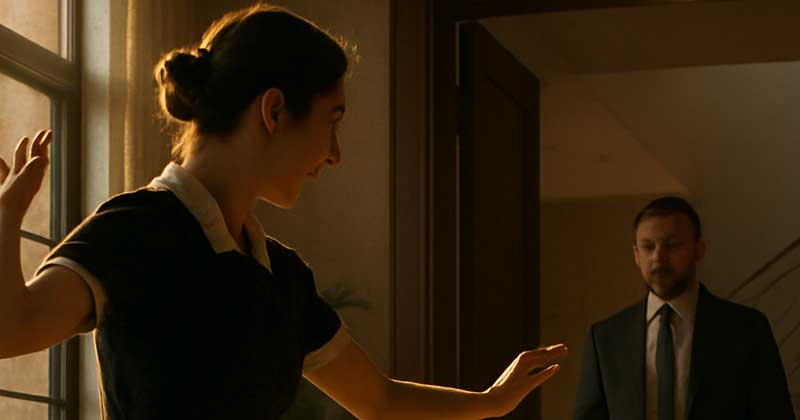
When he walked in the door, the father froze. In the middle of the living room, his son, who hadn’t lifted his gaze from the floor for months, was clapping and laughing. The maid was dancing around him, with simple, almost childlike steps, and he responded with a joy that the man hadn’t seen since before the accident.
For a moment, the billionaire felt his heart tighten. All his wealth, all the famous clinics, the doctors paid enormous sums had failed to bring this miracle. And a simple young woman, with a warm smile and an open heart, managed to awaken in the child what he thought was lost forever.
He approached without saying a word. The child spotted him and, for the first time since the accident, raised his hands towards him. It was a small gesture, but enough to bring tears to his eyes.
The maid stopped, embarrassed, trying to explain, but he raised his palm and whispered, “No. Continue. Don’t stop.” It was the first time his voice didn’t sound commanding, but trembling, full of gratitude.
From then on, every day began with music in that house. The child slowly learned to regain his small movements, but most importantly, he was laughing again. A house that had been cold and silent until then became full of life.
The father remembered his childhood in the village. The evenings when all the neighbors gathered for a dance in the schoolyard, the cheerful shouts, and the sound of the flute that echoed late into the night. “Maybe that’s why music heals,” he thought. “Because it reminds us of who we truly are.”
On a Sunday, the billionaire organized a small party in the garden. He invited a few close friends, as well as some children from his grandparents’ village, brought in specifically to play the violin and accordion. When the music started, the boy clapped again, but this time he also moved his feet slightly, like a tremor of life. Everyone fell silent.
The doctor who visited him periodically was left speechless: “It’s incredible. Conventional therapy couldn’t reach here. But will, joy, and emotion can do what medicine cannot.”
In that moment, the father understood. It wasn’t wealth that would save his son, but love, closeness, and simple things. So he made an unexpected decision: he began to invest in recovery centers for children with disabilities, but not luxurious clinics, rather places filled with music, dance, and smiles.
The maid, who had come just for a salary, became the soul of that house. She was not just an employee, but part of the family. And the billionaire, the cold and distant man, learned to laugh again alongside his son.
A year after that moment, the boy managed to stand supported, taking a few shaky steps in the flower-filled garden. Music echoed from a small speaker, and he smiled with eyes shining with hope.
People around spoke with emotion about how a simple dance changed a life. And how, in the end, it wasn’t the power of money that brought healing, but the power of the heart and tradition: music, dance, and love for people.
And thus, the billionaire’s house was no longer a cold palace of concrete and glass. It was a place where the echo of a simple and pure Romanian song could bring even the most broken souls back to life.
This work is inspired by real events and people, but has been fictionalized for creative purposes. Names, characters, and details have been changed to protect privacy and enhance the narrative. Any resemblance to real persons, living or dead, or to real events is purely coincidental and not intended by the author.
The author and publisher do not assume responsibility for the accuracy of the events or for how the characters are portrayed and are not liable for any misinterpretations. This story is provided “as is,” and any opinions expressed belong to the characters and do not reflect the views of the author or publisher.


