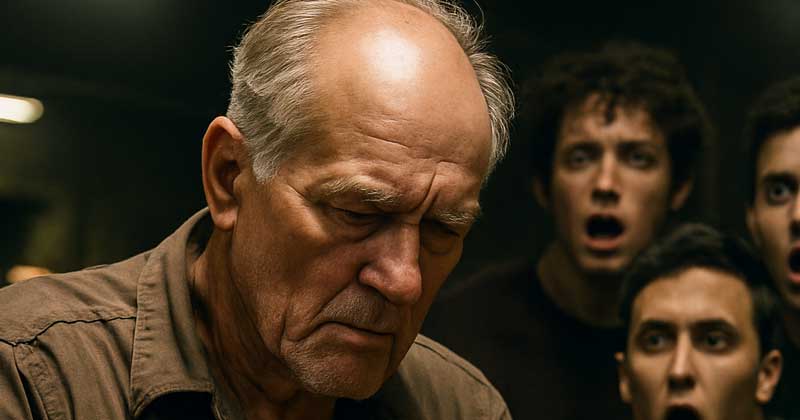
—Sir, please, now is not the time for curiosity! —Diego burst out, trying to hide his uncertainty.
But Don Esteban was not intimidated. He stepped forward with a determination that cut through the heavy air of the basement.
—I’ve worked with such engines for 40 years, before you were born. If you don’t want to listen, then keep playing with your tablets, but lives are at stake here.
His simple and sharp words fell like a thunderbolt over the young people. A few began to laugh mockingly, but their laughter sounded false, more like a mask over their own helplessness.
Don Esteban bent down and ran his hand over the tangled wires. In a few seconds, his calloused fingers found what others had ignored: a switch blocked by dust and a fuel hose improperly tightened.
He took out his old pocket knife, inherited from his father, and with precise movements, he opened the metal collar. A strong smell of gasoline filled the air. The young people took a step back, frightened.
—Hold this tight! —he shouted to Diego, handing him the hose. The engineer, caught between pride and panic, did as he was told.
The old man then pressed the priming button, quietly uttered a “God help us,” and the engine coughed a few times before roaring to life.
In the hospital, the lights flickered and then all turned on at once. The machines resumed their functions, the fans started again, and a wave of relief swept through the building.
Patients and families burst into applause. A woman made the sign of the cross, a child shouted, “Look, it’s on!”, and Dr. Carmen let tears flow down her cheeks as she continued resuscitation.
Diego, still holding the hose, looked at Don Esteban with wide eyes, as if he were a man from another world.
—How… how did you know?
The old man put his hat on and simply said:
—Son, in my village, when the power went out, you either fixed it or someone died. We didn’t have manuals or the internet, just hands and minds.
Soon, the news spread throughout the hospital. He was no longer “just an old man,” but the hero who had saved dozens of lives with a simple and sure gesture.
Maria, his granddaughter, hugged him tightly.
—Grandpa, everyone is talking about you!
He smiled tiredly, but warmly.
—I just did what I had to do. Not for glory, but for people.
In Romanian tradition, it is often said that the elderly are the “book of wisdom” of a family. Just as in the past, in villages, people gathered around the oldest for advice and support, here, in a modern hospital, life and death rested in the hands of a man who had endured hardships.
The applause did not cease. And for a moment, amidst the chaos, everyone understood the same thing: it is not age that brings weakness, but experience. And respect for the elderly is not just a tradition, but a duty that can sometimes save lives.
The hospital had resumed its rhythm, but people went home with a story they would tell for a long time: the day an old man, initially scorned, brought the light back.
And not just the light of the bulbs, but the light of respect for what it means to be human.
This work is inspired by real events and people, but has been fictionalized for creative purposes. Names, characters, and details have been changed to protect privacy and enhance the narrative. Any resemblance to real persons, living or dead, or actual events is purely coincidental and not intended by the author.
The author and publisher do not assume responsibility for the accuracy of the events or for how the characters are portrayed and are not liable for any misinterpretations. This story is provided “as is,” and any opinions expressed belong to the characters and do not reflect the views of the author or publisher.


