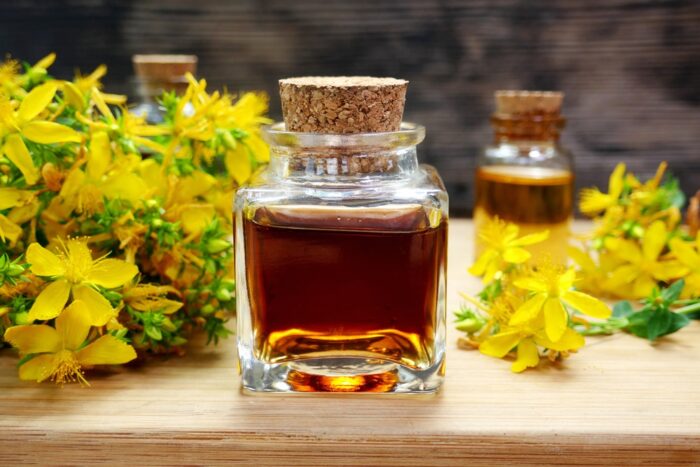
St. John’s Wort oil, made from the golden-yellow flowers of the Hypericum perforatum plant, is one of the most commonly used natural remedies for muscle pain, trauma, and inflammation. Although it is primarily known for its effects on anxiety disorders, this oil has surprisingly effective local action. How does it work? What do studies say? And how can it be prepared correctly at home? Find out everything below.
Benefits of St. John’s Wort Oil for Muscle Pain
The effectiveness of St. John’s Wort oil for muscle pain is based on its anti-inflammatory, analgesic, and regenerative properties, proven by several studies.
1. Deep Anti-inflammatory Action
The main active compound, hypericin, along with hyperforin and flavonoids, helps to calm inflammation by inhibiting prostaglandins, the molecules involved in pain and swelling of tissues. When applied locally, the oil penetrates the skin and reduces inflammation directly in the affected area.
A study published in the Journal of Ethnopharmacology (2014) showed that extracts from St. John’s Wort significantly reduce muscle inflammation in animals, with results comparable to classical anti-inflammatories.
2. Rapid Pain Relief
Due to its local analgesic effect, applying St. John’s Wort oil can alleviate back, neck, shoulder, or limb pain. The effect sets in gradually but is long-lasting.
A clinical study in Iran (2017) demonstrated that massage with St. John’s Wort oil reduces the intensity of muscle pain in patients with fibromyalgia, also improving sleep quality.
3. Muscle Regeneration and Healing
The oil accelerates the healing of micro-tears in muscles and helps restore affected fibers. It is effective in recovery after intense exertion, sprains, or bruises.
The oil also supports local circulation, promoting tissue oxygenation, an essential step for regeneration.
Recipe for St. John’s Wort Oil (for external use)
Ingredients:
- 1 jar of 500 ml with fresh St. John’s Wort flowers (collected around the summer solstice)
- 250-300 ml of cold-pressed oil (olive or sunflower oil)
- Glass jar with a tight lid
- Cheesecloth and dark glass for storage
Preparation Method:
- Fill the jar three-quarters full with clean, fresh flowers, free of impurities.
- Pour the oil until it completely covers the flowers.
- Seal the jar and leave it in the sun for 3 weeks, shaking gently daily.
- After 21 days, strain the contents through cheesecloth and store the oil in a dark glass bottle in a cool place.
The oil will take on a reddish hue, indicating that hypericin has been successfully extracted!
How to Use St. John’s Wort Oil for Muscle Pain
- Local Massage: apply a few drops to the painful area and massage gently for 5-10 minutes, twice a day.
- Warm Compresses: soak a compress in warm oil (not hot!) and apply it to the affected area for 20 minutes.
- Post-Exertion: after intense activities, use the oil for muscle relaxation and to prevent muscle soreness.
Do not apply the oil before sun exposure as it may cause photosensitivity!
Contraindications and Precautions
- Photosensitivity: the oil may increase skin sensitivity to sunlight. Avoid direct exposure for 24 hours after application.
- Allergies: test on a small area of skin first. It may cause reactions in individuals sensitive to plants from the Hypericaceae family.
- Pregnancy and Breastfeeding: use only with a doctor’s approval.
- Do not administer internally! This oil is for external use only.
Relevant Studies and Research
- Anti-inflammatory and antinociceptive effects of Hypericum perforatum in experimental models Journal of Ethnopharmacology, 2014
- The effect of Hypericum perforatum oil on muscle pain in fibromyalgia: a double-blind study Iranian Journal of Nursing, 2017
- St. John’s Wort in the treatment of somatic pain: a review Phytomedicine, 2016




