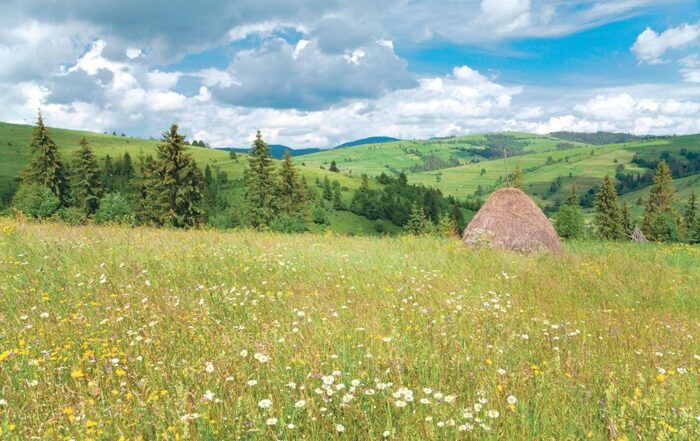
Little do you know that the humble hay, that mixture of dried plants gathered from alpine meadows and hills, hides a rare phytotherapeutic treasure: hay flowers. Used for centuries in healing balms, poultices, or inhalations, these flowers represent a valuable natural remedy, especially for rheumatic conditions, respiratory issues, stress, and detoxification. Beyond their unmistakable scent, hay flowers are a true herbal pharmacy.
What are hay flowers?
Hay flowers are the upper parts of hay plants—flowers, leaves, and seeds—gathered before mowing. They come from a natural mixture of wild plants, such as:
- St. John’s Wort (Hypericum perforatum)
- Yarrow (Achillea millefolium)
- Dandelion (Taraxacum officinale)
- Chamomile (Matricaria chamomilla)
- Red Clover (Trifolium pratense)
- Thyme (Thymus serpyllum)
- Wild Mint (Mentha arvensis)
- Great Agrimony (Agrimonia eupatoria)
The flowers are naturally dried and then used whole or crushed, especially for therapeutic purposes.
Composition
The mixture of plants in hay flowers contains:
- Essential oils (menthol, thymol, eugenol)
- Flavonoids with antioxidant and anti-inflammatory roles
- Tannins and mucilages useful for skin and mucous membranes
- Bitter substances and sesquiterpene lactones
- Natural vitamins (A, C, E)
- Minerals such as calcium, magnesium, and silicon
Benefits of hay flowers
1. Relieves rheumatic and muscular pain
By applying moist heat (poultices or bags with flowers), the active principles penetrate the skin and relax the muscles, reducing inflammation and alleviating joint pain.
A study published in Complementary Therapies in Medicine showed that hay flower poultices significantly reduced pain in osteoarthritis and rheumatoid arthritis in clinical groups.
2. Detoxifies the skin and stimulates circulation
Poultices with hay flowers promote sweating, open pores, eliminate toxins, and activate peripheral circulation, making them ideal after exertion or during weight loss regimens.
According to a study from the University of Vienna, treatments with hay flowers increased peripheral blood flow by up to 25%.
3. Helps with respiratory conditions
Inhalations or poultices with hay flowers thin bronchial secretions, soothe coughs, and assist in bronchitis, sinusitis, or colds.
The journal Phytotherapy Research documented the effectiveness of inhalations with hay flower plants in cases of chronic rhinitis.
4. Induces deep relaxation and combats insomnia
The essential oils released in poultices induce a state of deep calm, relax the nervous system, and contribute to more restful sleep.
A pilot study in the Journal of Ethnopharmacology observed a decrease in cortisol (the stress hormone) after 20 minutes of bathing with hay flowers.
5. Helps with cellulite and lymphatic drainage
Due to their thermal and detoxifying effect, poultices with hay flowers are also used in anti-cellulite therapies and for natural lymphatic drainage.
Recipes with hay flowers
1. General therapeutic bath
- 2 large handfuls of hay flowers (approx. 50 g)
- 1 liter of boiling water
Infuse for 30 minutes, strain, and add the liquid to warm bath water. Duration: 20-25 minutes. Do not rinse the body after the bath.
2. Pillow with hay flowers (dry or warm)
- Fill a cloth bag with hay flowers
- Heat the pillow over steam or in the oven (no more than 60°C)
- Apply to the painful area for 20-30 minutes
3. Inhalations for respiratory pathways
- 1 handful of flowers in 1 liter of boiling water
Inhale for 10-15 minutes under a towel in the evening. Ideal for bronchitis, sinusitis, colds.
Contraindications
- Individuals with allergies to hay plants (e.g., ragweed, grasses) may experience allergic reactions.
- Not recommended in cases of severe hypotension (mild hypotensive effect).
- Avoid very hot poultices in pregnancy or for individuals with heart problems.
- Do not apply directly to open wounds or severely irritated skin.
Sources:
- Complementary Therapies in Medicine Hay flower baths in osteoarthritis: a randomized controlled study
- Journal of Ethnopharmacology Traditional hay flower treatments and their effect on stress markers
- Phytotherapy Research Herbal inhalation and nasal symptoms: a clinical review
- University of Vienna Effect of hay flower baths on circulation and the autonomic nervous system




