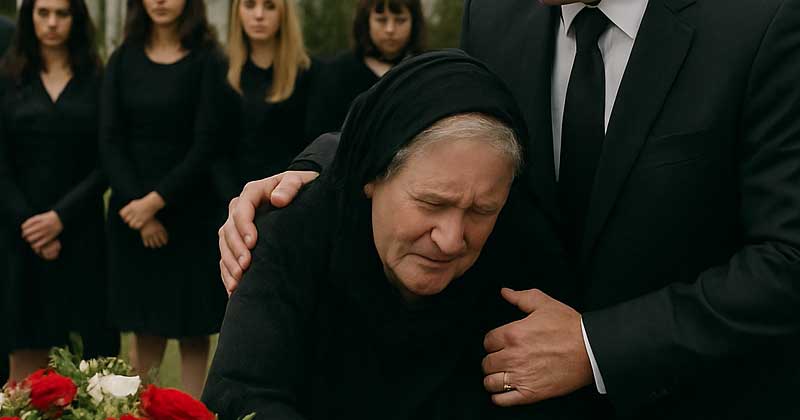
One morning, as the sun lazily rose over the hills surrounding the mansion, the woman received an anonymous letter. The envelope had no stamp or sender. Trembling, she opened it. The words, written in heavy letters, seemed to burn on the paper:
“The truth about your daughter’s death is not what you think.”
Her heart stopped for a moment. She read the sentence several times, unable to believe it. Who could send her something like this? And especially — why?
Filled with unease, she kept silent. But in the following days, strange signs began to appear. An unknown man had been seen by the servants walking through the garden at night. Locked doors were found ajar in the morning. And one evening, on the desk in the library, the woman discovered a photograph. It was her daughter, smiling, holding hands with her son-in-law. The photograph was taken just a few days before the accident, but on the back, someone had written: “Look closer.”
The woman’s eyes fell on a detail she had never noticed before. In the corner of the image, almost hidden, there was a black car. It wasn’t theirs. Someone had been following them.
Frightened but determined to uncover the truth, the woman began to investigate. She hired a private detective, a former police officer from a nearby town. After a few weeks, he brought her shocking information: the accident had not been a mere misfortune. Someone had sabotaged their car.
The pain turned into anger. For the first time since the tragedy, the woman felt she had a purpose. She was no longer just a grieving widow mourning the loss of her children, but a mother ready to fight for justice.
On long evenings, she would light the candle in her daughter’s room and remember the customs from her childhood village. Her grandmother always said, “The truth rises to the surface like oil above water.” She clung to these words as if they were a divine promise.
Slowly, the pieces of the puzzle began to fall into place. Her son-in-law, although poor, had worked at a transport company where he discovered serious irregularities. He had evidence, and someone influential did not want it to come to light.
On an autumn night, the wind howled fiercely among the old walnut trees in the yard. The woman, with the letter in hand and her daughter’s photograph pressed to her chest, understood the truth: the death of her loved ones had not been accidental. It had been a murder.
Her resolve strengthened in her soul. She knew the road would not be easy, but in her heart burned the desire to seek justice. Not for wealth, not for reputation, but for a mother’s love.
She raised her gaze to the icon in the corner, made the sign of the cross, and whispered, “I will find out everything. And I will not stop until they pay.”
In that moment, the wealthy woman was no longer just the mistress of an empty mansion. She had become what she had always been deep in her heart: a fierce Romanian mother, ready to face the world for her child.
And the story was just beginning to be written, not in the luxury of the mansion, but in the strength of a heart that refused to be defeated.
This work is inspired by real events and people, but has been fictionalized for creative purposes. Names, characters, and details have been changed to protect privacy and enhance the narrative. Any resemblance to real persons, living or dead, or actual events is purely coincidental and not intended by the author.
The author and publisher do not assume responsibility for the accuracy of events or for the portrayal of characters and are not liable for any misinterpretations. This story is provided “as is,” and any opinions expressed belong to the characters and do not reflect the views of the author or publisher.


