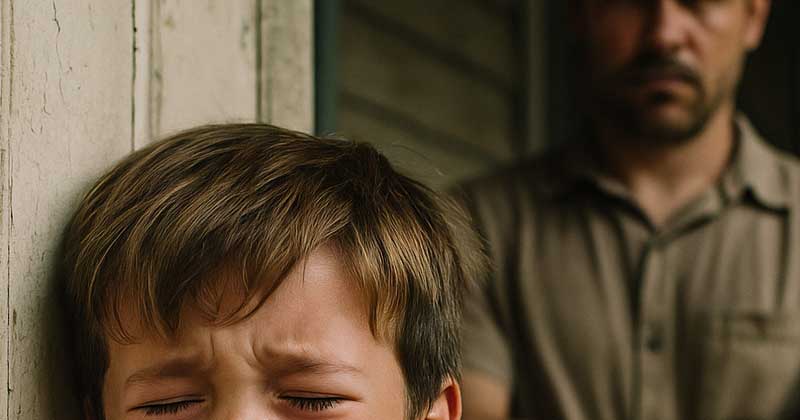
I stood still, with the phone pressed to my ear, feeling my heart race wildly. For ten years, I had convinced my soul that I didn’t care. And yet, in that moment, all the past crashed over me like a cold wave.
“Who are you?” I asked, my voice trembling.
“You will find out on Saturday. We are waiting for you at the gallery.”
I hung up the phone and stared blankly. That night, I slept fitfully, haunted by the image of the 12-year-old child with the torn backpack. I could see his empty eyes, devoid of reproach, yet full of silence. That silence now followed me like a curse.
On Saturday, I arrived at the gallery. My hands trembled as if I were going to trial. The room was filled with elegantly dressed people, and the walls were covered with paintings. When I lifted my gaze to the first piece, I felt my knees buckle.
It was his mother’s face, painted with a delicacy that broke my heart. Then, another painting — a child with a torn backpack. I was about to see, one by one, his life depicted in colors and shadows: suffering, loneliness, but also an inhuman strength that burst forth from each canvas.
I knew immediately: it was him.
And then, from the crowd, a tall man appeared, with a confident gaze. The world applauded him, and I stood frozen. I no longer recognized him, but my heart told me the truth. It was the child I had cast out.
He approached me with determined steps. Around us, people stopped talking, as if the moment had taken their breath away. When he stood face to face with me, he didn’t call me “dad,” he didn’t embrace me. He just looked me straight in the eye.
“I wanted you to be here to see what you lost,” he said calmly. “Not to take revenge, not to forgive yourself. Just to understand.”
I felt his words tear me apart. Everyone looked at him with admiration, and I felt smaller than ever.
“I was wrong,” I managed to whisper. “I can’t change the past, but I want to…”
“I want nothing from you,” he interrupted me. “I learned on my own what life means. I grew up among strangers, sometimes sleeping in train stations, other times in abandoned houses. I knew hunger and cold. But I also met good people. People who offered me warm bread or a kind word. They were my true family.”
Tears filled my eyes. In our culture, in the village, it was always said that “blood is thicker than water.” But here was my cold blood, my refusal, throwing him into the arms of strangers who loved him more than I ever could.
He continued: “Art saved me. Painting gave me purpose. Each painting is a memory, a wound, a victory. And today I no longer carry the burden of the past. I just want you to know: I never hated you. I just learned that love is not demanded, it is given.”
I felt the entire room judging me in silence. Not through words, but through the admiration they offered him, the cast-out child, now a strong man.
I left the gallery crushed. I walked alone through the city streets, with a heavy heart. I stopped at a small church, lit a candle, and prayed for the first time truly. I asked for forgiveness from my wife, the child I had cast out, God, and myself.
But forgiveness does not come from words. It comes from actions.
I began to change. I started donating money to orphaned children, visiting centers where they grew up without parents, bringing them clothes and food. I couldn’t turn back time, but I could try to be the man I should have been then.
Maybe I will never be able to heal the wound I left in his soul. But I understood a simple truth that our ancestors always said by the hearth: “A child does not ask for your blood. He only asks for you to be human.”
And this lesson, even if it came too late for me, I hope reaches the hearts of those who still have time not to repeat my mistake.
This work is inspired by real events and people, but has been fictionalized for creative purposes. Names, characters, and details have been changed to protect privacy and enhance the narrative. Any resemblance to real persons, living or dead, or to real events is purely coincidental and not intended by the author.
The author and publisher do not assume responsibility for the accuracy of events or for how characters are portrayed and are not liable for any misinterpretations. This story is provided “as is,” and any opinions expressed belong to the characters and do not reflect the views of the author or publisher.


