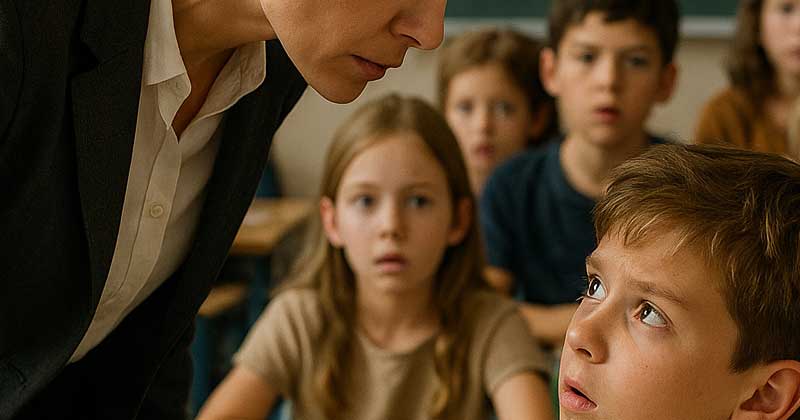
Elena said nothing. For the first time in many years, her cold eyes wavered, and the hand gripping the ruler remained suspended in the air, uncertain. The students waited with bated breath. In a class where humiliation had often been the teacher’s preferred method, something unusual was happening: absolute authority was cracking.
David began to read. His voice was calm but firm, with impeccable diction. The words flowed in English, then, without hesitation, he switched to French. After a few sentences, he continued in German, and the class erupted in exclamations. The students who had mocked him earlier were now mesmerized.
“In Spanish, ma’am?” he asked with a subtle smile. And he read from the same text, changing his accent and intonation like an actor on stage. In a few minutes, he had gone through seven languages. The textbook no longer seemed an obstacle, but a pretext to show the world that, beyond the tattered clothes and worn-out sneakers, there was an extraordinary spirit hidden.
The room exploded in applause. Some raised their phones, recording the moment. Others looked at him with a respect that no teacher had managed to extract until then.
Elena cleared her throat, but the words wouldn’t come out. She was ashamed. For years, she had built a reputation based on fear, and now, a child she had called illiterate had dismantled her in front of everyone.
David gathered his notebook and sat back down. He wasn’t asking for applause. He wasn’t asking for apologies. All he wanted was to be left to learn.
What had happened in that room went beyond a simple confrontation between a student and a teacher. It was proof that true value does not lie in appearances, but in the hidden power of every person.
In Romanian culture, there is a saying: “It is not the clothes that make the man, but the soul.” This was true for David as well. The child in tattered clothes, who seemed lost among the sons of bankers and lawyers, had proven that education is not just about expensive textbooks or elegant uniforms. It is about the courage to show your knowledge and to maintain your dignity.
Soon, his story spread throughout the school. In the hallways, students looked at him differently. Those who had pointed fingers at him yesterday now greeted him respectfully. Some asked for his help with homework, while others just wanted to talk to him.
David, however, had not changed. Every morning, he waited for his mother to return from work, still tired from the night, and made her a cheap coffee, but made with love. He noted new words, old phrases from rare books, and proverbs that his grandfather had left him as a legacy.
Teachers began to notice. Some looked at him with admiration, others with envy. But no one could deny what they had seen.
A few weeks after the incident, the school principal called David and his mother in. The woman, tired, with hands cracked from detergent, entered the office, emotional. The principal told them that they had received a letter from a local university: foreign language professors wanted to meet the boy.
His mother burst into tears. “David, your father would have been so proud…”
For the first time, the child who had endured mockery looked up at her and smiled. “Mom, everything I learned comes from you and from Grandpa. I just opened the notebook.”
David’s story reminds us of winter evenings in Romanian villages, when grandparents gathered their grandchildren around the stove and told them stories. There was no need for shiny textbooks or expensive phones. All that was needed was patience, love, and the right words.
In life, it is not exams or grades that define who you truly are, but the power to rise when others look down on you.
David Rosenberg, the boy labeled “illiterate,” left us all a lesson: knowledge cannot be hidden by torn clothes, and dignity cannot be crushed by mockery.
In the end, teacher Elena, once so proud, looked at him and said softly, almost like a prayer: “I apologize, David.”
The class fell silent. The students realized they were witnessing something rare: a moment when the truth, spoken by a child, managed to soften even the coldest heart.
And perhaps, one day, each of us will understand what the boy said: “You will know the truth, and the truth will set you free.”
This work is inspired by real events and people, but has been fictionalized for creative purposes. Names, characters, and details have been changed to protect privacy and enhance the narrative. Any resemblance to real persons, living or dead, or to real events is purely coincidental and not intended by the author.
The author and publisher do not assume responsibility for the accuracy of the events or for how the characters are portrayed and are not liable for any misinterpretations. This story is provided “as is,” and any opinions expressed belong to the characters and do not reflect the views of the author or publisher.


