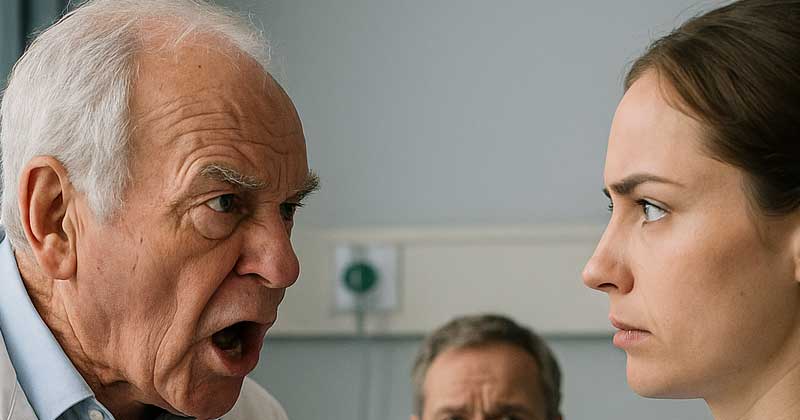
Thomas Edwards was not an ordinary patient. Behind his slightly pale face and bandaged arms lay one of the country’s most important philanthropists, a man who had invested millions in hospitals and medical foundations. His presence there was not just a coincidence, but an attempt to see for himself how the system he supported operated.
Angela, unknowingly, had profoundly impressed him. Her care, patience, and the dignity with which she bore her burden did not go unnoticed. In contrast, Dr. Greaves’ arrogance made Edwards understand exactly where the problem lay.
After that tense episode, the silence in the ward became oppressive. Angela tried to hold back her tears, but her hands trembled. Nevertheless, she continued her work, checking the IVs and monitoring the patient with professionalism. The heavy words of the doctor echoed in her mind, but she did not let them stop her duty.
A few days later, news spread through the hospital that a board of directors was set to visit the ward. Rumors spoke of a possible radical change, but no one suspected the real reason. On the designated day, in the hospital’s large hall, the medical staff lined up with emotion. Angela, with her perfectly arranged white coat, stood back in a corner.
When the doors opened, Thomas Edwards entered accompanied by a delegation of officials. All eyes turned to him, and Dr. Greaves immediately changed his attitude, trying to put on a servile smile.
Edwards wasted no time. In front of the entire staff, he recounted his experience as a patient, how he was treated with respect and compassion by a nurse named Angela Parker, and how he had shockingly witnessed disgraceful behavior from a senior doctor.
His words fell like a thunderbolt. The entire room fell silent. Angela felt her cheeks flush, but for the first time, her gaze met the respect of her colleagues.
“An institution that receives my support cannot tolerate such attitudes,” Edwards said firmly. “Such people have no place in a setting where human lives depend on trust and empathy.”
Dr. Greaves tried to intervene, but he was silenced by the cold stares of the board. The decision had already been made.
Angela was congratulated and promoted to the position of team coordinator for nurses. In that moment, she remembered her grandmother’s words from the countryside: “Being a great person does not mean having power, but lifting others when they are down.”
With tears in her eyes, Angela felt that she had not only earned her place but also her dignity. Behind the applause, a new strength was born in her soul, like the patience of the Romanian peasant who, after harsh winters, breathes a sigh of relief seeing the green earth in spring.
Thus, her story became not just an example of courage but also a lesson about respect, justice, and the power to remain dignified even when the world seems to push you down.
Angela was never “invisible” again. From that day on, her name was spoken with respect in the hospital corridors, and her once-hidden smile became a symbol of real change.
This work is inspired by real events and people, but has been fictionalized for creative purposes. Names, characters, and details have been changed to protect privacy and enhance the narrative. Any resemblance to real persons, living or dead, or actual events is purely coincidental and not intended by the author.
The author and publisher do not assume responsibility for the accuracy of the events or for how the characters are portrayed and are not liable for any misinterpretations. This story is provided “as is,” and any opinions expressed belong to the characters and do not reflect the views of the author or publisher.


