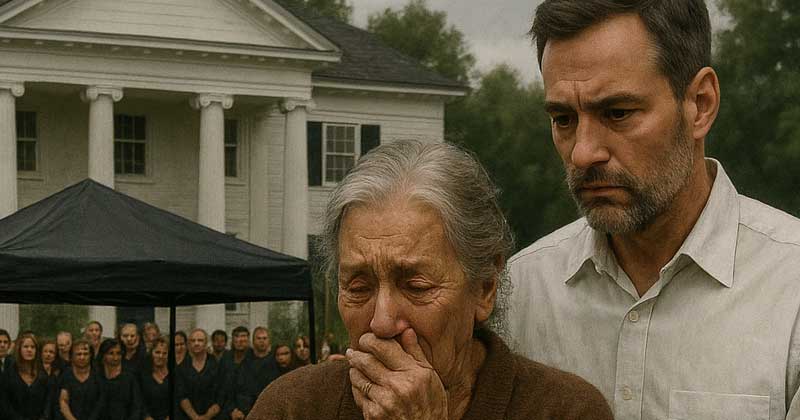
…she had taken her last breath. Next to her, in another coffin, lay her child, wrapped in a small shroud, white as snow. I felt the ground shake beneath my feet. A scream echoed in my chest, but the voice would not come out. The whole world turned to ashes.
I fell to my knees beside the coffins, trembling and with tear-filled eyes. It smelled of incense and damp earth. The entire yard was filled with neighbors, relatives, people murmuring prayers and words I could no longer hear. In my mind, only my daughter’s voice echoed: “Mother, take me with you…”
I touched the cold white cloth covering her coffin with my hands. I wanted to call her, to shake her, to pull her back to life. I wished I had defied shame, the words of the world, and gone after her on those nights. But I did not. And now, before my eyes, lay the cruelest price of waiting.
An older woman from the village approached me and, in a low voice, said:
— “She died burning from within, dear daughter-in-law. She had no milk, no food, no comfort. And the child faded away with her.”
I felt my blood stop. I looked at her in-laws, who sat silently, their eyes downcast. No one had the courage to look me in the eye. In the village, it was said she was treated as a burden, that she was made to work even after giving birth, that she had no rest or solace. And I, her mother, listened more to the fear of the world than to the voice of my child.
In that moment, I felt my whole life collapse. I understood what the old saying meant: “A mother’s eye sees far, but shame binds her hands.”
People began the burial ritual. The men lifted the coffins onto their shoulders, while the women scattered marigold flowers along the path. In the village, this is how it is done: the road to the cemetery must be strewn with flowers, so the souls of the departed can find peace. I walked behind them, barely holding myself up, tears streaming down my face. My husband, though a strong man, cried like a child.
At the edge of the village, when the priest began the service, I raised my eyes to the sky and swore: “My daughter, forgive me! In life, I could not save you, but in death, I promise that no one will ever mock your memory again.”
Returning home was an open wound. The house was empty, but the phone still held my daughter’s last calls. I listened to them again, sobbing. And then I understood that not only she and the child had died, but also a part of me.
The days that followed were hell. But the people in the village, young and old mothers, came to me and shared similar stories. Each had a hidden wound, each knew of a daughter-in-law who had been made to work too soon, each knew of a woman who had cried in silence. And I realized that my daughter’s story was not just mine, but that of many mothers in this country.
Since then, I vowed to speak, to no longer remain silent. At every memorial, when I share coliva and wine, I tell the women: “Listen to your children! Do not be ashamed! Their lives are more precious than the gossip of the village.” And I see how, one by one, the mothers begin to find courage.
Today, at my daughter’s grave, people come not only to light a candle but also to ease their own pains. Her simple cross, with her name written on a board, has become a place of prayer and confession. And every time I hear a woman’s sigh, I seem to hear her voice again: “Mother, take me with you…”
But this time I can no longer take her. All I can do is raise my voice in her name and ensure that no other mother will ever have to cry beside two coffins side by side.
And so, my story, filled with tears and pain, has become a cry for all mothers: never let fear and shame close your hearts. For sometimes, a simple embrace, a timely decision, can save a life.
That was the lesson my daughter left me, and I carry it in my soul, like a living icon.
This work is inspired by real events and people, but has been fictionalized for creative purposes. Names, characters, and details have been changed to protect privacy and enhance the narrative. Any resemblance to real persons, living or dead, or to real events is purely coincidental and not intended by the author.
The author and publisher do not assume responsibility for the accuracy of events or for the portrayal of characters and are not liable for any misinterpretations. This story is provided “as is,” and any opinions expressed belong to the characters and do not reflect the views of the author or publisher.


