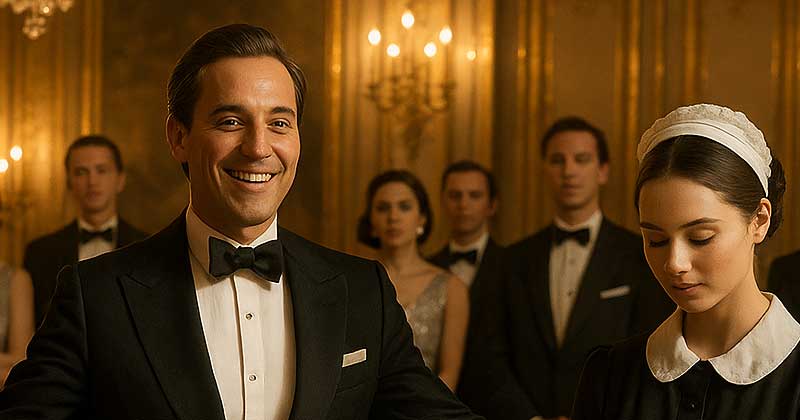
Lucia felt her heart pounding wildly in her chest. It was not just the shame that enveloped her like a flame, but also the heavy, disdainful gazes piercing her from all sides. She pressed her lips together and raised her eyes to Javier. His mocking smile told her everything: it was just a cruel game meant to entertain the bored aristocracy.
But in that moment, a force awakened within her that she had never felt before. It was not the desire to flee, but to respond. Not with tears, not with submission, but with dignity.
—Alright, she said, placing the tray on a nearby table. Let’s dance.
The silence that fell over the salon was sharp. Even the laughter faded, as if the air had retreated from the room. Javier stood still for a few seconds, surprised by her courage. Then, trying to regain his composure, he took her hand.
The orchestra, seemingly hypnotized, began to play a dramatic tango.
Lucia stepped alongside him on the shiny marble, and her simple dress, hidden beneath her uniform, revealed a femininity that no one had suspected. Her movements were confident, delicate, full of grace, as if the tango had lived in her blood all along.
The guests, astonished, leaned towards each other, whispering in fear: who was this girl, after all?
As the dance continued, Javier began to feel the ground slipping from under his feet. He was used to leading, but now he was being led. Lucia’s gaze burned, and her steps wrote a story of strength and freedom. She was no longer the invisible girl with a white apron. She was a woman turning humiliation into victory.
When the music reached its peak, Lucia suddenly broke away, leaving Javier alone in the middle of the salon. She made a short bow and, with astonishing calm, said:
—Thank you for the dance, Mr. Montero.
A heavy silence enveloped the room. No laughter could be heard, no whispers. Only applause erupted from somewhere in the back, then more and more, until the entire hall was applauding. Not for Javier, but for her.
He stood frozen, with the champagne glass trembling in his hand. His cruel game had turned against him.
Lucia, with calm steps, exited the salon. The cool night air of Madrid enveloped her like a blessing. She knew her life would never be the same.
Years later, people still spoke of that night as a legend. About the simple girl who, in a palace full of luxury, had the courage to turn mockery into a lesson of dignity.
And while in Spain the story was written in marble and under chandeliers, in Romania, people told it like a ballad, just as they speak of Ana lui Manole or Maria Doamna. Because in the heart of a Romanian, true nobility does not lie in wealth, but in the power to hold your head high when everyone wants you to bow.
Thus, the legend is born. From a tango, from a refusal, from a woman who refused to be humiliated.
And from that night until today, no one has laughed at the name Lucia Morales again.
This work is inspired by real events and people, but has been fictionalized for creative purposes. Names, characters, and details have been changed to protect privacy and enhance the narrative. Any resemblance to real persons, living or dead, or to real events is purely coincidental and not intended by the author.
The author and publisher do not assume responsibility for the accuracy of events or for how characters are portrayed and are not liable for any misinterpretations. This story is provided “as is,” and any opinions expressed belong to the characters and do not reflect the views of the author or publisher.


Related Posts

She Saw Her Husband with Another Woman — and Paid the Bill Without Saying a Word
October 21, 2025
I wanted to surprise my husband at work with his favorite lunch. Instead, I discovered a secret that could have destroyed my life
October 21, 2025