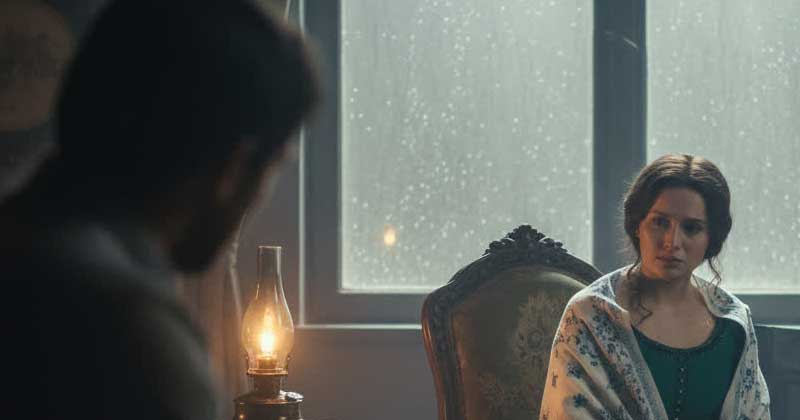
His eyes filled with tears. Not because he was facing a woman who couldn’t stand, but because her body bore the marks of pain she had never voiced aloud.
On Livia’s back, hidden beneath lace, deep scars were visible, like lines of healed fire. Horia gently touched one of them, as if he were caressing a living wound.
“Who did this to you?” he asked in a hushed voice.
Livia bit her lip and turned away. She was silent for a few moments, then whispered,
“Not the accident, Horia… Not the car. But the man I was with then.”
The air in the room stopped. The rain tapped softly on the window, like a prayer.
“Did he hit you?” he asked, with a pain in his voice he had never felt before.
Livia nodded affirmatively, and tears streamed down her cheeks.
“He made me believe I deserved this. That no one would love me if I left him. And one night, when I tried to escape, he swerved the wheel…”
Horia covered his face with his hands. For a moment, his world collapsed. But not out of anger, rather out of helplessness.
He remained like that for a few minutes, then approached and wiped her tears.
“From now on, no one will hurt you. Not even the memory.”
He carefully wrapped her up, kissed her forehead, and lay down next to her without saying anything. He just held her hand tightly until morning.
The sun rose timidly, illuminating their room like an altar. Livia woke up first and watched him sleep. He had traces of fatigue on his face, but also a peace she had never seen in anyone.
In the following months, their life was filled with small gestures: a hurried breakfast, a flower placed in a glass, a slow walk in the yard. Horia had learned to lift her without making her feel helpless, and Livia had learned to laugh again.
Then, one day, she said to him:
“Horia, I want to go back to school. Not as a student, but as a teacher.”
He looked at her in surprise, then smiled:
“Then we will build the most beautiful ramp in the world at the entrance.”
And so it was. In the fall, Livia returned to the school where she had once dreamed of teaching. The children awaited her with flowers, and the principal, with tears in his eyes, said to her:
“You haven’t lost anything, Livia. You’ve gained something greater: the power to uplift souls, even if you cannot stand.”
In a corner of the classroom, Horia watched her proudly, wearing a clean shirt and his hands still marked with traces of lime.
Because some miracles are not made of light and angels, but of dust, sweat, and true love.
And Horia and Livia were living proof that true strength does not lie in standing, but in the heart.
This work is inspired by real events and people, but has been fictionalized for creative purposes. Names, characters, and details have been changed to protect privacy and enhance the narrative. Any resemblance to real persons, living or dead, or actual events is purely coincidental and not intended by the author.
The author and publisher do not assume responsibility for the accuracy of events or the portrayal of characters and are not liable for any misinterpretations. This story is provided “as is,” and any opinions expressed belong to the characters and do not reflect the views of the author or publisher.


