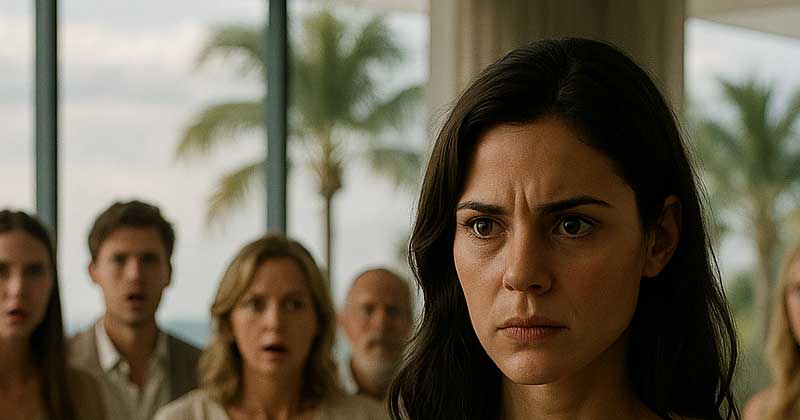
On Friday, at the appointed hour, I stepped into the courtyard of the beach house. The air smelled of salt and impending storm, and the sea crashed violently against the rocks, as if it knew that something was about to change that day.
Camille and the others were already there. I saw their cars parked carelessly, as if they were the masters of the place. I could hear them laughing from the living room, voices that once were so familiar to me, but now echoed like cold reminders.
When I opened the gate, the doorman looked at me for a long moment. He nodded, and for the first time in ten years, I felt that someone recognized me. Not just on paper, but in my rightful place to be there.
I entered without knocking. The laughter stopped abruptly. All eyes turned to me, as if they had seen a ghost. Camille dropped her wine glass, trembling. My mother pressed her lips into a thin line, trying to maintain her composure.
“What are you doing here?” she burst out.
I took a deep breath and raised my gaze to the portrait of my father still hanging on the living room wall. His eyes seemed to encourage me.
“I came home,” I replied calmly. “Where I should have always been.”
I placed the file with the documents on the table. The silence that followed was heavier than any shout. Camille rushed to the paper, reading line after line, and her face turned pale.
“No… it’s not possible,” she whispered.
“It’s legal. And it’s final,” I continued. “Dad never left me out of his heart, even though you tried.”
My mother pushed her chair back, the creaking wood sounding like a final protest. But neither she nor the others could say anything.
In my soul, there was no triumph, but a bitter calm. I had grown up in a family where Sunday dinners were sacred, where the air smelled of stuffed cabbage, sweet bread, and wood burning in the stove. Where my father gathered us and told stories about his hometown, about the church bells ringing on Easter mornings. All of it had vanished with my exclusion.
Now, however, I had the chance to rebuild something. Not for them, but for myself. And for my father’s memory.
“You have until Sunday to gather your things,” I said firmly. “After that, the house remains in my care.”
Camille burst into tears. Uncle Roger tried to say something, but I raised my hand.
“There’s no room for negotiation. You chose to erase me. I chose to survive. And Dad… Dad chose me.”
I stepped outside and took a deep breath of the salty air. Beyond the waves, the sun began to set, painting the sky in shades of orange and purple.
For the first time in years, I no longer felt invited or excluded. I felt like the owner of my own destiny.
And, in the sea breeze, I seemed to hear my father’s whisper: “Clara, never let anyone dim your light.”
The house was not just mine. It was a new beginning. It was the place where pain transformed into strength, and loneliness into freedom.
And, although my family had lost the right to sit at the same table with me, I knew that deep in my heart, I would always keep the memory of what our shared love once was.
But this time, I was the one setting the rules.
This work is inspired by real events and people, but has been fictionalized for creative purposes. Names, characters, and details have been changed to protect privacy and enhance the narrative. Any resemblance to real persons, living or dead, or to real events is purely coincidental and not intended by the author.
The author and publisher do not assume responsibility for the accuracy of events or for how characters are portrayed and are not liable for any misinterpretations. This story is provided “as is,” and any opinions expressed belong to the characters and do not reflect the views of the author or publisher.


