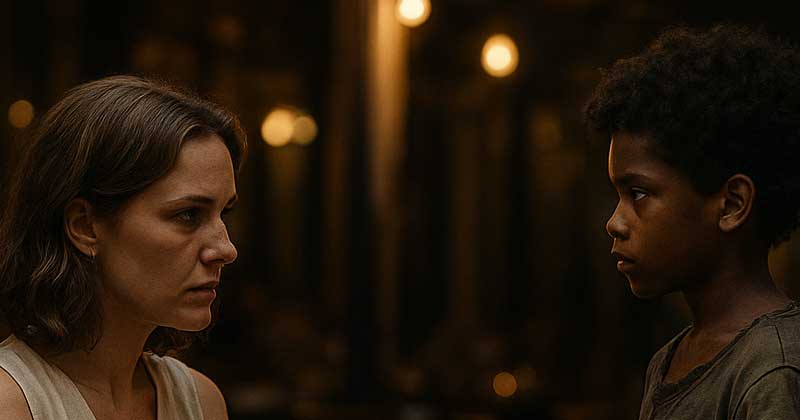
From that moment, Carolina’s life began to shake to its core. It was no longer just a recovery attempt, but a direct challenge to her beliefs. In the eyes of that child, she saw a light that sophisticated doctors had never possessed: hope mixed with stubbornness.
Marcus appeared again the next day, with his hurried steps and attentive eyes, sitting in front of her wheelchair. He had no equipment, no titles, but he had a confidence that unsettled her. He extended his thin hands and said, “Today we begin.”
Carolina felt a lump in her throat. For years, she had not exercised without the supervision of specialists. Yet, this boy acted like an experienced coach. He urged her to breathe deeply, to lift her arms, to let her back relax. At first, it seemed ridiculous. But with every movement, with every careful touch, she felt her forgotten body responding.
As Marcus guided her, she remembered her childhood in Romania. She had grown up in a small village where people only got up from the table once everyone was full, and neighbors never let anyone go hungry. She recalled how her grandmother would pull her by the hand to fetch water from the well, how the village elders told her that strength does not lie in muscles, but in patience and faith.
With each meeting, Carolina began to rediscover something she had lost. Marcus did not speak to her as a patient, but as a person who could try again. He always told her, “If you want to walk, you must remember that your legs have not forgotten you. You have forgotten them.”
Days passed, and a small group of curious onlookers gathered around them. People from the neighborhood saw how the millionaire and the poor boy worked together, and each brought something: a bottle of cold water, a clean towel, sometimes even a plate of stuffed cabbage or a piece of warm bread. The atmosphere resembled the old Romanian customs, when neighbors gathered to help each other.
Carolina had begun to laugh again. She woke up in the morning with the excitement that Marcus would come, with the desire to try something new. She felt the burn in her leg muscles, a sign that deep down, life still existed.
One evening, after a session tougher than usual, Marcus said to her, “You don’t have to give me anything in exchange for the food. I have learned more from you than you could believe. You have shown me that no matter how low you go, there is always a way to rise.”
Carolina remained silent. In her heart, a pang of emotion brought tears to her eyes. She realized that this boy was not just asking for food, but giving her a reason to believe again.
And then something happened that no one had foreseen. On a cool morning, as the sun barely rose over the city, Carolina stood up supported by Marcus’s arms. Her legs trembled, each step was a struggle, but she was standing. The people around burst into applause, and Marcus, with moist eyes, whispered, “I told you it was possible.”
From that moment on, Carolina was no longer just the wealthy and isolated woman from the penthouse. She was living proof that hope can be reborn even from the deepest falls. And Marcus was no longer just a hungry boy. He was the hero who proved that true strength does not come from degrees or money, but from the heart.
The two had intertwined their destinies in an unexpected way. Carolina began to invest in recovery centers for underprivileged children, inspired by the boy’s courage. And Marcus, with her support, continued his education, dreaming of becoming a physiotherapist.
Their story spread like wildfire, not just in the neighborhood, but around the world. And all who heard it understood the same thing: that sometimes, the greatest miracles are born from the smallest gestures.
For Carolina and Marcus, life was no longer about what they had lost, but about what they had discovered together – the power to lift not just bodies, but also souls.
This work is inspired by real events and people, but has been fictionalized for creative purposes. Names, characters, and details have been changed to protect privacy and enhance the narrative. Any resemblance to real persons, living or dead, or to real events is purely coincidental and not intended by the author.
The author and publisher do not assume responsibility for the accuracy of events or for how characters are portrayed and are not liable for any misinterpretations. This story is provided “as is,” and any opinions expressed belong to the characters and do not reflect the views of the author or publisher.


