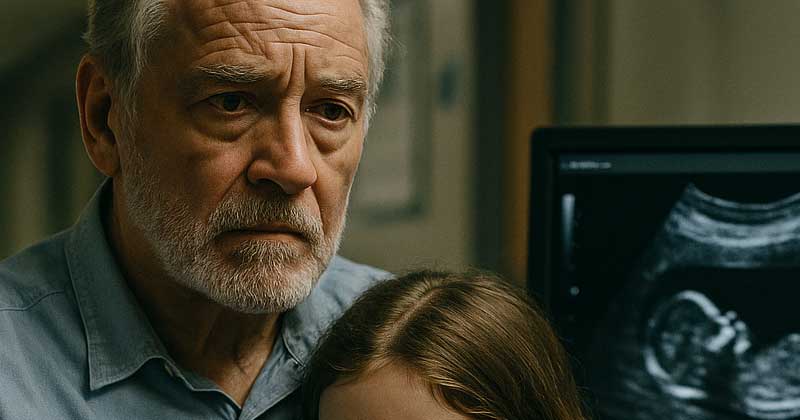
Dr. Benedescu suppressed her emotions, recalling all the delicate cases she had encountered. But none compared to this one. She faced a girl who was silently pleading for help, while her father waited just outside the door, ready to come in again.
Ana covered her face with her hands and trembled. “Please, don’t say… he will get angry,” she murmured, barely audible.
The doctor felt her stomach tighten. This was not just a medical issue. It was something more. It was a silent cry, cloaked in fear.
In a moment of inspiration, she remembered her own childhood in the countryside, the women who whispered stories at the well, their quiet solidarity, the power of supporting one another. She told herself that it was now her turn to be that support.
“Ana, you are safe here. I promise. But I need to know the truth so I can help you,” she said, trying to convey warmth and courage through her voice.
The girl lowered her hands. Her eyes were red from crying, but in that gaze, a glimmer of hope appeared.
“I can’t… if he finds out… I can’t,” she whispered.
The doctor understood. She signaled to the nurse and urgently requested an emergency psychological consultation and the involvement of social services. As the paperwork was being prepared, she made a quick decision: the father must not be allowed to find out yet.
When Radu entered again, the doctor’s voice was firm: “We need some additional investigations. I will stay with Ana, and I ask you to wait outside.”
His gaze was cold, but he did not comment. He left, slamming the door, and the clinic was momentarily engulfed in silence.
Ana burst into tears again, but now the tears were different. For the first time, she felt heard.
The doctor began to ask her questions carefully, without pressure. The answers came slowly, through sobs, but each word revealed a painful truth. It was clear: the girl lived in daily terror, and the pregnancy was not an innocent accident.
In a world where too many choose to remain silent, the doctor knew that silence was not an option.
She remembered the Romanian traditions, the stories of mothers who protected their young at all costs, the icons in her grandparents’ homes where the Virgin Mary always watched over the children. She felt that she was now called to be that shield.
Heavy footsteps echoed in the hallway. Radu had returned, impatient.
The doctor stepped out before he could enter. “Mr. Carter, we will need to conclude today’s visit and return for results. In the meantime, Ana will remain here for monitoring. It is medical protocol,” she said firmly, her gaze fixed on his eyes.
He seemed ready to explode, but the doctor’s calm authority stopped him.
When he finally left, the room filled with a heavy silence. Ana breathed deeply, as if for the first time in a long while she had air.
That day did not just bring a diagnosis. It brought the beginning of a rescue. Because beyond the cold walls of the clinic, there was a world ready to judge her, but also people prepared to defend her.
Dr. Benedescu knew that a long battle lay ahead, with laws, authorities, and the shadows of a troubled family. But looking at Ana, she told herself it was worth it.
Because in Romania, like anywhere else, a child should not bear the burden of such great suffering. And because sometimes, courage begins with a simple “I won’t tell him now.”
And that “no” was going to change everything.