With a wet face, he looked into the makeshift mirror of the water and barely recognized himself. The man who had once been cheered at the finish line was now just a shadow. But somewhere deep in his soul, the spark of an unyielding will still smoldered.
On the nearby cobbled street, the hustle and bustle of the market reminded him of his childhood in a village near Brașov, where people greeted their neighbors with a warm loaf of bread or a cup of fresh milk. There he learned, as a child, what work and dignity meant.
And there, on the dusty lane, he had first laid his hands on the steering wheel of an old Dacia belonging to a neighbor. He remembered how his heart raced, how the wheels bit into the road, and how he felt freedom in every fiber of his being.
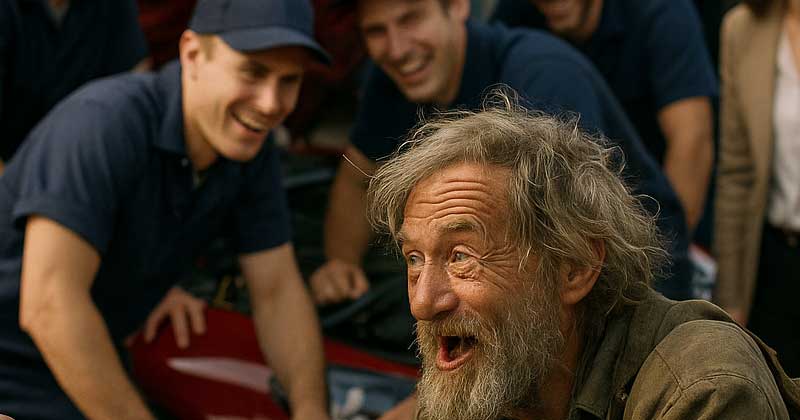
A group of mechanics now looked at him with disdain, laughing when he, trembling and hungry, told them he could fix their broken truck engine for just a bowl of food.
“This guy? This guy is going to touch the keys? Poor him!” one of the young men burst out laughing.
However, Alexandru did not react. In his eyes, there was no longer shame or anger, just the silence of those who have seen too much. He rolled up his sleeves, and his fingers, though trembling, remembered the precise, instinctive gestures of a master of driving and mechanics.
In a few moments, the stubborn screws gave way, the carburetor came to life, and the engine coughed, then roared with a forgotten strength. The silence that fell among the mechanics was heavier than all the insults thrown.
“How… how did you do that?” one of them stammered.
“With these hands that have held the wheel at 200 km/h through the forests of Romania,” Alexandru replied simply, wiping his palms on his torn pants.
Around him, the market paused for a few moments. People watched a vagabond who had just brought a dead car back to life. And, without realizing it, their gazes began to change. From disdain, respect was born.
An elderly woman from the market, with her scarf tied under her chin, approached and handed him a warm loaf of bread. She said nothing. But in that simple gesture, Alexandru found for the first time in many years the taste of dignity.
The young mechanic lowered his eyes and, embarrassed, brought him a plate of stew.
And in that moment, Alexandru understood that it was not the end of the road. That life, like rallies, had dangerous curves, but also straight lines where you could accelerate again.
With each bite, he felt his body strengthen and his soul rise. He was no longer just a man on the street. He was once again Alexandru Vega, the legend who had not died, but had only hidden under the dust of time.
And, in the midst of the Romanian market, with the smell of bread, noise, and simple people, he found his place among his own again. A fallen man, but not defeated.
And thus, his story was no longer one of decline, but of rebirth.
This work is inspired by real events and people, but has been fictionalized for creative purposes. Names, characters, and details have been changed to protect privacy and enhance the narrative. Any resemblance to real persons, living or dead, or to real events is purely coincidental and not intended by the author.
The author and publisher do not assume responsibility for the accuracy of events or for how characters are portrayed and are not liable for any misinterpretations. This story is provided “as is,” and any opinions expressed belong to the characters and do not reflect the views of the author or publisher.


