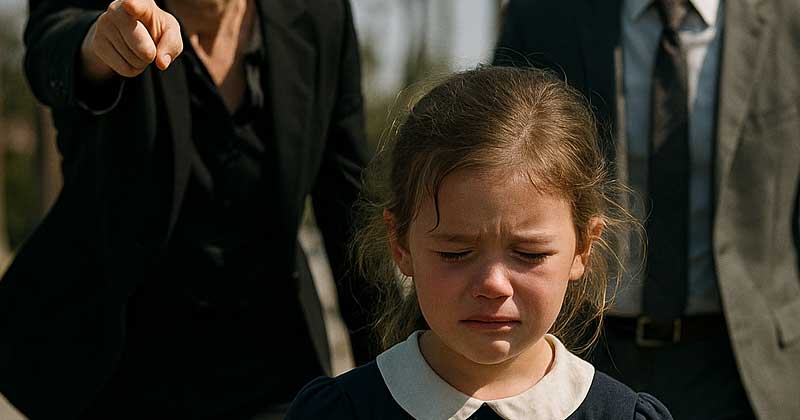
Michael led Emily to a sleek black car, different from the shiny opulence of Linda’s Mercedes. The back door opened smoothly, and the little girl climbed in hesitantly, clutching her backpack to her chest like an anchor. In the silence of the drive, the engine hummed barely perceptibly, and Emily’s eyes followed the city lights, which gradually faded away.
Before long, the car stopped in front of an imposing building in downtown Los Angeles. It was not just an office, but the place where Daniel Carter had left his final mark on the world. Harrington helped her out and, with measured steps, led her inside.
The office smelled of old wood and leather, and the walls were lined with legal volumes. On a shelf, discreetly placed, a photograph of Daniel and Emily smiled on a summer day. The girl’s eyes filled with tears again, and Harrington gently touched her shoulder.
“Your father left something for you, Emily. Not just memories.”
She opened a drawer and pulled out a thick, sealed folder. The cover simply read: “The Will of Daniel Carter”. Harrington broke the seal with a decisive gesture and began to read.
“I, Daniel Carter, being of sound mind, leave everything I have to my daughter, Emily Carter. I wish for her a protected childhood and a life in which she lacks for nothing. I entrust my attorney, Michael Harrington, to ensure that these wishes are respected.”
The words echoed in the room like a sentence. Emily looked up, not yet fully understanding the weight of that moment. But Harrington knew: Linda not only had no right to leave her on the streets, but also no claim to Daniel’s estate.
“You are the heir, Emily. Everything your father built belongs to you.”
The little girl shook her head, clutching her backpack. For her, wealth did not matter. She wanted her father back, she wanted the evenings when he read her stories, she wanted his comfort. But the reality was different.
Harrington stood up and extended his hand.
“You are not alone. In Romania, we have a saying: ‘A person sanctifies the place.’ Your father sanctified this place with his kindness and hard work. I will make sure you are well taken care of.”
Emily did not fully understand the saying, but the man’s warm tone brought her a sense of peace.
In the following days, the rumor about the will spread. Linda, blinded by rage, tried to contest the documents. However, tradition and law were clear: the wishes of the deceased could not be overturned so easily.
The ensuing trial attracted media attention. Headlines screamed about the “heiress girl” and the “rejected widow.” Emily, however, remained far from the noise of the world. Harrington had brought her to a quiet house, where chamomile flowers grew in the garden, reminding her of Romanian stories where grandmothers brewed tea for the soul’s comfort.
One evening, Harrington read the will to her again, this time emphasizing the last sentence: “I wish for Emily to live in a house where love is greater than wealth.”
Then, for the first time in a long time, the little girl felt her heart warm. She now understood that her father had left her not only material goods but also a path: to seek love, not just wealth.
When the trial concluded, Linda lost everything. She left her lavish villa and, like a character from Romanian fairy tales receiving her punishment, disappeared into anonymity.
Emily remained in the care of Harrington, but also of a community that began to see her not as the “rich girl,” but as a child with a story worthy of respect.
Years passed, and she grew wise, keeping her father’s words in her heart: love above all. One day, while watching the sunrise over the Pacific, she remembered another sunrise her father admired in Romania, on the peaks of the Carpathians, where people still greet each other in the morning with “God help us.”
She smiled and whispered to herself:
“God help me to be worthy of what you left me, father.”
Thus, the story that began with tears and abandonment closed with strength and light. Emily was no longer the lost girl on a foreign boulevard. She was the heir of an unwavering love and a tradition that said that no matter how great the storm, the sun rises again.
This work is inspired by real events and people, but has been fictionalized for creative purposes. Names, characters, and details have been changed to protect privacy and enhance the narrative. Any resemblance to real persons, living or dead, or to real events is purely coincidental and not intended by the author.
The author and publisher do not assume responsibility for the accuracy of events or for how characters are portrayed and are not liable for any misinterpretations. This story is provided “as is,” and any opinions expressed belong to the characters and do not reflect the views of the author or publisher.


