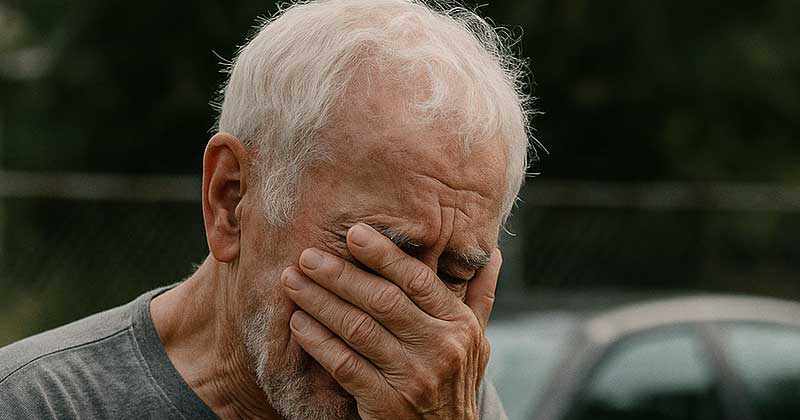
From behind the fence, an old neighbor, Ion, slowly approached, leaning on a cane. He looked at me with wide eyes, filled with wonder and concern.
— Gheorghe, what happened here? Why are your things on the road?
I tried to respond, but the words got stuck in my throat. I just pointed to the filled boxes and the locked door. Ion shook his head and came closer, placing his hand on my shoulder.
— Come to my house, don’t stand here like a stranger on the street.
I entered his yard. He offered me a chair at the gate, just as the old folks in the countryside did when they wanted to chat. He placed a glass of cold water from the well on the table, and I sipped from it, trembling.
— You know, Gheorghe, in the old days, people wouldn’t have thrown their parents out of the house for anything in the world, he said, his voice trembling. A parent was sacred, even if they could no longer walk or speak. They kept them close, watched over them.
His words tore at me. I had worked a lifetime for that house. Every brick had been laid by my hands. Every tree in the yard had been planted by me. And now I was a stranger, driven away from there.
I spent the night at Ion’s, but I couldn’t sleep. In my mind, my daughter’s voice echoed, so cold, so determined. “You don’t have much time left…” A sentence that hit me harder than any illness.
In the morning, I stepped in front of Ion’s house. The air smelled of freshly cut hay, just as it always did in the village at the beginning of summer. I remembered my youth, the time when I went to work parties, when the village was united, and everyone supported one another. Back then, the elders were listened to, and their advice was more valuable than money.
At that moment, I decided that I could not remain silent. I would not go to any nursing home; I would not leave the village like a wanderer. It was my land, my house, my lifetime of work. And above all, it was my dignity.
I took the boxes with Ion’s help and brought them to the town hall yard. The mayor, a younger man, looked surprised when he saw me. I told him everything, with a tight heart. The villagers passing by stopped to listen. Soon, the whole story spread from mouth to mouth.
And then something unexpected happened. The villagers gathered at my house’s gate. They knocked on the door and shouted my daughter’s name. Each of them said the same thing: “Isn’t it shameful to throw your father out? He built this house; he raised you here. Without him, you wouldn’t even exist.”
My daughter came out, red-faced, and for the first time, I saw not just anger in her eyes, but also fear. The crowd was holding her accountable. At that moment, she understood that the village was not on her side.
I felt my dignity, crushed that evening, beginning to rise again. I was not alone. I had a community behind me, people who still valued our traditions, who respected the elders.
In the end, my daughter opened the gate and, without saying a word, left. I entered my house again. I placed my hand on the cold wall and felt the warmth of my past.
Then I understood something: a person does not live just for themselves, but also for the memories and roots they leave behind. And no matter how hard old age may be, it must be lived with dignity, not in humiliation.
From that day on, the villagers visited me more often. They brought me food, talked to me, asked about my health. I was not rich, but I was home again. And for the first time in a long time, I felt that my old age was not a curse, but a blessing.
I looked up to the sky and whispered, “Thank you, Lord, for not leaving me alone.”
And so I remained there, in my house, where I belonged, surrounded not by indifference, but by people who still knew what respect and humanity meant.
This work is inspired by real events and people, but has been fictionalized for creative purposes. Names, characters, and details have been changed to protect privacy and enhance the narrative. Any resemblance to real persons, living or dead, or to real events is purely coincidental and not intended by the author.
The author and publisher do not assume responsibility for the accuracy of events or for the portrayal of characters and are not liable for any misinterpretations. This story is provided “as is,” and any opinions expressed belong to the characters and do not reflect the views of the author or publisher.


