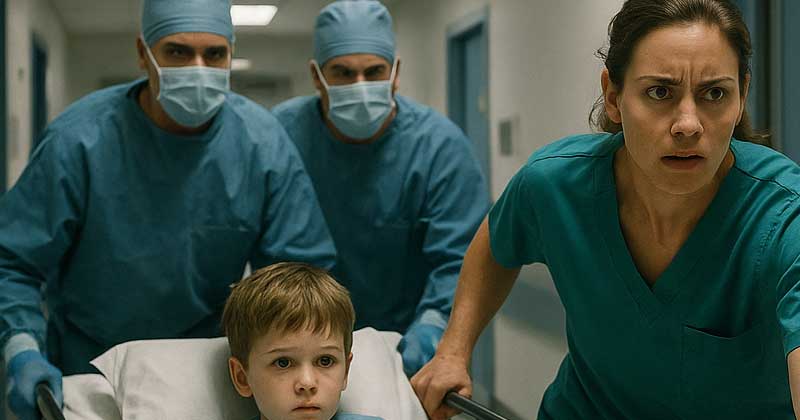
Tests showed that the infection had suddenly decreased, with no clear medical explanation. The kidney parameters were nearly normal, and the boy’s body had begun to fight the disease on its own.
Doctors looked at each other, incredulous. How was this possible? They had planned a life-saving intervention, but the child’s body seemed to have healed at its own pace.
Rex, lying next to the bed, watched intently, his eyes filled with a deep calm, as if he already knew what was about to be discovered.
In that moment, I understood that the animal’s instinct had been stronger than our knowledge. He sensed that the operation was not what was needed, that the child’s body just needed time.
Leo stretched out his arms and hugged Rex around the neck, whispering, “You knew, didn’t you? You always knew.”
The doctors decided to abandon the intervention and continue only with treatment and monitoring. Within a few days, Leo’s tests improved dramatically. By the end of the week, the boy was able to go home, holding onto Rex’s leash, amidst the applause of the medical staff.
For me, that day was a lesson. Medicine saves lives, but sometimes, the soul of an animal and its bond with a child can surpass science.
In Romania, people have always said, “A dog senses what a human does not.” Perhaps I grew up with these words as if they were village superstitions, but after that incident, I know for sure that there is truth hidden in them.
Rex was not just a loyal dog. He was the silent guardian of Leo’s life, a hero with fur and a huge heart, who demonstrated that love and instinct can conquer even the greatest fears.
And as I watched them leave the hospital, the child smiling and the dog proudly beside him, I remembered an old saying from my grandmother: “Whoever has a good dog has a guardian angel.”
Then I understood that, indeed, angels can walk on four legs.