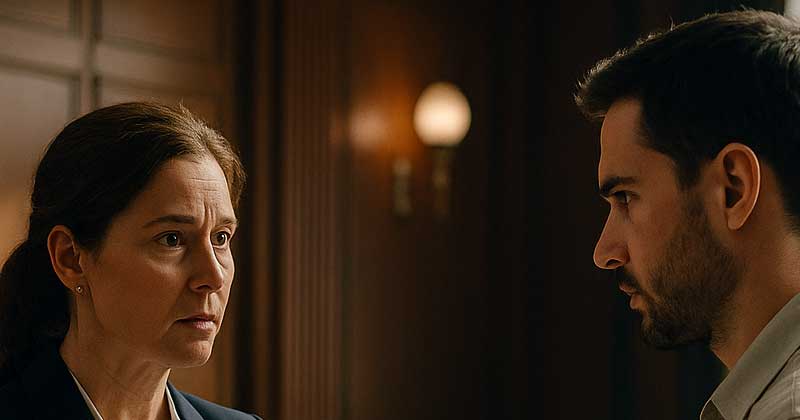
— Please explain your position, — the judge requested.
— The apartment was bought with my parents’ money. They sold their house in the village and gave us most of the amount. And the car is registered in our son, Dănuț’s name.
Mihai jumped to his feet:
— That’s not true! I paid for everything!
— Sit down, — the judge said sternly. — Do you have evidence, Mrs. Irina?
— Yes. My parents are here. And I have documents…
Mihai felt as if he had been splashed with cold water. His mother-in-law stood up from the back:
— My husband and I contributed three-quarters of the money for the apartment. We have the papers and bank statements.
— Nonsense! — Mihai turned to his lawyer. — Tell them!
The lawyer was awkwardly flipping through the file.
— I… was not informed about this.
The judge frowned:
— Are there documents confirming the transfer of funds?
— Yes, here you go, — Irina pulled a folder from her bag. — A donation deed and my parents’ bank statements.
Mihai couldn’t believe his ears.
— Irina, what are you doing? We agreed on something else…
The room fell silent. The rustling of papers, the clerk’s footsteps, and the heavy breaths of those in the back made the atmosphere even more tense.
Mihai felt his legs giving way beneath him. For twenty years, he had been the master of the house, the one who decided every move, every expense, and now, in a matter of moments, all his confidence was crumbling.
The judge took the documents, flipped through them carefully, and looked up at him.
— Mr. Socolov, if these documents are authentic, your position becomes fragile.
Mihai wiped his forehead, trying to gather his words. Every gaze in the room pierced him — his father-in-law with his cane, his mother-in-law frowning, Irina’s brother with his arms crossed. And, most importantly, Irina. She was no longer the resigned woman who always stayed silent. Now she stood tall, with clear eyes, as if she had become the girl she once was, who knew what she wanted.
— I worked! — Mihai burst out. — I toiled for that house for twenty years!
— And I worked too, Mihai, — Irina replied calmly. — It’s just that you never considered my work. Have you forgotten how many nights I stayed on guard, how many patients I lifted from their beds? Have you forgotten that I laid the foundation of the house with my parents’ money?
Her words took his breath away. In the room, a few people nodded in agreement. These were things they had never openly discussed. Mihai felt his back dampening.
The judge called for silence. Then, in a clear voice, she dictated to the clerk:
— The presented documents will be attached to the case file. The court finds that there is evidence regarding the wife’s family’s contribution to the purchase of the apartment. As for the car, if it is registered in the son’s name, it does not enter the division.
Mihai froze. His car, his apartment… were slipping through his fingers.
However, Irina was not rejoicing. She clasped her hands in her lap, trembling. She was not fighting to destroy him, but to reclaim her dignity.
In Mihai’s mind, scenes from the past began to unfold. When they first moved into the apartment, her parents had brought sacks of potatoes, apples, and homemade wine. He had laughed then, saying they lived like in the countryside. But that food had kept them on their feet for months. He remembered the winter holidays when Irina prepared stuffed cabbage, sweet bread, and waited for her parents to come with the blessed basil from Epiphany. All those memories, which he had despised, now burned in his chest.
The judge continued:
— The court will analyze the division of savings, but the apartment cannot be considered solely the claimant’s. There is clear evidence of contribution from the wife’s family.
The words fell like hammer blows. Mihai clenched his fists, but he had no more retorts.
Irina, with a trembling voice, added:
— I don’t want to take anything extra; I just want justice. I want our son to know that I was not a parasite, as you tried to make me seem.
In the corner of the room, the father-in-law tapped his cane on the floor, as a sign of approval. The mother-in-law made the sign of the cross, whispering something under her breath. They were simple, Romanian gestures, but full of weight.
Mihai felt a lump in his throat. The entire wall of authority he had built was collapsing. In front of everyone, he was no longer the man who “paid for everything.” He was just a man caught in his own lie, in his own pride.
When the session ended, the judge postponed the ruling. Everyone stood up. Mihai remained in his seat, unable to move. Irina walked past him, and for the first time in many years, she said gently:
— It was never just about money, Mihai. It was about respect.
She left the room, followed by her parents and brother. Mihai was left alone, with the lawyer hurriedly gathering his papers.
In that heavy silence, Mihai understood something he had never acknowledged: that he had lost much more than a house or a car. He had lost family, lost love, lost respect. And all of it, out of pride.
And the true verdict did not come from the court. It was already written in Irina’s eyes, in the rejection of their son, in the silence of his own conscience.
And for the first time, Mihai felt what it truly meant to be left with empty hands.


