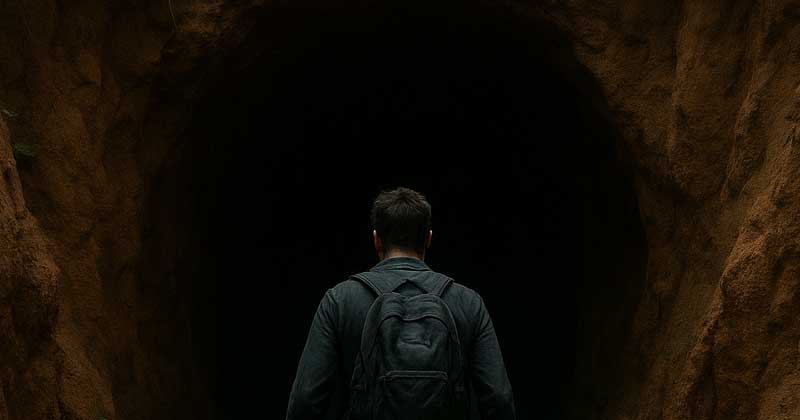
A few steps into the corridor, the lantern’s light began to reveal strange shapes. At first, the farmer thought they were just wet stones, but as he approached, he realized they were smooth walls, carefully crafted, as if shaped by human hands long ago.
His heart began to race. Beneath his modest farm lay a passage that could not be the work of nature. He touched the cold, damp walls and felt strange lines, almost like ancient markings.
He took a few steps forward, and the tunnel widened into a small, round room. The floor was covered with stones laid side by side, and in the center stood a large clay vessel, cracked by time but mostly intact.
The farmer stood still. All his life, he had thought that the earth beneath his homestead held only roots, worms, and stone. And now, in the flickering light of the lantern, he was face to face with a treasure of the past.
He carefully opened the vessel. Inside, wrapped in decaying cloth, were metal objects, some still faintly shining even after all this time. Among them were a few large coins with worn faces and a small silver icon, tarnished by age.
The farmer remembered the stories the elders in the village told during gatherings. It was said that during wars, peasants hid treasures in the ground so that foreign armies would not plunder them. Many never returned to seek them. Perhaps he had stumbled upon such a secret now.
He felt a shiver down his spine. It was not just the discovery of the objects, but the sensation that he was walking in the footsteps of his ancestors. Some of them, perhaps even distant relatives, had left that treasure behind in the hope that one day it would be found.
He sat on a stone and remained silent for a few moments, listening to the echo of his own breath. His thoughts drifted to the hard times the people of the village had endured: invasions, famine, drought. And yet, they had the strength to believe in the future, to carefully hide what they held most dear, leaving a trace for those who would come.
In one corner of the room, the farmer also noticed a small, almost rotting wooden box. With trembling hands, he lifted the lid. Inside were a few old letters, the ink barely visible. He brought them closer to the light and could read a few lines: they were prayers and wishes for descendants, written in an old Romanian that was still understandable.
“Lord, protect our home and those who will come after us…”
His eyes filled with tears. It was not just a hidden tunnel. It was a direct connection between him and those who had lived there hundreds of years ago.
He emerged from the tunnel trembling but with a clear determination. He had no intention of selling anything; he had not found those treasures for money. He would take them to the museum, to keep them safe, so that the entire community would know the story hidden beneath the soil of their village.
That evening, he lit a candle at the icon in his house and said a prayer. He felt that he was no longer just a simple farmer, but a witness to history.
The next day, the villagers gathered in his yard, and the news spread from mouth to mouth faster than the ringing of the church bell. Everyone came to see, to marvel, to remember the stories of their grandparents.
The tunnel discovered after the earthquake was not just a strange occurrence. It was a bridge between the past and the present, between the sufferings and hopes of those long ago and the peaceful life of a farmer today.
And for him, it was proof that sometimes, even a tremor of the earth can bring to light the deepest and most beautiful secrets of the lineage.
This work is inspired by real events and people, but has been fictionalized for creative purposes. Names, characters, and details have been changed to protect privacy and enhance the narrative. Any resemblance to real persons, living or dead, or to real events is purely coincidental and not intended by the author.
The author and publisher do not assume responsibility for the accuracy of events or for the portrayal of characters and are not liable for any misinterpretations. This story is provided “as is,” and any opinions expressed belong to the characters and do not reflect the views of the author or publisher.


