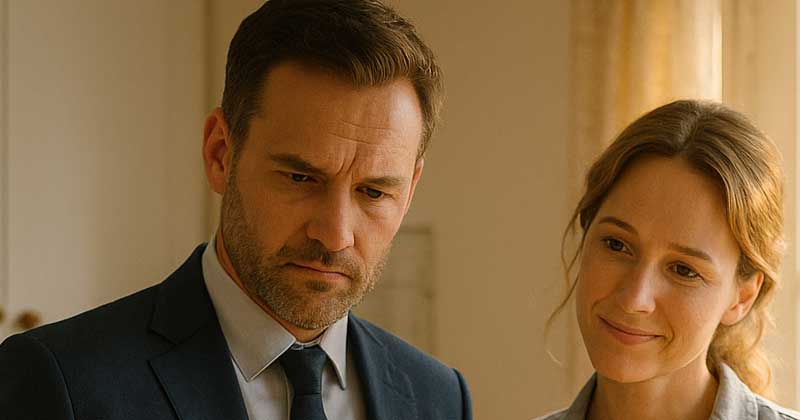
Jacob’s gaze was heavy, but not sharp. It was the look of a man who, for the first time in a long time, was not looking at his wealth, the marble of his house, or the calculations of his business. He was looking at a child.
Maria felt her heart sinking in her chest. Her hands trembled so much that the crucifix in her palm hurt her skin. She expected the worst: dismissal, shame, perhaps even more. In that house, a simple mistake could cost everything.
But then, the multimillionaire took a step forward. And another. And, to Maria’s surprise, not towards her. But towards the child.
He bent down slowly and, with a gentleness that no one would have suspected, touched the little one’s shoulder. The child flinched, frightened. The spoon fell from his hand, hitting the plate. The silence that followed was oppressive.
“What’s your name?” Jacob asked, in a low, almost pleading voice.
The child shook his head. No words. Just big, wet eyes, full of fear and hunger.
Then, the multimillionaire stood up. He looked at Maria and, for the first time, she saw something other than cold power in his eyes. She saw memories. Shadows. Pain.
“Let him eat,” he said slowly. “And bring him more.”
Maria couldn’t believe it. She hurried to refill the bowl, to bring warm milk, to put pieces of cheese and a few apples from the pantry on the table.
The child ate quietly, tears in his eyes, while the man who had billions in his accounts sat in front of him, watching as if witnessing a miracle.
Then, in the silence of the kitchen, Jacob began to speak. Slowly, rarely, with a trembling voice.
“When I was his age… I sat at a gate. Freezing, hungry. My mother died early, my father was always away. I asked for a piece of bread, and the gate was shut in my face.”
Maria felt tears welling up in her eyes. She had never imagined such a thing. In his world of wealth, there seemed to be no room for such heavy memories.
“And then I swore,” Jacob continued, “that if I ever had enough, no child would be sent away from the gate. But… I forgot. I forgot the oath.”
He paused, his gaze lost. Then, as if waking from a dream, he placed his hand on the back of the child’s chair.
“You’re not going anywhere tonight,” he said firmly. “Stay here. At the table. In the warmth.”
Maria could no longer hold back her tears. She clutched her apron with wet hands, feeling that something was changing forever.
In the following days, the child received clean clothes, new shoes, and a small bed in the guest room. Maria watched over him like a mother, and Jacob came in the evenings to see him, setting aside documents and phones.
Neighbors began to talk. In the village, people whispered at the tavern and in front of the church: “Multimillionaire Lanskói brought a poor child to his mansion. Who would have thought?”
But Maria knew the truth. She knew it was not just an act of charity. It was the healing of an old wound.
On a Sunday, when the church bells rang over the hills and people gathered for service, Jacob came hand in hand with the child. He was no longer “the orphan at the gate.” He was “his son.”
The priest, an old man with a white beard, blessed him, and the village fell silent. In that silence, Jacob spoke the words that remained on everyone’s lips:
“There is no greater wealth than to give a child a roof, a meal, and a name.”
And then, people understood. That behind the cold walls of a vast fortune, there could be a warm heart.
Maria smiled through her tears. Because she knew that on that day, in their village, not just a child had been saved. But also the soul of a man.
This work is inspired by real events and people, but has been fictionalized for creative purposes. Names, characters, and details have been changed to protect privacy and enhance the narrative. Any resemblance to real persons, living or dead, or to real events is purely coincidental and not intended by the author.
The author and publisher do not assume responsibility for the accuracy of events or for how characters are portrayed and are not liable for any misinterpretations. This story is provided “as is,” and any opinions expressed belong to the characters and do not reflect the views of the author or publisher.


