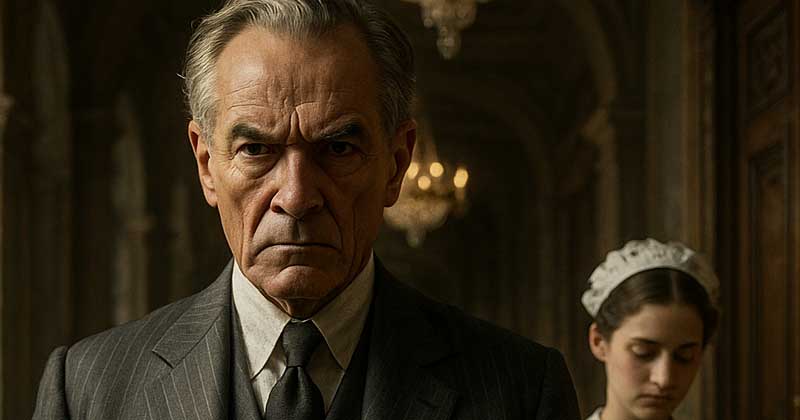
Years passed like the seasons that change the faces of the fields in Romania. Clara left the villa with heavy steps, but with a heart determined not to be defeated. She returned to her hometown, a small place with narrow streets and white houses with red roofs, where people still greeted each other at the gate and where the church bells rang every Sunday morning.
There, life was not easy, but it was pure. With calloused hands and a broken heart, Clara continued her days, carrying in her womb a life that would give her strength. The village looked at her with compassion and mixed gossip, but she held her head high. She had learned from a young age that shame is not determined by others, but by how you live your life.
She gave birth to a baby boy on a quiet winter night, when the snow covered the village like a thick blanket. The village midwife, an elderly woman with a black scarf, watched over her, and the first cry of the child echoed like a promise. Clara named him Andrei, a simple and pure name, just as she wanted her life to be.
Andrei’s childhood years were filled with hardships, but also with love. Clara worked hard: in the fields, in the households of wealthier people, and sometimes at the guesthouse near the monastery where tourists came. She often remembered the grand hotels of Alexander, but not with longing, rather with a bitter calm.
In contrast, Andrei grew beautifully, with bright and clever eyes, with a curiosity that reminded her of his father. He loved to draw and build things from wood, and Clara saw in him not only the trace of the man who had hurt her but also a chance for something better.
Fate, however, has a way of bringing the past back. One summer day, as the village prepared for the feast of “Saint Elijah,” with dances and tables set up in people’s yards, a convoy of luxury cars appeared on the dusty street. People stopped their preparations, and children ran after the black cars, curious.
From one of the cars stepped out Alexander Pierce. A little older, but still imposing, with a cold gaze and measured steps, he was looking for the place where a new tourist complex was to be built.
The meeting was inevitable.
Alexander saw a simple woman, with rolled-up sleeves and a boy who strikingly resembled him, running barefoot through the grass. His gaze broke, and his heart tightened like never before. All the cold decisions, all the harsh words returned to him like blades.
Clara, however, was no longer the same woman who had begged him to listen. She looked him straight in the eye, unafraid.
— This is your son, Alexander. He does not need your money. He needs his dignity.
The crowd in the village murmured, but the respect for Clara’s courage was evident. In that moment, Alexander felt the shame of a man who believed that money gave him the right to decide the fate of others. He saw in Andrei the future he had denied and in Clara the strength he had not understood.
In the days that followed, Alexander tried to repair what he had destroyed. He visited his son slowly, with timid steps. He brought him books and tried to learn how to be a father. The village looked at him with suspicion, but also with a curious hope.
Andrei listened to him, but his love was already anchored in Clara. She had been the one to wipe his tears, to lift him when he fell, to show him how to look at the sky and believe in it.
Alexander’s true redemption did not come from money, nor from grand gestures, but from accepting that power does not lie in control, but in humility.
At the village feast, in front of the entire community, Alexander stood up and said with a trembling voice:
— I was wrong. And I will live my whole life with this mistake. All I ask is the chance to be at least a part of this child’s life.
Clara did not respond immediately. But the people in the village applauded, not for Alexander, but for the woman who, in her silence, had shown everyone that dignity cannot be bought.
The ending was not a fairy tale, but a true life. Alexander remained to come and go, learning to be a father step by step. Clara continued her path, strong and respected. And Andrei grew up knowing that, although his beginning was marked by betrayal, his life was built on the unwavering courage and love of his mother.
This was the true victory. Not of money, nor of power, but of the heart.
This work is inspired by real events and people, but has been fictionalized for creative purposes. Names, characters, and details have been changed to protect privacy and enhance the narrative. Any resemblance to real persons, living or dead, or to real events is purely coincidental and not intended by the author.
The author and publisher do not assume responsibility for the accuracy of events or for how characters are portrayed and are not liable for any misinterpretations. This story is provided “as is,” and any opinions expressed belong to the characters and do not reflect the views of the author or publisher.


