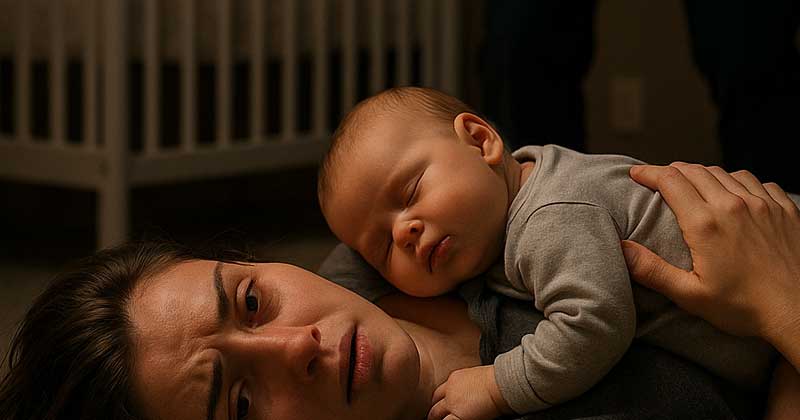
Maya looked at him with fear, the sleeping baby pressed against her chest. The pale light of the lamp cast harsh shadows on Nathaniel’s face, and for a moment, he seemed older, more tired than she had ever seen him.
“Tell me…” she whispered, afraid to wake the baby.
He did not enter immediately. He lingered at the threshold, as if battling with himself. Then he stepped slowly inside and sat on the edge of the little girl’s bed.
“I can’t go on like this,” he murmured, almost to himself. “I can’t hear her crying and feel like I can do nothing. It’s… it’s as if I’m a stranger to my own child.”
Maya felt a lump in her throat. She hadn’t expected such a confession. She had only seen his anger, coldness, distance. Not his vulnerability.
“Children sense when someone rejects them, Mr. Blake,” she said gently. “But they also feel when someone welcomes them with love. Lili knows you want her close; you just don’t know how to show it.”
He ran his hand through his hair, a gesture of helplessness. “I’ve never had patience. My father always said that emotions are for the weak. I tried to do everything by the rules, to appear strong. And now…”
He stopped, looking at his daughter. His eyes misted, but he quickly turned his head away.
Maya remembered the evenings in her village when mothers would step out to the gate to lull their children to sleep, humming “Nani, nani, my little one.” It was something simple, but it came from the heart. It didn’t matter the house, the money, or the rules. What mattered was the warm arm and the heart beating softly next to the child.
“Maybe you should try it too,” she said.
“Try… what?”
“To hold her. To rock her. Not as a duty. As a gift.”
For a moment, Nathaniel remained still. Then, almost uncertain, he extended his arms. Maya gently placed the baby in his hands.
At first, Lili squirmed and whimpered. But when he began to rock her awkwardly, the little one calmed down. His eyes widened, as if he were witnessing a miracle.
“She… calms down,” he whispered.
“Because she feels you are her father,” Maya said with a warm smile. “You don’t have to be perfect. You just need to be present.”
Minutes passed in silence. Only the baby’s breathing and the father’s heartbeat filled the room.
That night, Nathaniel did not leave the room. He stayed in the chair, with his daughter asleep in his arms. For the first time, Maya saw him not as a cold, cruel billionaire, but as a man finding himself through a child.
In the morning, when the sun’s rays filtered through the curtains, Nathaniel was sleeping with Lili tightly against his chest. Maya covered them with a blanket and tiptoed out, leaving them alone.
From then on, everything changed. Nathaniel began to spend evenings in the baby’s room, sometimes singing, other times just whispering stories. He was slowly learning what it meant to be a father.
And Maya, although still a servant on paper, had become the soul of the house. Because she had brought into that cold palace what was truly missing: the warmth of a home.
One Sunday, Nathaniel asked her to show him the songs from her childhood. She began to hum “Nani, nani, my little one,” and he awkwardly repeated the lyrics, but with a full heart. Lili smiled in her sleep, and in that moment, Nathaniel understood: money could not buy that peace, nor the love that was blossoming between them.
The Blake house was no longer made of stone. It was alive. And it all began with a servant who dared to listen to a child’s cry.
The ending was not just about a sleeping girl, but about a man who had finally discovered what it meant to be a father.
This work is inspired by real events and people, but has been fictionalized for creative purposes. Names, characters, and details have been changed to protect privacy and enhance the narrative. Any resemblance to real persons, living or dead, or to real events is purely coincidental and not intended by the author.
The author and publisher do not assume responsibility for the accuracy of events or for how characters are portrayed and are not liable for any misinterpretations. This story is provided “as is,” and any opinions expressed belong to the characters and do not reflect the views of the author or publisher.


