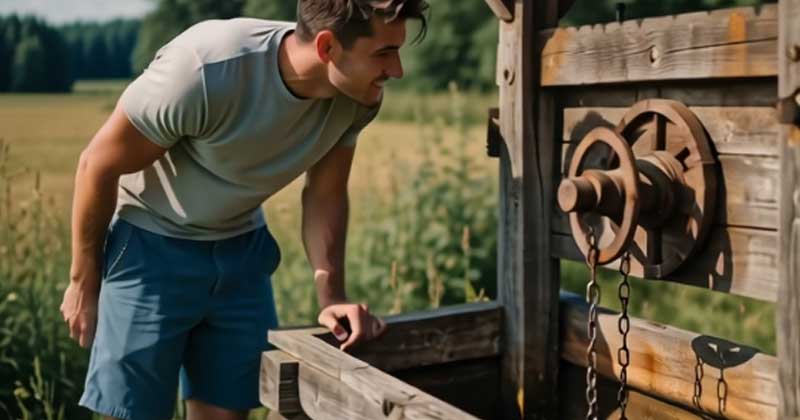
The moment the lantern’s light pierced through the old boards, I felt my blood freeze in my veins. Down, on the damp walls of the well, a whitish silhouette took shape, like a shadow moving slowly. It seemed to be a face, an expression of suffering, with empty eyes staring at me.
My wife let out a short, muffled scream, covering her mouth with her hands. I stood frozen. Part of me wanted to run inside, to shut all the shutters, but another part held me there, the light fixed in the darkness.
From the depths, a faint moan was heard, almost like a sigh. The rusty chain swayed slightly, as if someone had touched it. I took a step back, but then I looked at my wife, who was trembling, and I understood that I had to do something.
— Bring me the hatchet from the shed, I whispered.
She nodded and ran. I was left alone with the well. In the village, the elders had always told stories that abandoned places have their own “voice.” That in old wells, the shadows of those who have left gather, and that the water, even if dry, keeps the memory.
My wife quickly returned with the hatchet. I lifted the rotting boards, and at that moment, a cold wind, even though it was sultry outside, came out of the well. We looked at each other in fear.
— This isn’t normal, I murmured.
The lantern’s light danced on the damp walls, and for a moment, I clearly saw the face of a woman. A young woman, with long hair, wet and stuck to her face. Her gaze was full of sadness, not hatred.
My wife began to cry.
— It’s a soul trapped there… didn’t I tell you it was a voice?
I thought of my mother’s words from childhood: “Don’t throw stones into the well, for you disturb the rest of the waters and those who have drunk from them.”
I closed the lantern for a moment and made the sign of the cross. In Romania, in the villages, people do not joke about these things. Where there is mystery, there is also respect.
I brought a candle from the house from the icon and lit it by the well. The small flame trembled, but it seemed to chase away the cold that had enveloped us. My wife murmured a prayer, and I felt that it was the only way to bring peace to that place.
Suddenly, the chain stopped moving. The moan faded away. And the face… I no longer saw it.
I put the boards back in place and secured them well, so that no one could open it again. The next day, I called the priest from the village. He came with the epitrachelion on his shoulder, looked long at the well, and said only this:
— Something bad happened here. Someone has not moved on.
He blessed the place, sprinkled it with holy water, and read prayers. Neighbors, hearing what had happened, also came. Some knew the story. Many years ago, a girl from the village had disappeared. It was said that she had run away to the city, but the truth was never found out.
We then understood that the well had been her grave. And that her soul was still crying out, asking to be heard.
After the service, the air in the yard seemed lighter. The song of the crickets could be heard again, and the warm wind rustled through the leaves.
In the evening, when we sat down at the table, my wife said softly:
— This is not just a vacation house; it is a house that has chosen us. Here we must take care, respect what was, and live in peace.
I nodded, knowing she was right. That night, I slept for the first time peacefully, without noises, without shadows.
But in my soul, I remained with a certainty: sometimes, in deep Romania, houses and land hide stories older than us. And wells, those gates between water and sky, should never be taken lightly.
That old well was no longer just a place in the yard. It was a lesson, a memory, and a reminder that no matter how much we run from the past, it always finds a way to be heard.


