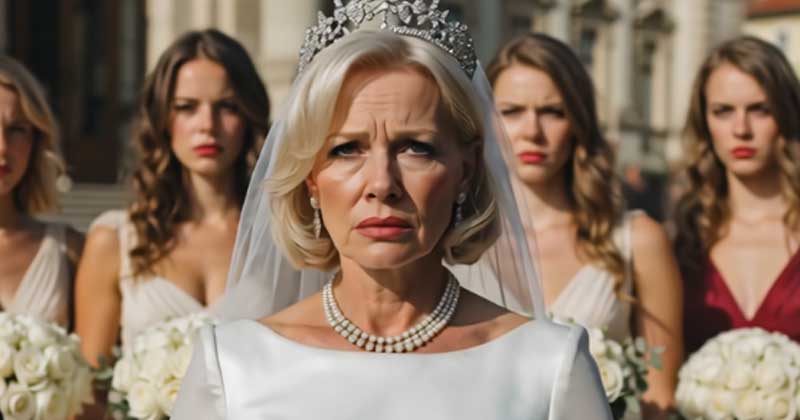
After we exited the church, instead of feeling the joy of that moment, my heart was filled with fire. My groom tried to calm me, whispering that I was the most beautiful and that no one could overshadow our day. But I could see the guests nudging each other, some hiding their ironic smiles.
It wasn’t just the momentary shame. It was the humiliation she had intentionally caused me. And I knew I couldn’t let things stay like this.
At the reception, when everyone had settled at their tables, I waited for the right moment. The music was playing, glasses were clinking, and she, with the air of a queen, sat in the front row, adjusting her white skirt and smiling falsely.
I raised my glass and asked for silence. Everyone turned their gaze towards me. I took a deep breath and said firmly:
— Thank you for coming to be with us on the most important day of our lives. But today I also received a lesson: that not all older people know how to respect the young, and that sometimes selfishness overshadows the joy of others.
I looked her straight in the eye. She lost her smile. Whispers began to echo through the hall.
— And because, in our Romanian tradition, the bride is the only one who wears white on her wedding day, I would like to establish a new custom: to show what respect for this moment means.
I made a discreet signal to my friends. Two of them approached her with polite smiles and said:
— Come on, let us change your outfit, so there’s room for the real bride.
In a few moments, they led her outside. She protested, but the guests began to applaud and laugh, and the applause drowned out any words from her. They brought her back in a simple dress that I had prepared as a backup, colorful and sober.
The entire hall erupted in applause and giggles. I sat down next to my groom, head held high. My mother-in-law, red-faced, no longer dared to say anything.
The atmosphere changed. The music came alive, the guests began to dance, and my day regained its shine. But I knew that my revenge was not just for me, but for every girl who dreams of a wedding without humiliation.
Later, at the cake moment, I decided to put an end to her theatrics. I raised the cake-cutting knife and, looking at her, said:
— This is the symbol of a new life. And just as we will cut our burdens together, we also cut the ties that weigh us down.
I cut the first slice and offered it to my husband. Everyone applauded, while she remained on the sidelines, diminished by the gazes of all.
That evening ended with Romanian dances, cheers, and good cheer. People congratulated me for my courage, and my husband held my hand, proud.
My mother-in-law never wore a white dress to any party again, and since then, she has changed her tone. She never tried to overshadow my joy again.
In my heart, I felt not only that I had reclaimed my day, but that I had defended something greater: respect for our tradition, in which the bride is the queen of the evening. And from then on, I knew that sometimes you have to fight for your happiness, even when the one standing against you is a family member.
It was my day, and I transformed it, with my strength, into the victory of my life.
This work is inspired by real events and people, but has been fictionalized for creative purposes. Names, characters, and details have been changed to protect privacy and enhance the narrative. Any resemblance to real persons, living or dead, or actual events is purely coincidental and not intended by the author.
The author and publisher do not assume responsibility for the accuracy of the events or for how the characters are portrayed and are not liable for any misinterpretations. This story is provided “as is,” and any opinions expressed belong to the characters and do not reflect the views of the author or publisher.


