Bee products have been used for decades in the field of apitherapy. Natural substances, secreted either directly by the bees’ bodies through glands (venom, wax, royal jelly) or collected and processed by bees (nectar, flower pollen, honey), offer significant benefits for the human body, being used both in the treatment of diseases and in their prevention. In recent years, there has been a growing trend to identify bioactive molecules of natural origin, and this trend has also extended to bee products: honey, propolis, royal jelly, bee pollen (the so-called bee bread), and pollen. Bee pollen is a unique bee product that is still relatively unknown.
Studies on the chemical composition of the substance known as bee pollen have shown that it generally consists of water, proteins, free amino acids, carbohydrates, fatty acids, and, most importantly, a wide range of bioactive molecules with therapeutic properties. Of course, bee pollen’s chemical composition varies depending on the climatic conditions of the plants from which the pollen is collected (nectar-producing plants) and seasonal variations. Nevertheless, it has been concluded that bee pollen has extraordinary therapeutic potential, although it is still little known and studied. All these benefits associated with consumption are mainly due to the bioactive molecules.
How is bee pollen obtained?
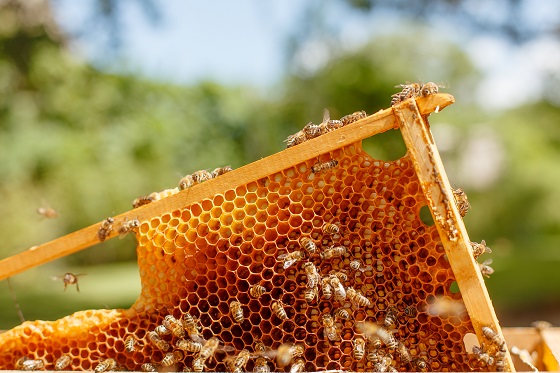
Bee pollen is obtained naturally, being, in fact, the substance that bees consume (hence the name bee bread). During pollination, bees store pollen in the baskets on their hind legs and transport it to the hive. Here, non-flying bees will fill the honeycombs with a mixture of honey and bee pollen and will add a thin layer of wax on top to protect it from contact with oxygen. Naturally, bee pollen will also contain the bees’ digestive enzymes. A lactic fermentation process occurs, influenced by temperature, microbial flora, and humidity (lasting about 3 months), during which the pollen is processed into bee pollen.
Bee Pollen: Therapeutic Properties
Bee pollen is a compound with significant therapeutic properties, primarily used as part of apitherapy (therapy that uses bee products). Studies in the field indicate that this compound exhibits biological activity in a wide range of conditions, due to the bioactive molecules it contains:
Amino Acids: phenylalanine, valine, histidine, methionine, leucine, isoleucine, alanine, arginine, and tyrosine, glutamic acid, aspartic acid, lysine;
Fatty Acids: especially alpha-linolenic acid and arachidonic acid;
Minerals: potassium, phosphorus, calcium, magnesium, iron, sodium, zinc, manganese;
Organic Acids: gluconic acid, formic acid, butyric acid, propionic acid;
Vitamins: alpha-tocopherol and gamma-tocopherol (vitamin E), vitamin C, vitamin A, riboflavin (B2), and thiamine (B1);
Polyphenols: most of the benefits that bee pollen presents are due to these compounds, such as flavonols, flavones, flavanones, quercetin, kaempferol, myricetin, as well as compounds like isorhamnetin and herbacetin (derived from glycosides), apigenin, luteolin, rutin, naringenin;
Beneficial Microorganisms (i.e., Probiotics): Apilactobacillus kunkeei, Lactiplantibacillus plantarum, Fructobacillus fructosus, Levilactobacillus brevis, Lactobacillus delbrueckii, and Lactobacillus musae, Lactobacillus delbrueckii, and others.
Flavonoids, phenolic acids, and other antioxidant compounds in bee pollen are the main substances with biological activity. According to studies, they present significant benefits upon consumption, as they have bio-pharmacological properties in the body. In fact, many studies suggest that bee pollen used as a food preservative or even as a dietary supplement presents an effective therapeutic alternative in combating oxidative stress, thus addressing the wide range of conditions associated with it: cardiovascular, neurodegenerative, or cancerous diseases. Below, we will present several benefits associated with the consumption of this natural product.
Bee Pollen: Benefits Associated with Consumption
Studies have shown that bee pollen presents a wide range of properties that support the overall health of the body. However, many of them have been based either on studies conducted on animals or on studies conducted on cellular models. For this reason, we will focus primarily on the main clinically demonstrated benefits, that is, through observational studies conducted on individuals who have consumed bee pollen in one form or another. It should be noted, on the other hand, that these benefits are not solely due to the administration of bee pollen, but to the administration of this compound as part of a healthy lifestyle, with proper nutrition and physical activity.
1. Hepatoprotective Effect
Bee pollen has been used in a clinical study by individuals with chronic hepatitis or other liver conditions. After the study concluded, a significant improvement was observed in individuals with liver conditions, especially in blood parameters (red blood cell count, C-reactive protein, leukocytes, blood sugar), as well as those relevant for liver function (AST, ALT, and bilirubin concentration). Thus, the compound proved to be very effective in managing liver conditions.
2. Anti-Atherosclerotic Effect
In individuals with dyslipidemia (high cholesterol levels) and a risk of atherosclerosis, four types of diets were considered as alternatives to reduce cholesterol levels:
– Low-fat diet;
– Low-fat diet, but with added pollen or honey;
– Diet rich in bee pollen;
– Diet rich in honey and pollen.
The study observed that the diet with the most effective cholesterol-lowering effect was the one that included pollen and bee pollen. As a result, bee pollen can be effective in treating hypercholesterolemia as well as preventing it, thus reducing the risk of cardiovascular diseases and stroke. Consumption of bee pollen helps lower LDL cholesterol.
3. Improves Visual Acuity and Function
In a study involving 34 children and adolescents aged 6-17 years who were previously diagnosed with thyroid conditions, both refraction status and visual acuity of the eye were tested. They were prescribed treatment and advised to include bee pollen in their diet. At the end of the study, it was observed that those who received bee pollen showed a much greater improvement in visual acuity than those who did not include this compound in their daily diet.
4. Protects the Body from Free Radical Action
Free radicals are reactive oxygen and nitrogen species that are constantly formed in the body as a result of various processes. These free radicals are involved in many chronic diseases. Although the body has antioxidant enzymes that neutralize their action, the exogenous intake of natural antioxidants is essential to ensure additional protection for the body. As mentioned above, bee pollen is very rich in natural antioxidants. Cancer, as well as other chronic diseases (diabetes, heart diseases, neurodegenerative diseases), are caused, among other things, by the toxic action of these free radicals. Therefore, this compound helps in their prevention.
5. Improves Athletic Performance and Endurance
The potential benefits of bee pollen on athletic performance have also been studied. It was concluded that, in addition to improving endurance during physical activity, these benefits extend to the recovery capacity after training. In an athlete who consumed bee pollen, recovery is much faster, and the results obtained after training are much better. These benefits were observed only in those athletes who received bee pollen, unlike athletes who received a placebo compound or did not receive any supplement before training.
6. Strengthens the Immune System
Since it contains essential vitamins and minerals, regular consumption of bee pollen strengthens the immune system and thus supports the body’s fight against infections.
7. Supports Gastrointestinal Health
Being rich in probiotics, bee pollen supports the integrity of the intestinal microbiome. Subsequently, this reflects in ensuring gastrointestinal health and even preventing intestinal conditions. There is a close correlation between imbalances in the intestinal microbiome and various gastrointestinal conditions, but not only. These benefits are very important.
Methods of Administration and Contraindications
Bee pollen is consumed in solid form, usually being sold by various producers. It is stored in jars of different weights. The usual recommended dose is one teaspoon per day (for adults and children), usually after breakfast. Daily consumption is recommended for at least a month and a half. Regarding contraindications, the compound should not be used if there is any suspicion of allergy to bee products or pollen. It is also not recommended to consume it and administer it in large doses as long as it is unknown whether there is an allergy to such products, as there is a risk of allergic reactions and, in severe cases, anaphylactic shock.




