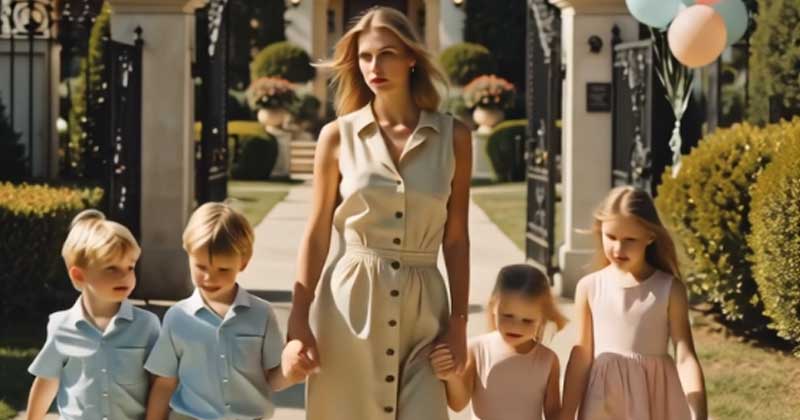
A strange silence settled over the vast courtyard. The clinking of glasses, laughter, music—all seemed to stop abruptly, as if someone had pressed an invisible button.
My triplets clutched my hands. I felt their emotions through each small, warm finger. They looked up at me, seeking courage, and I tried to offer them a smile. Inside, however, my heart was pounding.
He stood a few meters away, holding a glass of champagne. His hair, slightly graying, gave him a mature look, but his eyes… his eyes were the same storm I knew. The eyes that once made me believe in eternal promises.
Next to him was the woman he had left me for—dressed in a white dress, with a perfect smile and a child in her arms. The little girl had hair like my triplets and that curious spark in her eyes that I saw every morning at home.
I took a step forward. The murmurs of the guests grew. An elderly lady covered her mouth with her hand. A man pulled out his phone, probably ready to capture the moment.
“Good afternoon,” I said calmly, though my voice trembled slightly. “I came so these children could meet their sister.”
He was left speechless. He moved his lips, but no sound came out. His eyes darted from me to the children, then to his wife. She, on the other hand, hardened her gaze.
“I think this is a mistake,” she said coldly. “The party is private.”
“The mistake was made five years ago,” I replied, without raising my voice. “When he left, not knowing… or perhaps not caring… that he was about to become a father.”
A sigh was heard from the crowd. The triplets moved closer to me. I tried to stay strong, not for myself, but for them.
He took a step towards us.
“Are they… mine?” he asked, his voice breaking.
“Ours,” I said.
His expression changed. The confidence of the man who controlled everything was gone. He seemed vulnerable. The woman beside him began to protest, but he gestured for her to be quiet.
He leaned down to the children’s level.
“What are your names?”
“Andrei,” said the tallest of the boys. Then his brother: “Radu.” And the little girl, with a shy smile: “Ioana.”
I saw him bite his lip. His chin trembled. He reached out his hands, but the children instinctively pulled back towards me.
“You don’t have to…” I started.
“Yes, I do,” he said softly. “I have to.”
And then, something changed. The music started again, but softer, like a background. People stepped back, leaving us a space that was just ours. He knelt in front of them and said:
“I’m sorry. For everything.”
I didn’t know if it was too late for forgiveness. I hadn’t come for that. But I saw his eyes glistening, and in the woman’s arms, his little girl—and their sister—was reaching out to us.
I took a step, allowing the triplets to approach. Ioana smiled widely and touched her sister’s small hand. In that moment, I felt all the tension dissolve.
Maybe I couldn’t change the past, but I could offer my children something they had never had: recognized blood ties.
In Romania, in the villages, people say that brothers, once they meet, never truly part ways again, no matter how far apart they are. I clung to that thought.
He looked at me. I knew discussions would follow, perhaps fights, perhaps reconciliations. But on that day, in that courtyard filled with balloons and expensive flowers, my children were meeting their sister.
And that, for me, was the ultimate victory.
This work is inspired by real events and people, but has been fictionalized for creative purposes. Names, characters, and details have been changed to protect privacy and enhance the narrative. Any resemblance to real persons, living or dead, or to real events is purely coincidental and not intended by the author.
The author and publisher do not assume responsibility for the accuracy of events or for how characters are portrayed and are not liable for any misinterpretations. This story is provided “as is,” and any opinions expressed belong to the characters and do not reflect the views of the author or publisher.


