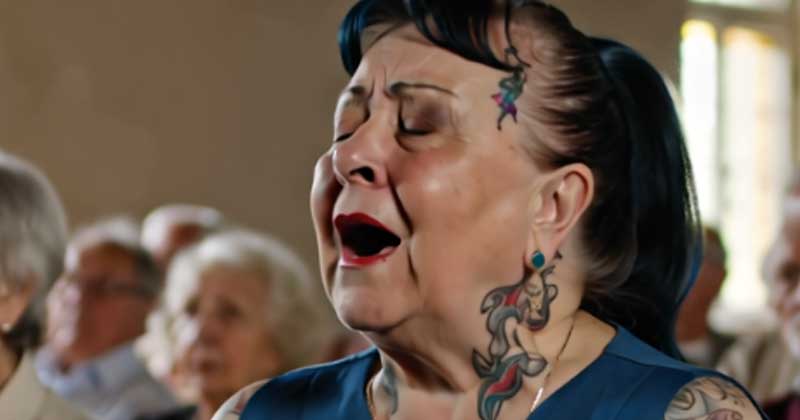
Last Sunday, when I entered the church, I had a moment of personal reflection. I noticed a woman around 40 years old, with visible tattoos and multiple piercings.
I grew up with the idea that the church is a place of respect and humility, where modest clothing reflects consideration for the sacred space. Her bold appearance challenged my deeply rooted beliefs about what is “appropriate” to wear in a church.
I began to wonder: are my views on church attire still valid today? Should we actually have expectations regarding how people dress in places of worship?
Questioning traditional ideas about church attire
Seeing this woman’s unconventional style made me start reevaluating my traditional opinions on how we should dress for church. After the service, I politely told her that I thought her outfit was a bit too bold for such a place and that perhaps a more sober appearance would be more appropriate. Her response was direct: “How I look has nothing to do with you.”
Her words made me think – was my discomfort actually related to outdated beliefs about church attire, rather than her actual appearance?
I realized that I might still be clinging to a rigid idea of how one “should” present themselves in a holy place. In a world where self-expression is increasingly important, is it still reasonable to expect everyone to conform to the same rules? As society evolves, so do our perceptions of individuality, and perhaps it is time to reconsider what “appropriate attire” for church truly means.
Should there be a dress code for church?
Many of us grew up with a clear image of church attire — modest dresses, suits, ties, and clothes that do not draw attention. These unspoken dress codes created a sense of uniformity and respect.
However, in recent years, the boundaries between what is “acceptable” and what is “inappropriate” have blurred. Tattoos, piercings, and original clothing choices are now common forms of personal expression.
So, should there still be a standard for how we dress for church? For some, modest clothing represents a sign of respect for the sacredness of the place. For others, outward appearance should not dictate one’s ability to participate in prayer or belong to a religious community.
After all, isn’t the essence of the church about acceptance, compassion, and unity – values that welcome everyone, regardless of how they look?
Embracing diversity in places of worship
Churches should be spaces of unity and inclusion. If we focus too much on appearances, we risk losing sight of the true purpose of the church: to bring people closer to God and to each other.
Judging someone for tattoos or piercings can prevent us from truly getting to know them, missing their unique story and spiritual journey.
Every person brings a personal history when they enter a church. Tattoos, piercings, and unusual clothing can be expressions of life experiences, struggles, or inner searches. If we stop at appearances, we risk missing a diversity of stories that could enrich our own understanding of faith and life.
Blending tradition with personal expression
It is important to encourage individual expression while also maintaining a spirit of respect for what a place of worship means. For some, covering their tattoos or dressing more modestly is a way to honor the traditions in which they were raised.
At the same time, we must understand that each person’s relationship with faith is deeply personal and unique. Finding a balance between respecting tradition and accepting personal expression can lead to a worship atmosphere where everyone feels welcome and respected.
Promoting respect in religious communities
Perhaps the solution is not to impose a rigid dress code, but to cultivate a culture of mutual respect. Churches can encourage attire that reflects respect for the place, but without nullifying individual expression.
An environment where people are encouraged to dress as they feel, while being aware of the space they are in, can lead to an inclusive and respectful atmosphere. Thus, faith communities can honor both tradition and modern values of acceptance and diversity.
Welcoming everyone with an open heart
At the heart of any religious community should be the principle of inclusion. Jesus reached out to the marginalized, showing compassion to those judged by society.
If we want to follow these values, we must look beyond appearances and focus on what truly matters – the heart. Whether someone comes to church with tattoos, in casual clothes, or in the most elegant Sunday attire, the sincerity of faith and the desire to connect spiritually are what truly count.
By embracing diversity in our churches, we can build a community where everyone feels welcomed, respected, and loved – regardless of how they choose to express themselves.
This work is inspired by real events and people, but has been fictionalized for creative purposes. Names, characters, and details have been changed to protect privacy and enhance the narrative. Any resemblance to real persons, living or dead, or to real events is purely coincidental and not intended by the author.
The author and editor do not assume responsibility for the accuracy of events or for how characters are portrayed and are not liable for any misinterpretations. This story is provided “as is,” and any opinions expressed belong to the characters and do not reflect the views of the author or editor.


