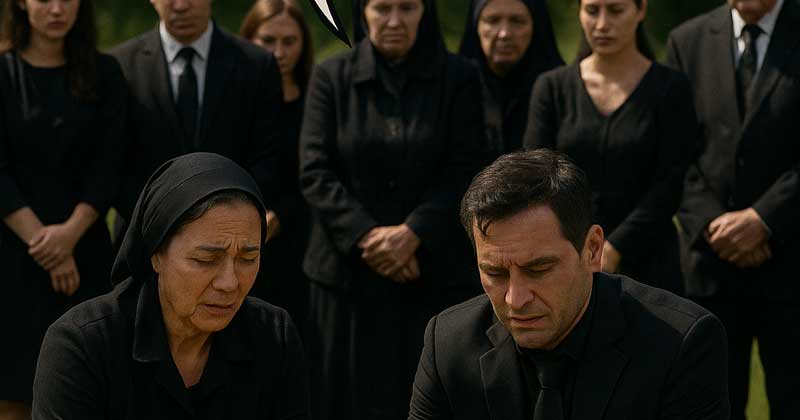
“I dreamed of her…”
The words whispered like a cold breeze through the hearts of all. It was not just a dream — it was a calling. Unfazed by the light rain seeping through the holes in the tin roof, the people gathered, watching in awe as the man found the courage to continue.
“I dreamed of her the night she died,” he murmured, his voice trembling between breaths. “She was dressed in bridal garments, under the moonlight, with her hair woven with acacia flowers. And she told me one thing: ‘Find my offering next to my grandmother’s grave, at the edge of the village, where we often forget to return. There I will find peace.’”
A profound silence settled in. The hearts of all beat rapidly. What fates sent from heaven called them to that forgotten place? Beyond the village, the winding cart path, covered with linden leaves and the song of crickets, awaited them.
The mother-in-law, wiping her eyes with a black scarf, flinched. A strange determination trembled in her voice: “We will go tomorrow, at dawn. We will take coliva and round loaves, we will place a beeswax candle, as is customary according to our ancestral tradition.”
At dawn, the village was bathed in the morning dew. Children dressed in traditional shirts rushed past the wooden church, where dozens of candles flickered in the porch, clustered like a beacon of hope. A group of weathered women sang fragments of carols, while the steam from the coliva mingled with the bittersweet aroma of sweet bread.
The path to the grandmother’s grave was strewn with acacia branches. Each step echoed under the soles of their boots, like a priest singing in silence. The silence was theirs alone and, at the same time, it belonged to all those who could no longer speak.
Upon reaching the grave, they found the old tombstone, nearly swallowed by grass. Around them, the heavy bells of the church seemed to murmur the ancient prayer for the departed. The husband carefully placed the coffin, and the mother-in-law opened the bag of treats: coliva burnt with sugar, round loaves, engraved with almonds, and homemade bread. She touched the gravestone, her palm making the sign of the cross, and said: “Rest well, dear child. May you receive our offering and forgive us.”
Suddenly, a warm breeze caressed their faces. A bird’s trill — like a winged akathist — faded among the branches. They all felt a gentle shiver, as if the girl’s soul thanked them for the gesture. No one whispered anything; there was no need. The emotional weight was so profound that compassion and solace intertwined in an unseen but powerful knot.
When they lifted their eyes to the grave, they saw something that no mind would dare to predict: a white apple blossom growing from the crack in the stone. The shimmering petals seemed frozen in dew, yet they had a living warmth — like a sign that life can arise from any pain.
The husband reached out, carefully plucking the flower. “In her name,” he whispered, “I promise to raise the child with the love you all bear for her.”
A sigh of relief rose from every thought. Tears transformed into fragile smiles. They then went to the little house at the end of the street, where the grandmother awaited them with an icon of the Virgin Mary and a sprig of basil stuck in the coliva. Together, they sang the troparion for the departed, and in the clean morning air resounded a hymn of forgiveness and rediscovered hope.
The day ended with a memorial meal in the yard, under an old walnut tree. Each placed a hand on the shoulder of the other, and between stories about the girl’s legacy and plans for the future, the entire village felt that life could go on, that the bonds of the soul are stronger than any cold stone, and that true love never dies.
And thus, beyond the rain and the sighs, from the ashes of pain arose a veil of peace and faith — a clear, bright, and reconciled ending.
This work is inspired by real events and people, but has been fictionalized for creative purposes. Names, characters, and details have been changed to protect privacy and enhance the narrative. Any resemblance to real persons, living or dead, or to real events is purely coincidental and not intended by the author.
The author and publisher do not assume responsibility for the accuracy of events or for how characters are portrayed and are not liable for any misinterpretations. This story is provided “as is,” and any opinions expressed belong to the characters and do not reflect the views of the author or publisher.


