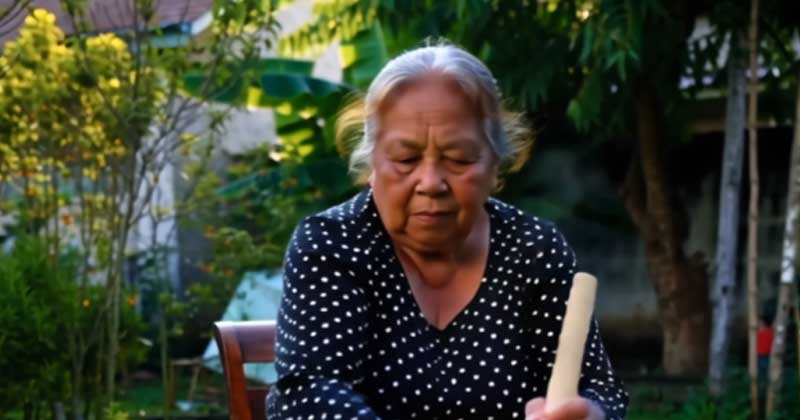
And now… it smells the same.
In the backyard of the old house, the steam of tomatoes, basil, and something you couldn’t name hung heavily, like a memory that didn’t want to die. Aunt Ilinca didn’t stop. Not when the police officer raised his voice, nor when the neighbor across the street came out with her phone in hand, filming everything. She even looked up at me.
— Do you remember how it smelled back then? On that night?
I looked at her, without answering. Yes, I remembered. Of fire. Of panic. Of the screams of a man I never saw again after that.
In the village, no one spoke anymore about the fire in ’99. Out of fear. Out of shame. Or maybe because, in Romania, when the fire burns too close to your secrets, you let it consume them and say nothing.
But now… someone was digging through the ashes.
The police officer, young and visibly confused, pulled out a notebook.
— Ma’am, I need to ask you something. Did you have any connection to that restaurant?
Ilinca laughed shortly, dryly, wiped her forehead with the back of her hand, and said:
— The connection was blood. My sister made the recipe. With her own hands. Before she was stolen.
— But she lives in Argentina, right? She stated she hasn’t been here for over 20 years.
— She hasn’t been… physically, no. But her recipe has. Stolen, copied, put on the menu, and served as if it were theirs.
I felt my stomach tighten. In childhood, I had heard fragments. That my aunt had never really talked about her sister’s departure. She just kept saying: “You burn some once. But they burn you for life.”
— Do you mean someone set the fire? — the police officer asked.
— I say nothing. I just simmer the sauce. For years.
And she continued to stir.
Behind us, other neighbors gathered. Some drawn by curiosity, others by the smell that took them back in time. An old man said quietly:
— That’s how it smelled at Vito’s yard before everything burned. Only hers was cleaner. More honest.
The police officer closed the notebook.
— I don’t know what to write here.
— Write that you saw a woman defending her memories, Aunt Ilinca replied. And that she never ran from the fire. She just taught it to simmer slowly.
On that day, no one left.
Towards evening, people brought bread, garlic, empty jars. One played the accordion. Another set up chairs in the shade. No one spoke about the fire anymore. But with every ladle of sauce, pieces of the past were washed away.
Aunt Ilinca put the lid on the pot and signaled me to come closer.
— Here, she said, handing me a full spoon. Taste. It’s the real recipe.
I tasted it. And I remembered my mother’s voice, my grandmother’s smile, the childhood when everything seemed simple. Just tomatoes, basil… and an old story simmering slowly, until the truth.
For the first time, I understood why she never stopped. She wasn’t just making sauce. She was simmering justice. In the yard of an old house, in a village where no one forgets, but everyone forgives… at the right time.


