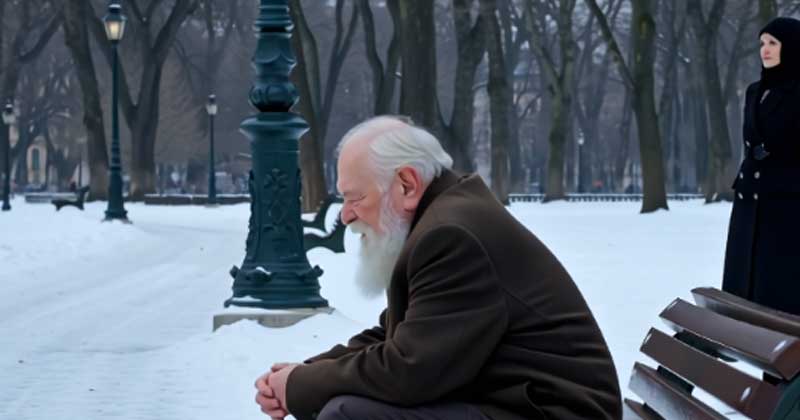
He sat on the cold metal bench, wrapped in a faded cloak – once worn during his time as a master at the housing office. His name was Radu Antonescu. A retiree, widower, father of a single son, and at one time, a proud grandfather. But all of that changed on a fateful day.
When his son introduced Oana to the family, Radu felt a disquieting chill. Her presence was too intense, her gaze too cold, hidden behind a deceptive smile. He did not raise his voice or cause drama – he simply, quietly, removed everything that mattered to the man from her path. Radu sensed it from the beginning, but by then, there was no turning back.
At first, his possessions disappeared: his books were moved to the attic, his cherished chair was deemed “useless,” and eventually, even the teapot vanished. Then came the subtle suggestions: “Dad, maybe you should spend more time outside? Fresh air would do you good.” It wasn’t long before the idea was presented: “Maybe it would be better for you in a nursing home or at your aunt’s in the countryside.”
Radu did not respond. He simply gathered the little that remained and left. No accusations, no tears, no pleas – just pride and pain, buried deep in his heart.
He wandered the snow-covered streets like an invisible man. Only a park bench became his support – a place where he once walked with his wife and later with his small son. There, he spent hours staring into space.
On an especially cold day, when the frost bit his face and his eyes blurred from the cold and pain, a voice called out:
— Radu? Radu Antonescu?
He turned. In front of him stood a woman in a warm coat and a scarf on her head. He did not recognize her immediately, but the memory returned – Maria Sorescu. His first love. The one he lost due to his job and then forgot, marrying Lidia.
She held a thermos and a bag of homemade pastries.
— What are you doing here? You’re freezing…
That simple, caring question warmed him more than any coat. Radu silently took the thermos of tea and the muffins. His voice had long abandoned him, and his heart ached so much that even tears no longer came.
Maria sat next to him as if time had not passed between them, as if it had frozen in place.
— Sometimes I walk around here, — she began gently. — And you… why are you here?
— It’s just a familiar place, — he smiled weakly. — This is where my son took his first steps. Do you remember?
Maria nodded. Of course, she remembered.
— And now… — Radu sighed, — he has grown up, got married, settled into an apartment. His wife said: “Choose – me or your father.” He chose. I don’t blame him. Young people have their own worries.
Maria remained silent, just looking at his red, cracked hands from the cold – so familiar yet so lonely.
— Come to my place, Radu, — she suggested suddenly. — It’s warm, we’ll eat, and tomorrow we’ll figure out what comes next. I’ll make you soup, and we’ll talk about everything. You’re not a stone; you’re a person. And you shouldn’t be alone.
He did not move for a long time. Then he asked slowly:
— And you… why are you alone?
Maria sighed. Her eyes misted over.
— My husband died long ago. My son… died before he was born. After that – life, work, retirement, a cat, and knitting. Everything in a circle. You’re the first in ten years with whom I’ve had tea, not in solitude.
They sat there for a long time. Passersby thinned out, and the snow fell gently, as if trying to smother their pain.
The next morning, Radu woke not on the bench but in a cozy room with daisy-patterned curtains. The air smelled of pies. Outside, the winter frost covered the trees. And inside, there was a strange feeling of peace, as if someone had restored his right to life.
— Good morning! — Maria entered with a plate of cheese pancakes. — When was the last time you ate something homemade?
— About ten years ago, — Radu smiled. — My son and his wife mostly ordered food.
Maria did not ask questions. She just fed him, wrapped him in a blanket, and turned on the radio softly – so it wouldn’t be so quiet.
Days passed. Then weeks. Radu seemed to come back to life. He repaired chairs, helped around the house, and told stories about his work, how he saved a colleague from a gas explosion. And Maria listened. While cooking childhood soup for him, washing his socks, and knitting scarves, she offered him what he hadn’t felt in a long time – care.
But one day, everything changed.
Maria was returning from the market when she noticed a car at the gate. A man got out, and Radu would have called him his son. Valentin.
— Hello… Excuse me… Do you know if Radu Antonescu lives here?
Maria felt her heart tighten.
— And who are you to him?
— I… I am his son. I was looking for him. He left, and I didn’t know… Oana left. It seems that all this time… — he lowered his head. — I won’t lie. I was a fool.
Maria looked at him closely.
— Come in. But remember: your father is not an object, not a piece of furniture. He is not obliged to return just because you are left alone.
— I understand.
At home, Radu sat in an armchair with a newspaper. When he saw his son, he immediately understood – he hadn’t come for no reason. His chest ached with memories – of years, of cold, of homelessness.
— Father… — Valentin whispered. — Forgive me.
The silence hung in the room. Then Radu spoke:
— You could have said this earlier. Before the bench, before the nights under the bridge, before all of this. But… I forgive you.
And a tear slowly rolled down his cheek – heavy, like a memory, but warm, like forgiveness.
A month later, Valentin suggested to his father that he return home. But Radu refused.
— I have already found my little corner, — he said. — It’s warm here, real tea and care await me here. I am not angry; I am just tired of starting over. To forgive does not mean to forget.
Two years later, Radu and Maria came together to the park bench. They held hands, brought bread for the birds, and drank tea from the same thermos. Sometimes they were silent. Other times they talked about anything.
One day, standing in the middle of the street, Radu looked up at the sky and said softly:
— Life is a strange thing. They throw you out of your house, and you feel that everything inside has crumbled. But then someone comes – not from the door, but from the warmth of the heart – and gives you a new home – not of walls, but of love.
Maria hugged him.
— So it was worth it that we met. Even if it happened on a bench in the park.
Radu and Maria lived in peace. They did not rush to register their relationship, did not call each other husband and wife. But in their home, there was family – unseen, but felt in everything. The morning began with the sound of the samovar, the smell of fresh tea, and Maria’s voice humming at the stove. Their bond was not in words but in actions – in every glance, in every movement.
But one day, in spring, Valentin came to the house. Not alone – he had a boy, about eight years old.
— Father… — he began cautiously. — This is Sasha. Your grandson. He wanted to see you.
Radu froze. The boy looked at him with trust and a little shyness. He held in his hands a drawing: an old house, a tree, two figures on a bench.
— This is you and Grandma Maria, — he said. — Dad told me. Now I want to have a grandfather.
Radu knelt down, hugged the child, and felt warmth returning to his chest.
From that day on, Sasha became part of their lives. He not only played in the garden – he brought life into the house. Radu began to do things again: swings, a toy boat, even repairing an old radio. And in the evenings, he read stories to his grandson, just as he once did for his son.
One day, watching them, Maria said softly:
— Radu, you are living again. You are not just existing – you are living.
He took her hand tightly and pressed it to his cheek.
— Thanks to you.
In autumn, Radu took an important step. He brought a marriage proposal to the civil registry office. He and Maria married in front of four people – Valentin and Sasha were present. No fanfare, no dress or banquet. Just two people who found each other after a long journey.
When the civil servant at the registry office smiled and noted that it was a bit late, Maria replied:
— Love has no age. It either is or it isn’t. And for us, it is. And we made the right choice.
Years passed. Radu began to write. From old, worn notebooks, the story of his life was born – from childhood in a post-war yard to his work as a master at the housing office, from the loss of Lidia to exile, and then – the meeting with Maria. He wrote everything for his grandson, so he would remember: life is not always fair, but there will always be light in it.
Sasha read these notes with bated breath.
And when he turned sixteen, he said:
— Grandpa, I want to make a book from your notes. So that people know: you cannot abandon your loved ones, you cannot be blind to the pain of others. You must know how to forgive. And to know when to leave when there is pain.
Radu nodded silently. There was no greater pride for him.
One day, Oana unexpectedly came to the house. She had lost weight, her hair was graying, and her eyes were empty.
— I’m sorry, — she said. — I lost everything. The man I left you for turned out to be nothing. Health is gone, prosperity is gone… I thought then that you were in the way of Valentin. But now I realize: you were his foundation.
Radu looked at her for a long time.
— I am not angry, — he finally said. — But I will not invite you in. Because in this house, there is kindness. And you brought cold. And now you want to warm yourself where you never felt warmth. That is not how it works. I wish you peace – but not here.
And he closed the door.
Ten years later, Maria left quietly. She did not wake up in the morning. The room smelled of lilies of the valley – her favorite flowers. Radu sat beside her, holding her hand, whispering words of gratitude. He did not cry. He just whispered:
— Thank you. I will come soon. Wait for me.
Neighbors, acquaintances, and children from the park came to the funeral. Everyone knew Marusia – gentle, quiet, always ready to offer tea and a shoulder to lean on.
Sasha wrote the book. He named it:
“The Bench Where Life Began”
He dedicated it to his grandparents. The book found thousands of readers. People wrote letters, thanking for the honesty, for the truth, for the belief that even in old age, you can find love and a home.
And Radu… lived a little longer. One day, he simply lay down on the same bench where it all began. He closed his eyes. And he saw: Maria walking through the snow. Smiling. She said:
— It’s time to go home, Radu.
He smiled and took a step toward her.
Now, on that bench, there is a small plaque:
“Here everything changed. Here hope was born.
Do not pass by the elderly – they need love too.”
Every evening, grandchildren sit here, holding hands with their grandmothers and grandfathers. Because love is not in grand ceremonies. It is in saying:
“I found you. Now you are not alone.”


