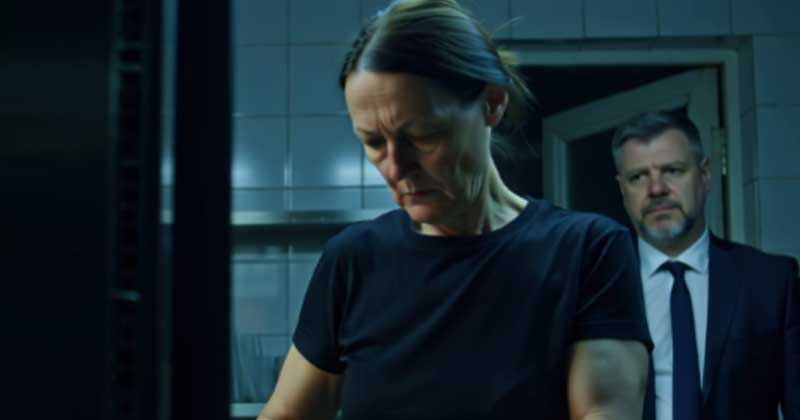
A RESTAURANT OWNER GETS ANGRY WHEN HE DISCOVERS ONE OF THE CLEANING LADIES IS TAKING LEFTOVERS FROM PLATES FOR HER CHILDREN
Gheorghe Călinescu was the proud owner of one of the most prestigious and well-known restaurants in Bucharest, “The Fish Pot.” Gheorghe had inherited the establishment from his father, who had, in turn, inherited it from his grandfather.
Although Gheorghe had an extremely efficient manager named Costin Farcaș, he continued to closely monitor his business, often showing up at unusual hours when employees least expected it. That’s how he discovered that one of the night cleaning ladies, Consuela Rusu, was taking home leftover food.
The kitchen usually closed at 10:30 PM, at which point the cleaning crew took over. The chefs and their assistants left for a well-deserved rest, leaving the workstations spotless.
Three employees were responsible for collecting dirty glasses, plates, and cutlery, which they placed in the industrial dishwashers. In the morning, the staff found everything sparkling clean.
One night, at 1:00 AM, Gheorghe entered the restaurant and walked through the kitchen to the back, wanting to check on his precious wine collection, for which “The Fish Pot” was famous.
On his way, he spotted a woman scraping leftover meat from a plate into a plastic bag tied around her waist, under her apron. After finishing, she carefully rinsed the dish and placed it in the dishwasher.
She took the next plate and did the same. This time, the leftovers were almost a full serving of Chicken Kiev. Gheorghe stepped back and watched. The woman appeared to be about 45 years old, with a thin, drawn face.
It was Consuela Rusu, a quiet woman who had recently joined the cleaning team. Gheorghe had only heard her referred to as “Rusu,” but now he was seeing her for the first time. As she worked, she hummed softly to herself.
“Rusu!” Gheorghe jumped at the sharp tone of his manager, Costin Farcaș. “Shut up and stop stealing! We need to close!”
The woman flushed, lowered her head, and closed the dishwasher door. She poured in the detergent, started the steel motor that began to hum, then rushed to the locker room as another woman started cleaning the kitchen floor.
Gheorghe, who had kept himself well hidden, sneaked out and waited in the shadows by the back door. Soon, the three cleaning ladies came out, followed by Farcaș, who was grumbling unhappily.
Consuela wrapped her thin coat around her body and walked down a dark, narrow alley, and Gheorghe followed her. After three streets, she opened a door and disappeared into an industrial building.
Gheorghe frowned as he read the sign at the entrance: “CONDEMNED BUILDING.” This meant that the former industrial space was declared unsafe. What was the woman doing there?
Gheorghe opened the door and entered. He followed the sounds of voices and dim light until he reached an administrative office with glass walls.
The walls were still intact, and inside, Gheorghe saw Consuela Rusu with four children of varying ages. She was carefully taking several plastic bags out of her bag and placing them on a table.
Then she began to divide the leftover food into plates and offered them to the children. So Consuela was taking leftovers from the dirty plates of customers and feeding her children with them.
Gheorghe was stunned. How could this happen in his restaurant? He had to put an end to this situation. He quietly left, without the woman or the children noticing him.
The next day, when the restaurant staff came to prepare for the evening rush, Gheorghe was already there.
“Farcaș,” he called. “Come here for a moment, I want to talk.”
Farcaș followed him into the office. “Mr. Călinescu,” he greeted him with a sycophantic smile. “What a pleasant surprise!”
“We’ll see about that,” Gheorghe replied coldly. “There are some things happening in the restaurant that I don’t like, Farcaș.”
Farcaș frowned. “Whatever is bothering you… tell me, and I will resolve it immediately.”
“I was here last night at closing time, and I saw a woman collecting leftovers from plates and taking them home — probably to eat.”
Farcaș looked shocked. “Really? I didn’t know…”
“Yes, you did,” Gheorghe burst out. “I heard you talking to her.”
“Sir,” Farcaș whined. “I swear that…”
“I gave clear instructions for leftover food and ingredients from the kitchen to be donated to a shelter,” Gheorghe said. “And you knew that. You also knew that one of the employees was living off the leftovers from dirty plates?”
“Well…” Farcaș cleared his throat. “Yes, but I wanted to stop that! It’s this woman — Rusu? I hired her temporarily. She’s an immigrant, you know how they are!”
“Yes,” Gheorghe replied coldly. “I know how they are. Desperate, willing to work for nothing, sometimes starving. I know how they are, Farcaș. Because my grandfather was an immigrant too.”
“Sir,” Farcaș mumbled, “please, I assure you that…”
“I assume you offered Mrs. Rusu a salary much lower than what was budgeted for her position and pocketed the rest,” Gheorghe accused, and Farcaș turned beet red.
“You’re fired, Farcaș. You exploited these desperate women, forcing them to feed their children with leftovers,” Gheorghe thundered. “But it’s over!”
Then he called for Consuela Rusu. “Mrs. Rusu?” he gently asked the frightened woman.
“Yes,” she whispered.
“I know you’ve been taking home leftovers for your children, and I want to tell you that it’s over,” Gheorghe said to her.
“Please, sir,” Consuela said with dignity. “Don’t fire me. I have no one, and I need food… The money isn’t enough.”
“I know,” Gheorghe said gently. “That’s why you will receive a raise and a work contract.”
Consuela looked at him in shock, her mouth slightly open. “A raise?”
“And,” Gheorghe added, “my grandfather bought this entire property, and there’s a small apartment in the back that we used for storage. I’ve asked for it to be emptied and cleaned.
“It’s small, but better than an abandoned building. It has electricity, hot and cold water. You and your children will move there today. And no more leftovers — you’ll receive real food!”
Consuela was crying. “Why are you doing this?” she whispered. “Why are you helping us?”
“Because,” Gheorghe replied gently, “many years ago, my grandfather came to this city, to this country, with only his dreams, and someone helped him. I’m doing the same for you.”
“Maybe one day, you or one of your grandchildren will lend a hand to someone else. That, Mrs. Rusu,” Gheorghe smiled, “is the true Romanian dream.”
From that day on, Consuela’s life began to change. With a stable income and a safe place to live, her children started attending school regularly, having hot meals every evening, and even smiling more often.
The small apartment, though modest, became a home filled with laughter and hope. Consuela continued to work hard in the restaurant, now with pride and dignity, knowing that her efforts were providing her children with the future they deserved.
This work is inspired by real events and people, but has been fictionalized for creative purposes. Names, characters, and details have been changed to protect privacy and enhance the narrative. Any resemblance to real persons, living or dead, or to real events is purely coincidental and not intended by the author.
The author and publisher do not assume responsibility for the accuracy of events or for how characters are portrayed and are not liable for any misinterpretations. This story is provided “as is,” and any opinions expressed belong to the characters and do not reflect the views of the author or publisher.


