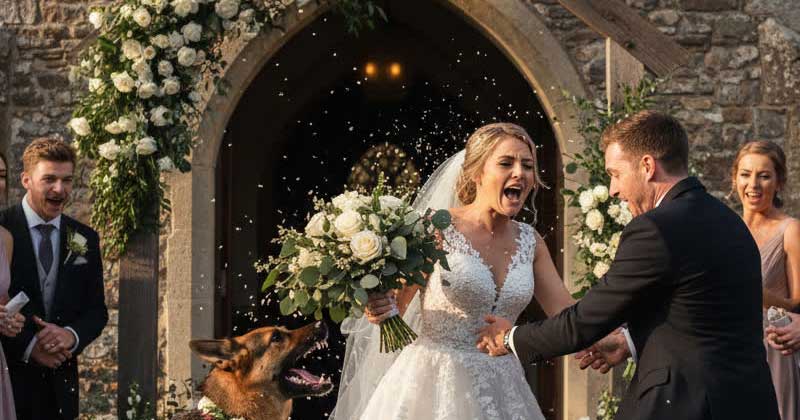
Everything came to a sudden halt. The music stopped, the guests stood up, and the bride, red-faced from nerves and alcohol, screamed that she would call the police. Roi whined softly, trembling, while the groom shielded him with his body.
“Don’t touch him!” he said emphatically, in a cold voice that no one had ever heard before.
In his eyes, there was more pain than anger. He looked at the bride who, just an hour ago, had promised to stand by him “in good times and in bad.” Now, the woman looked like a stranger.
After the guests were asked to calm down, the groom took the bride aside, behind the tent where the festive meal was prepared.
“Tell me the truth,” he said calmly but firmly. “What did you do to the dog?”
The woman burst out:
“Nothing! He’s a crazy animal! You should have kept him tied up!”
But the man stared at her intently, without blinking. He gently lifted the dog’s paw and noticed something: on the fur around his neck, there were scratch marks and a thin trickle of blood.
Roi looked him in the eye, trembling, with his tail between his legs, as if he wanted to say something.
“No… that’s not true…” she began, stepping back.
Then, the groom’s uncle, who had seen everything earlier, approached.
“I saw it,” the old man said. “When you entered the kitchen, the dog was there. You stepped on his tail and kicked him. After that, you poured champagne over his fur and said it ‘smelled less now.’”
Everyone around fell silent. The groom looked long at the woman who was to become his wife. His heart was pounding, but his eyes remained clear and cold.
“There’s no need to continue,” he said. “The wedding is over.”
Then he turned to the guests:
“Thank you for coming. You can keep the food, the drinks… but the party is over.”
His words cut through the air like a blade. The bride tried to stop him, she began to cry, but there was no one left to talk to. The man had taken his dog in his arms and walked away among the people, in silence.
On the way home, Roi lay on the back seat, and the groom stroked his head.
“Well done, boy,” he whispered. “You saw clearer than I did.”
A few days later, he learned that the woman had been engaged once before, but the engagement had ended due to her behavior. She had a habit of humiliating those around her, especially when drinking.
For the first time, the man felt that the dog was not just an animal. He was a sign, a pure instinct that people lose over the years.
Since then, his life changed. He sold the big house he had bought for the “perfect family” and moved to the outskirts of the city, to a modest yard with an old walnut tree and a wooden porch. Roi ran freely through the grass, and he smiled.
Sometimes, when the sun set over the rooftops, he poured himself a glass of wine and told himself: “Better alone with a pure soul beside me than surrounded by people wearing masks.”
It was a painful but true lesson: sometimes, those who truly love you do not speak — they bark.
This work is inspired by real events and people, but has been fictionalized for creative purposes. Names, characters, and details have been changed to protect privacy and enhance the narrative. Any resemblance to real persons, living or dead, or actual events is purely coincidental and not intended by the author.
The author and publisher do not assume responsibility for the accuracy of the events or for how the characters are portrayed and are not liable for any misinterpretations. This story is provided “as is,” and any opinions expressed belong to the characters and do not reflect the views of the author or publisher.


