When Mendoza first stepped into that abandoned yard, he felt the oppressive air that seemed not to belong to the living world. The smell of mold and dry earth filled his lungs, and the silence was so dense that each step sounded like an echo of death.
The villagers had gathered at the gate, but no one dared to enter. Some made the sign of the cross, while others murmured short prayers, as if the walls of that house harbored not just a secret, but also a curse.
In the world of the Romanian village, such places were avoided, for the elders always whispered that “where man does not live, something else enters.” Superstitions mingled with reality, and courage became a test of faith.
Mendoza and his team broke down the freshly erected wall and descended into the darkness. At that moment, a barely perceptible breath was heard, a kind of moan, as if the earth itself was expressing its pain. And then they found her.
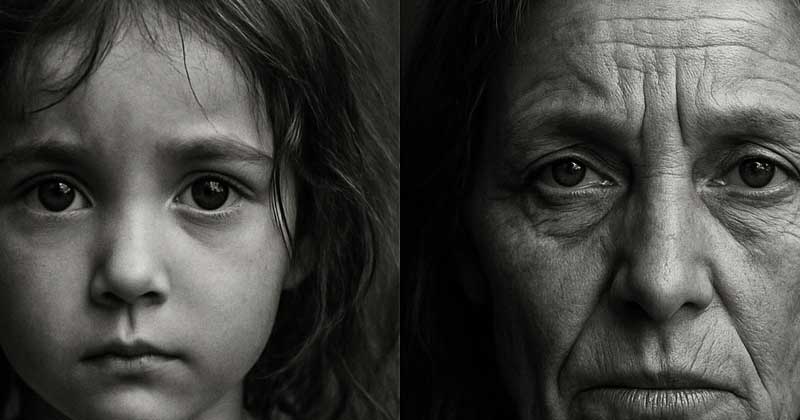
Clara was huddled, small and helpless, with a lost gaze and fragile movements. She did not know how to protect herself, did not know how to speak, but only repeated a few slurred words, like a child who had never been loved. Her large, empty eyes looked at the kerosene lamp as if it were a sun she had never understood.
The police burst into tears, some turning their gaze away in shame. It was hard to accept that a father could condemn his daughter to such a hell.
When they brought her into the light, the village fell silent. The woman, with tangled hair and a frail body, swayed and collapsed to the ground. She touched the grass with her hands, feeling it as if it were a miracle. A 30-year-old child was discovering the world for the first time.
Some elders said they had heard similar stories from wars, when prisoners were hidden in cellars for years. But no one could imagine such a thing in their own community.
Mendoza looked at the sky at that moment. The clouds gathered above the village, and a light rain began to fall, washing away the dust, washing away the ruin, washing away the sin. The locals then said that God had cried for Clara.
Years later, her story became a warning. In every house in the village, parents told their children: “Never let silence cover the screams. For silence is the greatest accomplice of evil.”
Clara slowly learned, like a late-born child, to recognize the sun, to walk barefoot through the grass, to smell the linden flowers, and to taste the warm bread taken from the oven. And each simple gesture became a celebration for her.
The villagers began to protect her. Women brought her bowls of soup, children played with her, teaching her to catch the ball, while the elders told her stories by the fireplace, filling her mind with worlds that her father had stolen from her.
But the burden of the past could not be erased. Clara sometimes woke up at night screaming, with that strange, broken voice of someone who did not know how to cry out. And then the women of the village would go to her, placing basil under her pillow and making the sign of the cross, hoping that peace would bring her comfort.
The Calderón case remained forever a deep wound. A father who believed his power above life, a daughter who paid the price of absolute loneliness, and a community that understood that evil does not hide only in big cities, but also in the clay houses at the edge of the village.
Clara died later, but not alone. People watched over her, and the bells rang long, as if to chase away all shadows. And her story transformed into a lesson for generations: that love and freedom are not gifts that someone can take from us, but rights that we must defend, even when the voice that cries out seems too weak to be heard.
Thus, in that village, the name Clara did not only mean pain, but also rebirth. A reminder that, beyond the deepest darkness, one can still find the light.


Related Posts

She Saw Her Husband with Another Woman — and Paid the Bill Without Saying a Word
October 21, 2025
I wanted to surprise my husband at work with his favorite lunch. Instead, I discovered a secret that could have destroyed my life
October 21, 2025