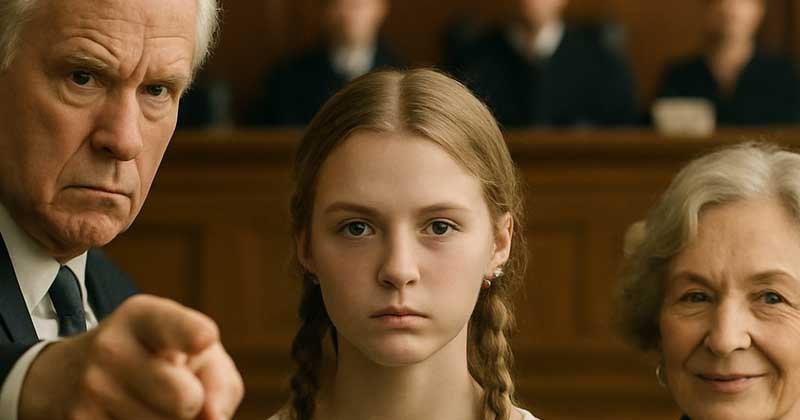
The process began with a full courtroom, our hearts heavy with fear. Lidia sat next to me, holding my hand tightly, her eyes moist. She couldn’t understand why a stranger who called himself “dad” had returned after so many years to turn her world upside down.
Matthew’s lawyer spoke clearly, portraying him as an unjustly wronged parent. He claimed that I had pushed him away, that I had made him seem like a monster. I felt the anger boiling inside me, but I remained silent, waiting for the right moment.
When it was my turn, I pulled a transparent plastic sheet from my bag. Inside was the note. The judge took the paper, read it, and silence fell over the room.
“Now it’s your burden.”
The words echoed like a cold chill.
I recounted how, on that December night, I had found the baby crying at my door. How I had worked for years to give Lidia a dignified life, how I had become both father and mother to her. I brought photographs: school celebrations, her first day of kindergarten, the day she won an award in a math competition.
The people in the room listened in silence, some with tears in their eyes. And then Lidia stood up. With a trembling voice, she said:
“This man has never held me in his arms. He has never asked if I’ve eaten, if I’m cold, if I’m sick. My mother is here, beside me. She raised me. I choose her.”
Her words were like a knife to Matthew. I saw him collapse into his chair, his forehead in his hands. He was defeated not only by the law but by the truth he could no longer deny.
The judge pronounced the verdict: custody remained with me. In that courtroom, I felt a heavy burden lift from my shoulders.
On the way home, Lidia smiled at me. “Mom, now we are free.”
I hugged her tightly, and in my heart, I felt that Emilia, my daughter, was watching over us.
In Romania, there is an old custom that after going through a great trial, you light a candle in church. That Sunday, Lidia and I went together to the nearby monastery. We lit two candles: one for Emilia, the other for Lidia’s future.
Their small flames danced in the cold air, and I understood then that true love does not need laws or papers. It is seen in sleepless nights, in hard work, in tears wiped away in secret, and in the smiles you bring to a child.
At home, Lidia opened her notebook and wrote in big letters: “I will be a doctor. For mom.”
And I knew that our story, no matter how difficult it had been, had turned into a life lesson: that sometimes family is not defined by blood, but by heart.
That evening, I closed my eyes in peace. I had beside me a child raised in love, and in my soul, the blessing of a mother who never gave up.
The truth had won. And with it, love.