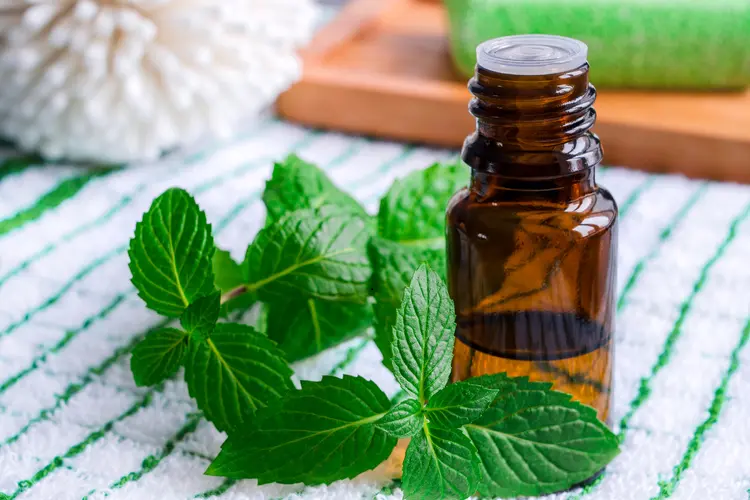
Peppermint essential oil is considered by many herbalists to be a first-aid remedy for headaches, due to its analgesic, anti-inflammatory, and relaxing effects. Peppermint leaves contain menthol, an active substance with vasodilating and mild anesthetic effects, which acts quickly on the scalp and temples, soothing tension-type or migraine headaches. But how effective is it, how to apply it, and especially how can you prepare it safely at home?
How Peppermint Oil Affects Headaches
1. Menthol – the key active component
Menthol stimulates the skin’s cooling receptors (TRPM8), inducing an immediate sensation of freshness. This cooling sends signals to the brain that can counteract the sensation of pain.
2. Improves local circulation
Topical application of peppermint oil promotes the dilation of blood vessels in the forehead, neck, and temples, reducing intracranial pressure associated with migraines.
3. Relaxing effect on muscles
It helps to relax the tense muscles of the head and neck, one of the common causes of tension-type headaches.
What Recent Studies Say
A study published in International Journal of Clinical Practice (2007) demonstrated that the topical application of 10% peppermint oil (diluted in ethyl alcohol) significantly reduced pain intensity in patients with tension-type headaches in less than 15 minutes.
Another study, published in Phytomedicine (2016), compared the efficacy of peppermint oil with paracetamol in mild migraines; the result: similar efficacy in the first 2 hours, without side effects.
According to an article in Clinical Therapeutics (2018), menthol applied topically is well tolerated, safe, and effective in managing moderate migraine symptoms.
How to Prepare Peppermint Oil at Home
If you do not wish to use a store-bought essential oil, you can prepare a simple, effective, and natural macerate:
Ingredients:
- 1 handful of fresh peppermint leaves (or 2 tablespoons dried)
- 100 ml carrier oil (olive oil, sweet almond oil, or jojoba oil)
Preparation Method:
- Chop the fresh leaves and place them in a sterilized jar.
- Pour the carrier oil over them until they are completely covered.
- Cover the jar and let it macerate for 7-10 days in a warm, dark place.
- Gently shake the jar once a day.
- After maceration, strain the oil and store it in a dark-colored bottle in a cool place.
This oil will not have the concentration of an essential oil, but it is milder and safer for direct application on the skin.
How to Apply It Correctly
Temples and forehead – Gently massage a few drops of oil onto the temples, forehead, and neck with your fingers. Avoid contact with the eyes!
Cold compress – Soak a compress in cold water mixed with a few drops of oil and apply it to the forehead for 10-15 minutes.
Inhalation – Add 2 drops to a bowl of hot water and inhale the steam for 5-10 minutes.
Cervical massage – Gently massage the neck and shoulders with diluted peppermint oil to relax muscle tension.
Contraindications and Precautions
Do not apply pure essential oil directly to the skin – always dilute it in a carrier oil (e.g., 1-2 drops in 1 teaspoon of vegetable oil).
Contraindicated for children under 6 years old, pregnant or breastfeeding women, individuals with epilepsy, or respiratory allergies.
Avoid contact with eyes and mucous membranes.
Do not administer internally without medical advice.
Sources:
- International Journal of Clinical Practice – Peppermint oil in tension-type headache: a randomized, double-blind study
- Phytomedicine – Efficacy of peppermint oil in migraine treatment
- Clinical Therapeutics – Topical menthol for acute migraine relief




