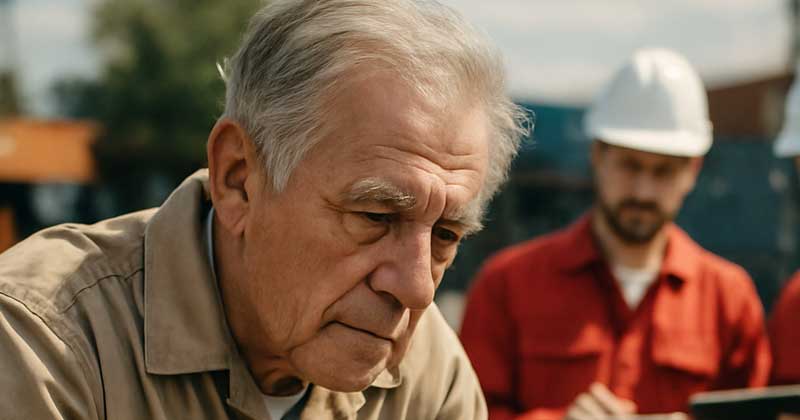
In the workshop, the atmosphere was oppressive. The engines were silent, the stillness broken only by the nervous ringing of phones and the hurried footsteps of the managers.
When Manuel entered, he said nothing. He walked past colleagues who looked at him with disdain and slowly placed his toolbox on the floor. The smell of oil and hot metal was more familiar to him than any other place in the world. He touched the engine casing as if he were touching an old friend’s shoulder.
— Listen, he murmured. The engine speaks.
The young ones burst into laughter. One even said:
— What’s next? Are you going to ask it how it feels?
But Manuel did not respond. He took a small screwdriver, tightened two screws, opened a compartment that no one had noticed, and touched a stuck part. The noise changed instantly, like a sigh of relief.
In less than ten minutes, the 50 million euro engine started smoothly, rotating like a rejuvenated heart.
The managers were left speechless. The young engineers, who until then had been boasting, were biting their lips in shame.
Manuel wiped his hands on an old rag and simply said:
— Sometimes, experience beats textbooks.
In Romania, stories like this are not uncommon. We too have had old craftsmen who repaired things just by listening to them. The peasants in the villages knew how to fix a plow, a cart wheel, or a stove just by instinct and years of work. They didn’t have computers, but they had something more precious: wisdom passed down from father to son.
Manuel was like these people. He had grown up with engines, felt their vibrations, understood how they breathed. In a world of buttons and algorithms, he still knew how to listen to metal.
When the engine was restarted, the CEO rushed in.
— How did you do it? he asked.
Manuel shrugged.
— Some things cannot be learned from books. They are learned by living them.
At that moment, everyone understood that a person’s value does not lie only in diplomas but also in the experience accumulated through years of hard work.
The young engineers, embarrassed, no longer had the courage to laugh. Some even came to ask him what he had done exactly. Manuel smiled at them:
— It’s not just about what I did. It’s important to learn to look and to listen.
That lesson remained in memory. Not only had the engine been repaired, but also the respect for the generation that laid the foundation of the industry.
In Romania, often, the elderly are marginalized, forgotten, sent into retirement with an air of uselessness. And yet, how many families have relied on the advice of a grandparent, on the skill of an old neighbor who knew how to fix something when no one else could?
Manuel demonstrated that experience does not expire. He showed that tradition and modernity do not have to exclude each other but can complement one another.
After that day, the factory was never the same. The young engineers began to come to Manuel, not to mock him, but to learn from him. And the company understood that true innovation is born when you combine the energy of youth with the wisdom of the elderly.
As he left, Manuel did not just take his toolbox. He also took with him the satisfaction of having regained his dignity.
In the hallway, a young apprentice stopped him and timidly said:
— Mr. Herrera, I want to be like you.
The old man placed his hand on his shoulder and replied:
— Don’t be like me. Be better. But never forget where you came from.
This is the lesson we should all keep. In our rush for the new, we often forget those who laid the bricks we walk on.
And, like the Romanian who still bakes bread in a clay oven or who repairs an old watch without ever having opened an electronics book, lived experience does not die. It remains, ready to reignite an engine when the modern world fails.
The end of Manuel’s story is not just about a repaired engine, but about a whole world learning to respect once again the hands that toil and the hearts full of passion.
Because some things, no matter how much progress tries to hide them, remain eternal: work, dignity, and the wisdom of those who never give up on what they love.
This work is inspired by real events and people, but has been fictionalized for creative purposes. Names, characters, and details have been changed to protect privacy and enhance the narrative. Any resemblance to real persons, living or dead, or actual events is purely coincidental and not intended by the author.
The author and publisher do not assume responsibility for the accuracy of events or for how characters are portrayed and are not liable for any misinterpretations. This story is provided “as is,” and any opinions expressed belong to the characters and do not reflect the views of the author or publisher.


