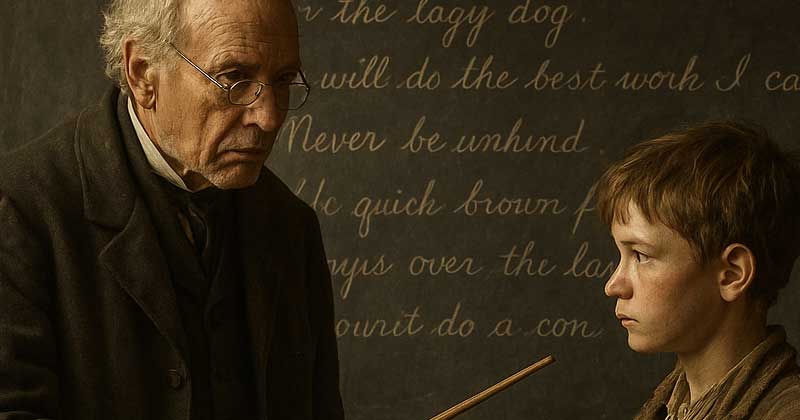
Camilo felt every gaze like an arrow in his back. Every ironic smile was a thorn in fresh flesh. And yet, deep in his heart, he carried a strange calm, like the one felt before a storm.
He slowly opened his tattered notebook, and the yellowed pages, creased at the corners, looked like pages from an old book forgotten in a village library. The dull pencil trembled slightly between his fingers, not from fear, but from the emotion of the moment.
Professor Emiliano raised an eyebrow, ready to humiliate him again. But when the boy drew the first letters, the entire class fell silent.
One by one, like a dance of words, phrases in Latin, Greek, French, Russian, German, Arabic, Italian, Hungarian, and Romanian appeared on the page. The letters flowed orderly, clearly, as if an unseen hand guided his writing.
A murmur swept through the room. The privileged students, who had been giggling until then, leaned forward, trying to read every line.
The professor, feeling his authority waver, snatched the notebook from the child’s hands. He flipped through it furiously, but his hand suddenly stopped. In his eyes, accustomed to disdain, a shadow of astonishment appeared.
Camilo looked up for the first time. Not defiantly, but with a deep calm, that of a man who knows he has nothing left to lose.
—And who taught you all this? —the professor asked, his voice lower than usual.
The boy smiled faintly. The image of his grandmother flashed through his mind, who would put him to sleep at night with Romanian tales about heroes and lords, about Stephen the Great and the forests of Moldavia. He remembered the evenings when he wrote on his knees, by the light of the gas lamp, while the wind beat against the small window of their little house.
—No one, sir, he said. Just life. And the books that others threw away.
A stir ran through the class. The wealthy children, for the first time, were silent.
Professor Emiliano tried to regain his authority. But his voice broke. The gold medal on his chest suddenly seemed a weightless object.
Then, a boy from the back row, the son of a peasant who had come to the capital, burst into applause. Then another. And another. Until the whole room, except for the professor, was clapping.
Camilo felt tears welling up in his eyes. Not from pain, but from recognition. Finally, in that place that had not wanted him, he found a moment of justice.
The professor let his cane fall to the floor. His gaze, once harsh, darkened with helplessness. He could no longer deny what he saw: before him was not an illiterate child, but a silent genius, a son of the country who carried within him the strength of Romanian roots.
On that day, in the 12th grade, history was rewritten in silence. Not with canes and medals, but with letters and courage.
And Camilo, the boy with worn shoes and an old notebook, became the living symbol that true nobility does not lie in uniform or wealth, but in the mind and heart of a person.
And for many of those present, it was the first true lesson they had ever received.
This work is inspired by real events and people, but has been fictionalized for creative purposes. Names, characters, and details have been changed to protect privacy and enhance the narrative. Any resemblance to real persons, living or dead, or to real events is purely coincidental and not intended by the author.
The author and publisher do not assume responsibility for the accuracy of events or for how characters are portrayed and are not liable for any misinterpretations. This story is provided “as is,” and any opinions expressed belong to the characters and do not reflect the views of the author or publisher.


