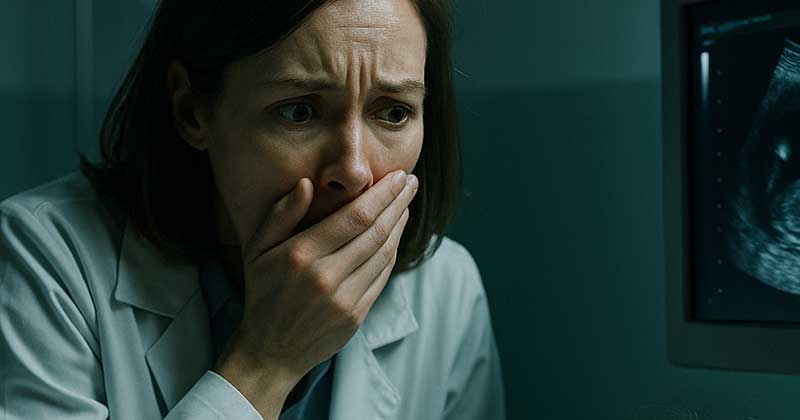
When the ambulance arrived, Clara climbed next to Ana with tears in her eyes. The siren shattered the morning silence, and her thoughts raced chaotically. She remembered how her mother always told her that a child’s health should come first, that a small sign could hide a serious illness.
At the hospital, the doctors immediately took Ana in. Tests, additional ultrasounds, doctors rushing in and out of the room. Clara sat on a chair, her hands clasped, murmuring a prayer she had known since childhood: “Lord, take care of my child.”
After a few hours of anxiety, the pediatrician came to her. He had a serious face, but also a gentleness in his eyes.
“Ma’am, your daughter has complicated acute appendicitis. She was close to perforation. If you had delayed, it would have been very serious.”
Clara felt her knees tremble. An avalanche of relief and horror at the same time. She hugged Ana, who smiled weakly, tired but safe.
However, the question that haunted her did not disappear: why did Luca not take the girl’s complaints seriously?
In the following days, while Ana was hospitalized, Clara began to notice more things. The little girl avoided talking about the weekend, and when asked directly, she would only say, “I don’t want to remember.” That fear in her eyes spoke louder than any words.
Clara remembered the stories from her grandparents’ village, where people always said that “the truth comes to light, no matter how much you hide it.” It was the same now: something unspoken was at play.
One evening, Ana, holding her mother’s hand, whispered, “Mom, I don’t want to be alone with Luca anymore.”
Then Clara understood that the problem was not just medical. It was something deeper, darker. Instead of closing her eyes, as she might have done before, she felt the strength of a Romanian mother in her soul, one who does not let her child fall prey to suffering.
Luca was confronted. He tried to downplay everything, but Ana’s eyes told a different story. In Romania, there is an old proverb: “A lie has short legs.” And indeed, the truth began to come to light, step by step.
With the support of doctors, a social worker, and her own family, Clara decided to end the marriage. It was painful but life-saving. For Ana, for the peace of their home.
A few months later, Ana was running again in her grandparents’ yard, with rosy cheeks and a crystal-clear laugh. Clara watched her and felt her heart healing along with her.
From that experience, Clara learned a truth that many Romanian parents instinctively know: no job, no relationship, and no excuse is worth more than the health and soul of your child.
And Ana, with her innocence, said one day, stroking her mother’s hand: “Mom, now I know you will always protect me.”
And those words were the greatest reward for Clara, stronger than anything else.
Because, in the end, a mother’s love is what heals the deepest wounds and brings light back into a child’s life.
This work is inspired by real events and people, but has been fictionalized for creative purposes. Names, characters, and details have been changed to protect privacy and enhance the narrative. Any resemblance to real persons, living or dead, or actual events is purely coincidental and not intended by the author.
The author and publisher do not assume responsibility for the accuracy of events or for how characters are portrayed and are not liable for any misinterpretations. This story is provided “as is,” and any opinions expressed belong to the characters and do not reflect the views of the author or publisher.


